Key Takeaways
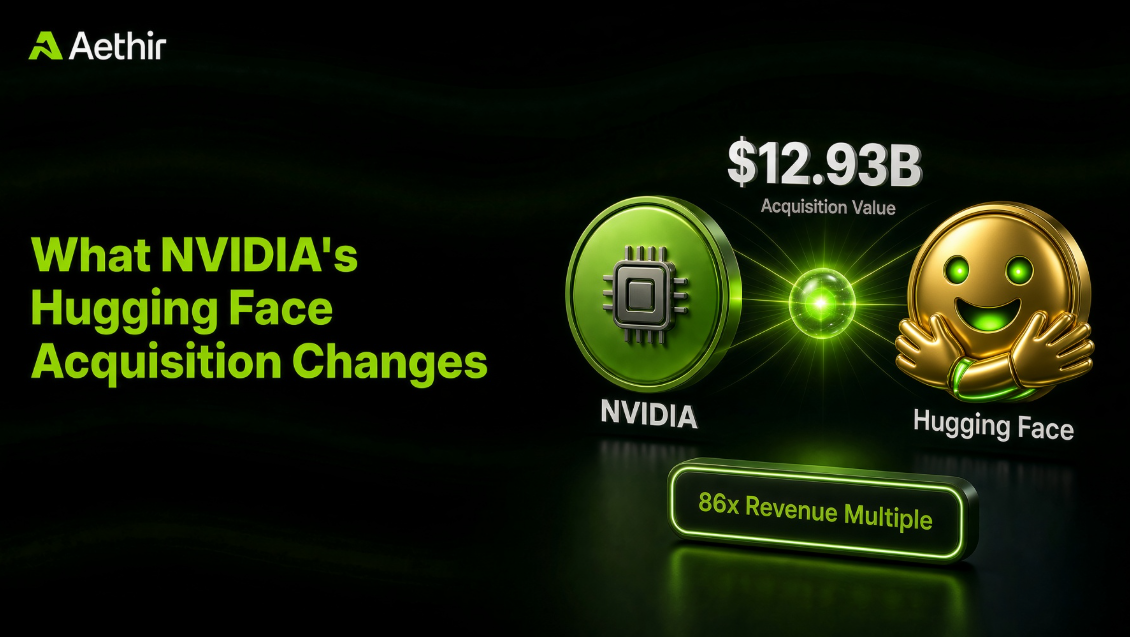
A $12.93 Billion Deal for Distribution: NVIDIA agreed on September 3, 2026, to buy Hugging Face for $12.93 billion, with closing expected in the first half of 2027, subject to regulatory approval. Against roughly $150 million in annualized revenue, that is about 86 times revenue, so the NVIDIA Hugging Face acquisition isn’t a revenue purchase.
AI Model Distribution Is the Asset: The platform carries 18 million developers, more than 3 million models and over 200,000 companies. AI model distribution sets defaults, and defaults quietly decide which hardware a workload lands on.
The Open Model Ecosystem Keeps Growing: Public models on Hugging Face went from 2.43 million to 2.96 million between January and August 2026. Models under 1 billion parameters account for 83% of all-time downloads.
Neutrality Is the Antitrust Question: NVIDIA says the platform stays open to every framework, cloud, and accelerator, and describes it as a deconcentration platform.
The GPU Compute Sector Doesn’t Reprice Overnight: A GPU hour costs the same the day after the deal. What changes is that AI infrastructure vertical integration now reaches where models are found, making where you run open weights a live decision rather than an afterthought.
Inside the $12.93 Billion NVIDIA Hugging Face Acquisition
NVIDIA said on September 3, 2026, that it had agreed to acquire Hugging Face for $12.93 billion, framing the deal in its own announcement as a commitment to open-weight models rather than a hardware play. Coverage of the announcement says co-founder Clement Delangue approached Jensen Huang weeks before the terms were agreed, and closing is expected in the first half of 2027, subject to regulatory approval.
The NVIDIA Hugging Face acquisition follows a pattern set earlier this year, when Stripe, a payments company, paid more than $7 billion for OpenRouter.
How the Open Model Ecosystem Got Here
Hugging Face started in 2016 as a chatbot company and became something else once its Transformers library turned publishing model weights into a two-line operation. That library is embedded in production pipelines everywhere, which is why the open model ecosystem grew around the platform.
What NVIDIA Is Buying: Hugging Face brings 18 million developers, more than 3 million models, 500,000 datasets, and over 200,000 companies. NVIDIA says the platform keeps its brand and stays open to models, frameworks, clouds, and inference providers.
What It Costs Relative to Revenue: Hugging Face was running at roughly $150 million in annualized revenue, up from about $100 million two months earlier. At $12.93 billion, that is around 86 times revenue, reflecting price positioning rather than earnings.
The Offer That Came First: Hugging Face turned down a $500 million investment from NVIDIA in late 2025 that would have valued it near $7 billion. Nine months later, it agreed to sell outright at nearly double that valuation, showing how fast this layer repriced.
AI Model Distribution Is the Layer Being Bought
NVIDIA reported $96.2 billion in revenue for its most recent quarter, with $89 billion of it from data centers, so $12.93 billion is roughly six weeks of sales. The purchase makes sense only as a position in AI model distribution, the layer where developer mindshare forms and where the first working example a team copies gets written. Demand keeps terminating on hardware, and compute demand is growing faster than supply, which makes the front door worth owning.
Where Developer Mindshare Actually Forms
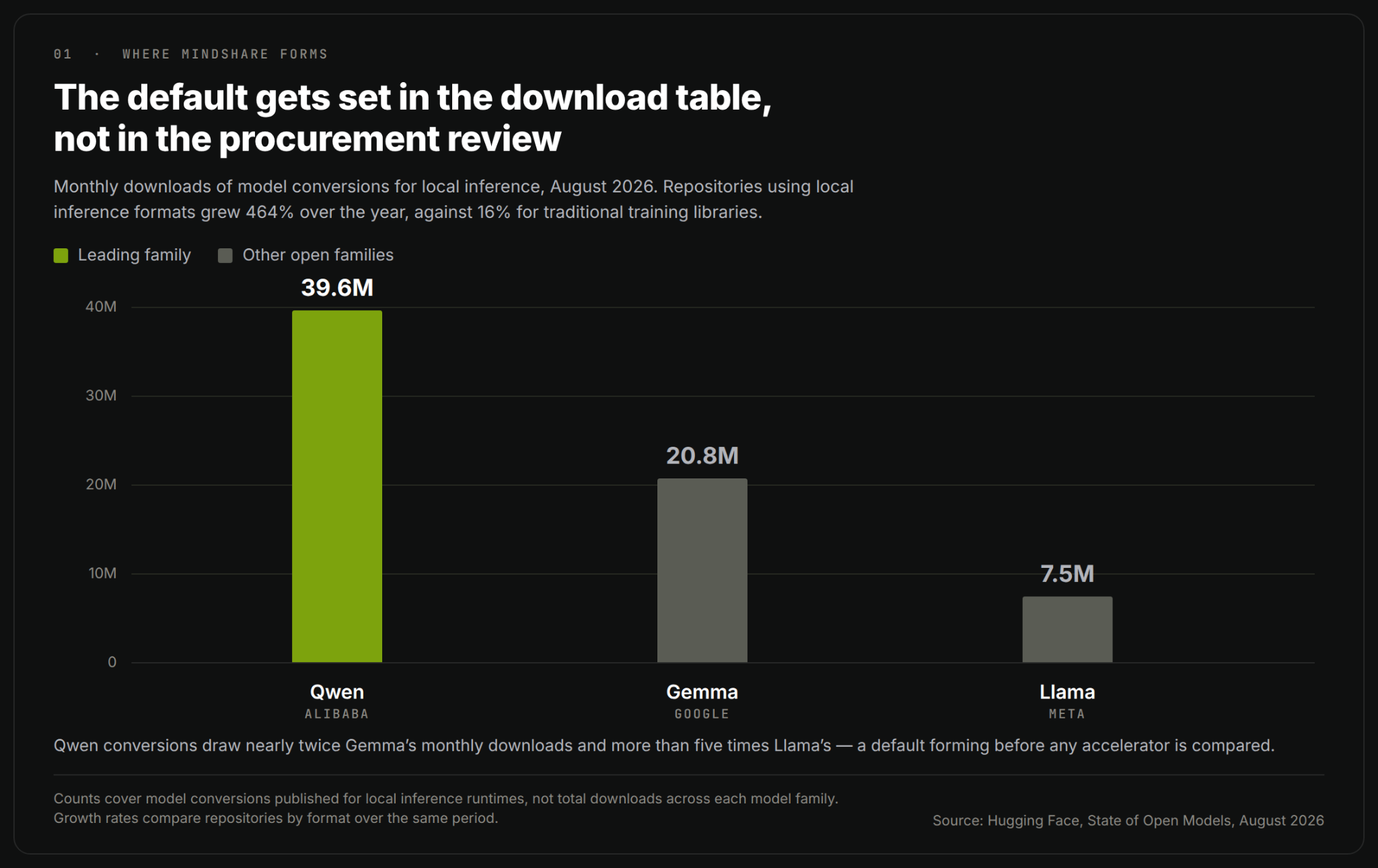
Developer mindshare shows up in download tables long before it shows up in procurement. Qwen conversions for local inference reached 39.6 million monthly downloads, up from 20.8 million for Gemma and 7.5 million for Llama, according to platform data published in August, while repositories using local inference formats grew 464% versus 16% for traditional training libraries. People run models on their own terms, and Hugging Face is where they choose which one.
Most teams never benchmark accelerators before shipping. They copy the snippet that works, and that snippet is the one the model card publishes, which makes AI model distribution a quieter form of hardware selection than any procurement review.
Only 3% of 2026 download volume went to models above 70 billion parameters. The models people deploy are small enough to run almost anywhere, and that portability is what makes the distribution layer strategically interesting.
Furthermore, Hugging Face’s growth is based on breadth, not on concrete and grid connections. That is the opposite of the business NVIDIA finances everywhere else, and it buys more reach here than the same money buys in a data center.
AI Infrastructure Vertical Integration
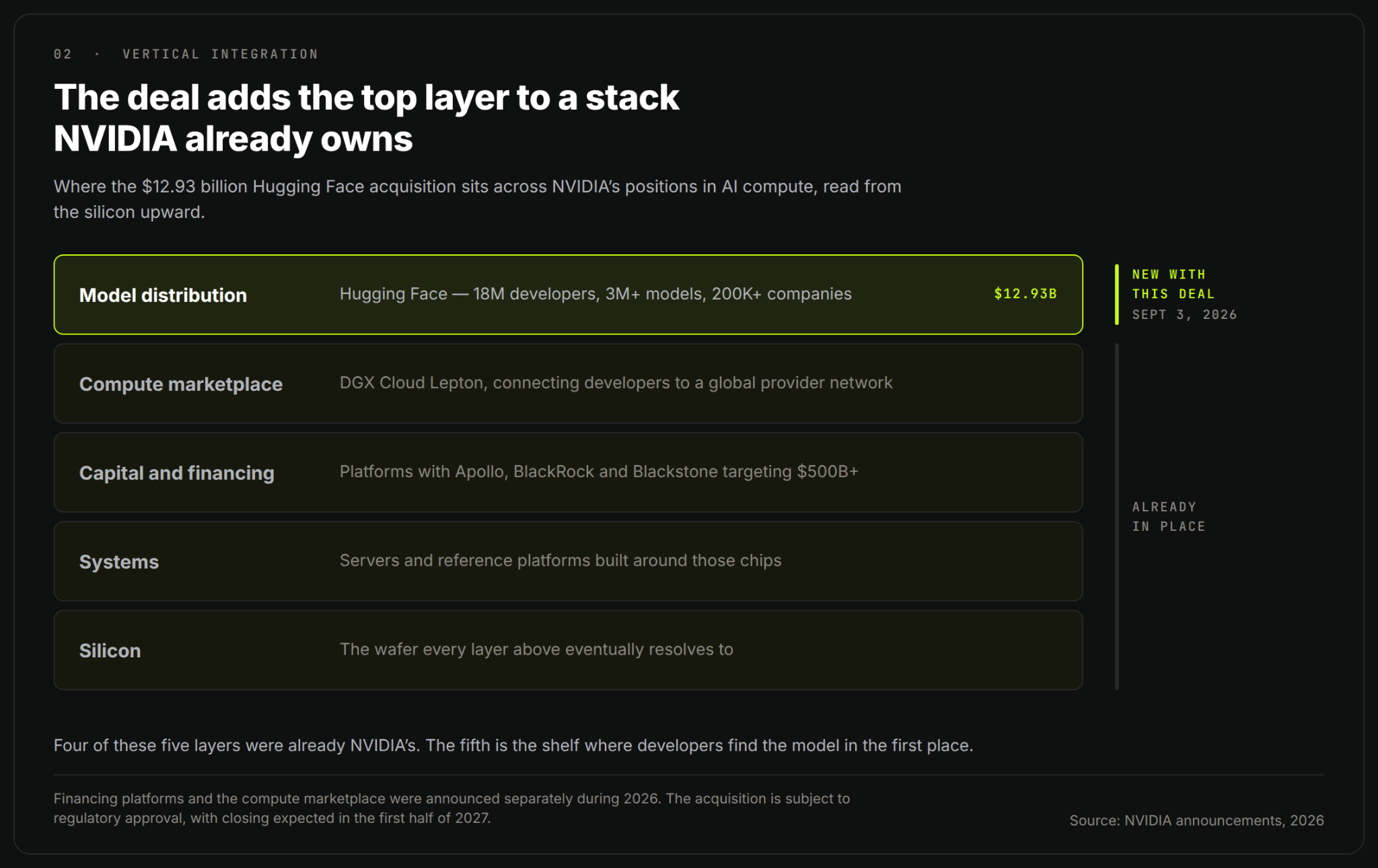
The deal reads differently against everything else NVIDIA did this year. In August, the company helped assemble financing platforms with Apollo, BlackRock and Blackstone to mobilize more than $500 billion of third-party capital for AI compute infrastructure. It already operates a marketplace connecting developers to compute across a global network of providers. AI infrastructure vertical integration now spans the wafer, the system, the financing, the marketplace, and the shelf the models sit on.
What Model Hub Neutrality Would Have to Mean
Model hub neutrality is a set of testable commitments rather than a sentiment: published ranking and search rules, continued funding for the optimization libraries that serve competing accelerators, identical API terms for every inference provider, and no privileged view of usage telemetry. Each of those can be checked from outside, which matters more than any promise. The same discipline governs how prepaid capacity funds an AI build, where structure earns trust rather than intent.
NVIDIA spent 2026 taking positions above the silicon through licenses, investments, and financing vehicles instead of acquisitions. AI infrastructure vertical integration reaching model distribution continues that pattern.
A distribution layer with NVIDIA engineering behind it can move faster, be safer, and be better instrumented than one funded by $150 million in revenue. Developers who use Hugging Face daily may well see it improve.
The Antitrust Review: NVIDIA Says It Will Pass
A $12.93 billion transaction clears the US premerger notification threshold many times over, so it goes to the FTC and the Department of Justice, with a parallel filing in Europe. NVIDIA argues that an open platform is structurally a deconcentration platform, spreading capability outward, while proprietary interfaces concentrate it.
Regulators have heard a neutrality case from this company before: the FTC sued to block the Arm acquisition, describing Arm as the Switzerland of the semiconductor industry and arguing that rivals shared sensitive information with it precisely because it wasn’t a chipmaker.
Testing the Hardware Agnostic AI Promise
NVIDIA states that its hardware isn’t required to build or deploy on the Hugging Face platform, and that multi-accelerator support continues. The hardware-agnostic AI promise is checkable over time: watch whether optimization libraries for competing accelerators keep shipping releases at the same cadence. One analysis of the deal argues that trust erodes long before any technical change lands. Migrations run slowly either way, which matches how hard infrastructure changes are in practice.
What the Antitrust Review Will Test: Authorities will look at whether search and ranking can favor first-party models, whether maintenance of non-NVIDIA backends keeps getting resourced, and whether ownership yields early sight of what rivals are adopting. Those mechanics sit underneath any neutrality promise, and each is measurable.
The Arm Case Is the Precedent Everyone Cites: The FTC argued that ownership by a chipmaker would erode trust in a neutral platform and dull the incentive to build features that help competitors. The parallel isn’t exact, since a model hub isn’t a licensing business, but the trust argument transfers cleanly.
The Counterargument: Open weights spread capability to teams that can’t train a frontier model, and a better-funded hub spreads it further. Whether that outweighs the vertical concern is the question the antitrust review exists to answer, and it isn’t obvious in either direction.
What the Deal Changes for the GPU Compute Sector
Nothing about the price of a GPU hour moves on announcement day. What moves is the shape of the question buyers ask, because inference is now roughly two-thirds of all compute ,and inference is exactly the workload Hugging Face distributes. With AI spending forecast to grow 47% this year, the GPU compute sector is adding capacity faster than it adds independent places to run it.
A $12.93 billion price on the place where models get published says where leverage sits in the stack. It doesn’t settle whether the open model ecosystem ends up better or worse off since both outcomes are still available. What it does settle is that model distribution is infrastructure now, priced and owned accordingly. For anyone planning compute across the next four quarters, that makes portability worth writing into the plan rather than assuming it.
Frequently Asked Questions
What is the NVIDIA Hugging Face acquisition?
NVIDIA agreed on September 3, 2026 to buy Hugging Face for $12.93 billion, with closing expected in the first half of 2027, subject to regulatory approval. Hugging Face keeps its brand and, according to NVIDIA, stays open to every model, framework, cloud, and inference provider.
Why does AI model distribution matter to compute buyers?
AI model distribution sets defaults: the example code, the quickstart, and the recommended runtime a team copies on day one. Those defaults shape which accelerator a workload ends up on far more reliably than a procurement review does. Owning distribution is therefore a position in the compute market, not only in software.
What does the deal mean for the open model ecosystem?
In the short term, very little changes, since the platform keeps operating as it did and the open model ecosystem keeps growing. Over a longer horizon, the question is whether investment continues to flow to support competing accelerators, which is what kept the platform genuinely open.