Key Takeaways
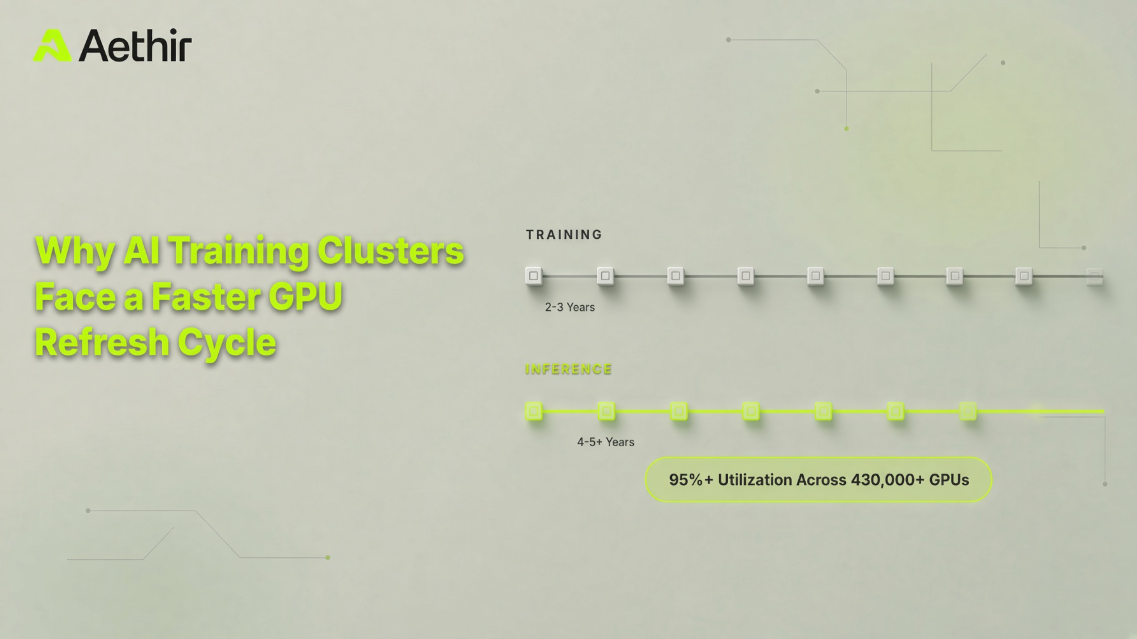
There is no single GPU refresh cycle: Frontier training fleets are commonly modeled on a two- to three-year replacement cadence, while production inference fleets are modeled at four to five years or longer. Averaging those two numbers into one useful life estimate hides the difference that actually matters.
An AI training cluster is a concentrated position: Purpose-built single-tenant clusters are designed around one workload profile and one customer. When the contract ends, the operator needs a replacement tenant of similar size.
The GPU value cascade needs internal demand: The cascade model moves hardware from frontier training in years one and two, to inference in years three and four, to batch work later. A fleet built for training alone has nowhere internal to cascade into.
Production inference workloads are the hedge: Inference tolerates previous-generation silicon far better than large synchronized training does, which is why older accelerators keep earning.
Aethir runs a diversified fleet by design: More than 430,000 GPU containers across 94 countries and 200+ locations serve training, inference, and burst workloads simultaneously. Network utilization above 95% is way beyond the 60% to 70% typical of centralized fleets, and that gap is the single largest input into GPU fleet economics.
The GPU Refresh Cycle Split in Two
Most arguments about GPU useful life treat the fleet as one asset class with one replacement cadence. Practitioner guidance on optimizing GPU asset lifecycles describes something more specific: training clusters refreshed on a two to three-year cycle to stay competitive, and production inference refreshed at four to five years, or whenever efficiency gains exceed the cost of replacement.
A detailed review of useful lives for AI hardware shows how far apart reasonable estimates can sit, and Aethir has written about how each new NVIDIA platform re-prices the fleet behind it.
A GPU becomes obsolete when the work it is asked to do can be done materially cheaper on something newer. That threshold arrives at very different times for a frontier pretraining run and for a production endpoint serving a fixed latency target.
Training performance is judged against whatever the leading AI lab is running this quarter, while interconnect bandwidth and memory capacity gate the largest runs. GPU hardware obsolescence therefore arrives quickly for training-first fleets, with server refresh horizons in some estimates compressing from five to seven years down to eighteen to thirty-six months.
Additionally, an inference deployment either meets its latency and throughput target at an acceptable cost per token or it doesn’t. Hardware that clears that bar keeps clearing it long after it stops being the fastest option available.
An AI Training Cluster Serves One Customer
The dedicated single-tenant model that dominates large AI infrastructure contracts is built for one workload, at one site, for one buyer. Analysis of how AI factories handle useful-life assumptions treats redeployment as the safety valve, but that same company's demand curve constrains redeployment within a company. Legal work on contracting for AI compute capacity makes the same point from the financing side, noting that many projects depend on a very small number of counterparties.
Why the Single-Tenant GPU Cluster Concentrates the Bet
One tenant defines the whole workload profile: A single-tenant GPU cluster is provisioned, networked, and cooled around what that tenant intends to run. The fleet has no internal mix to fall back on because the mix was never the design goal.
Purpose-built topology resists repurposing: High-bandwidth interconnect fabrics and very high rack power densities are what make large synchronized training possible, and they are expensive overhead for steady inference. Hardware optimized for the hardest job isn’t automatically efficient at the easier one.
Replacement demand has to arrive in one piece: When a multi-year contract ends, the operator needs another buyer willing to take the cluster at close to its original scale. That is a much narrower search than filling the same capacity with many smaller consumers.
Where the GPU Value Cascade Stalls on a Narrow Fleet
The GPU value cascade is the argument that justifies longer useful lives: frontier training in years one and two, production inference in years three and four, batch and analytics work later. The cascade is a sound description of how hardware ages, and the economics of AI inference explain why the middle tier holds up so well.
The cascade requires a diverse workload portfolio to cascade into, which is why guidance on whether to rent or own AI compute keeps returning to workload mix, and why Aethir framed the shift toward inference-heavy demand as an infrastructure question rather than a model question.
Production inference workloads don’t synchronize thousands of accelerators through a single collective operation, so they degrade gracefully on previous-generation hardware. This is the entire mechanism behind the claim that a four-year-old GPU still earns.
A100-class capacity has continued to rent in the range of roughly $0.87 to $1.39 per hour for single-GPU inference, against considerably higher rates for H100-class capacity. Older hardware doesn’t stop working, but it stops being the cheapest way to do the newest thing.
Furthermore, if the fleet was built and sold entirely for training, the year-three inference demand the cascade assumes has to be found externally, at whatever price an external market will pay. GPU fleet economics then depend on a venue that a purpose-built cluster was never designed to reach.
Workload Diversification Inside Aethir’s Decentralized GPU Cloud
Aethir aggregates enterprise GPU capacity from independent operators into one orchestrated pool of more than 430,000 GPU containers across 94 countries and 200+ locations, running training, inference, and burst workloads at the same time. Supply in Aethir’s network comes from many Cloud Hosts monetizing their GPUs instead of one owner.
Aethir’s decentralized GPU network runs above 95% GPU utilization compared with the 60% to 70% typical of centralized fleets. Depreciation per productive hour falls as utilization rises, which does more for GPU fleet economics than any schedule change.
Furthermore, Aethir’s GPU fleet spans H100, H200, B200, and B300 class capacity, as well as other models, so a new generation arriving doesn’t strand the one before it. Workload diversification means demand exists at several performance tiers simultaneously rather than migrating wholesale to the newest one.
Independent operators can keep earning on accelerators that a single-tenant cluster would have to retire or resell. That gives the value cascade an actual counterparty instead of an internal transfer price set by the same balance sheet that owns the asset.
What Fleet Composition Means for AI Compute Costs
Fleet composition isn’t an operator-only concern, because the depreciation profile of the hardware behind a contract eventually shows up in the price of that contract.
Frontier pretraining benefits genuinely from a dedicated, purpose-built site with the fastest available interconnect. Accepting a shorter GPU refresh cycle is a reasonable trade for that workload, and it should be chosen deliberately rather than applied to everything.
These workloads tolerate mixed hardware generations and benefit from being close to users, which is exactly where Aethir’s decentralized GPU cloud is strongest. Consumption pricing also means AI compute costs track usage.
Before signing a multi-year term, it is worth asking what proportion of the provider fleet serves inference, what generations are in production, and what happens to your rate when the next platform ships. Those answers explain more about future pricing than the headline number does, as we argued in our work on hidden AI infrastructure costs.
A shorter refresh cycle is the correct answer for the hardest class of workload. The mistake is applying one cadence to a fleet that serves several. Aethir delivers enterprise GPU compute on demand across 94 countries with no long-term commitments and no egress fees, spanning several hardware generations at once so workloads land on the tier that fits them.
Explore the Aethir enterprise GPU offering to see how a diversified fleet compares with a dedicated cluster for your workload mix.
Frequently Asked Questions
What is a GPU refresh cycle?
A GPU refresh cycle is the interval at which an operator replaces accelerators with newer hardware. It is driven by the point at which a workload becomes materially cheaper to run on a new generation, so the cycle length depends on what the fleet is actually running.
Why do AI training clusters refresh hardware faster?
Training performance is judged relative to whatever the leading labs are running, and the largest runs are gated by interconnect bandwidth and memory capacity that improve sharply between generations. AI training clusters are commonly modeled on a two- to three-year replacement cadence for that reason, against four to five years or longer for production inference fleets.
How does the GPU value cascade work?
The GPU value cascade describes hardware moving down workload tiers as it ages, typically from frontier training in the first two years, to production inference, to batch and analytics work later. The model holds only if a buyer exists at each tier, which is why it depends on a diverse workload portfolio rather than the passage of time.
Do production inference workloads need the newest GPUs?
Usually not. Production inference workloads run against a latency and throughput target, and hardware that meets that target at an acceptable cost per token keeps meeting it for years after newer accelerators arrive. This tolerance is the main reason previous-generation GPUs retain meaningful earning capacity.
How does Aethir’s decentralized GPU cloud affect AI compute costs?
Aethir’s decentralized GPU cloud aggregates supply from many independent operators and serves several workload types at once, keeping utilization high and spreading demand across hardware generations. Aethir runs above 95% utilization across more than 430,000 GPU containers in 94 countries, and consumption pricing means AI compute costs follow actual usage rather than a fixed commitment.