Key Takeaways
NVIDIA Vera Rubin Resets the Inference Cost Curve: NVIDIA Vera Rubin reports up to 10x lower cost per generated token versus Blackwell, driven mainly by a near-tripling of per-GPU memory bandwidth.
A Familiar Capacity Crunch: Every major NVIDIA generation launches into a supply squeeze where the largest cloud platforms claim the earliest allocations. Builders who can’t wait in that queue are increasingly routing workloads through decentralized GPU infrastructure.
Aethir Has Already Run This Playbook At Scale: Aethir is one of the main infrastructure partners behind a 2,304-GPU NVIDIA B300 cluster deployed for Axe Compute under a $260 million enterprise contract. That deployment shows the Aethir network can stand up frontier-generation GPU compute cloud capacity at production scale.
Hands-On Use Cases: The builders who benefit most from new AI GPU infrastructure are not chasing benchmark numbers. They are running long-context agent pipelines, multi-agent orchestration, and regulated data workloads that need memory headroom and confidential computing right now, not next year.
The Decentralized Path Is Already Live Through Aethir Claw: Aethir Claw runs AI agents on Aethir’s GPU infrastructure today, through isolated VPS instances and a bundled Model-as-a-Service layer. It gives builders a working preview of how Vera Rubin-class hardware could reach agentic workloads without a hyperscaler waitlist.
The Inference Bill Problem NVIDIA Vera Rubin Was Built to Solve
Most AI teams running production agents hit the same wall by 2026: Usage is climbing, context windows keep growing, and the inference bill is rising faster than the roadmap can keep up with. NVIDIA Vera Rubin exists to change that math. The platform launched at CES on January 5, 2026, and reached full production across more than 350 factories by late May, with shipments beginning this fall.
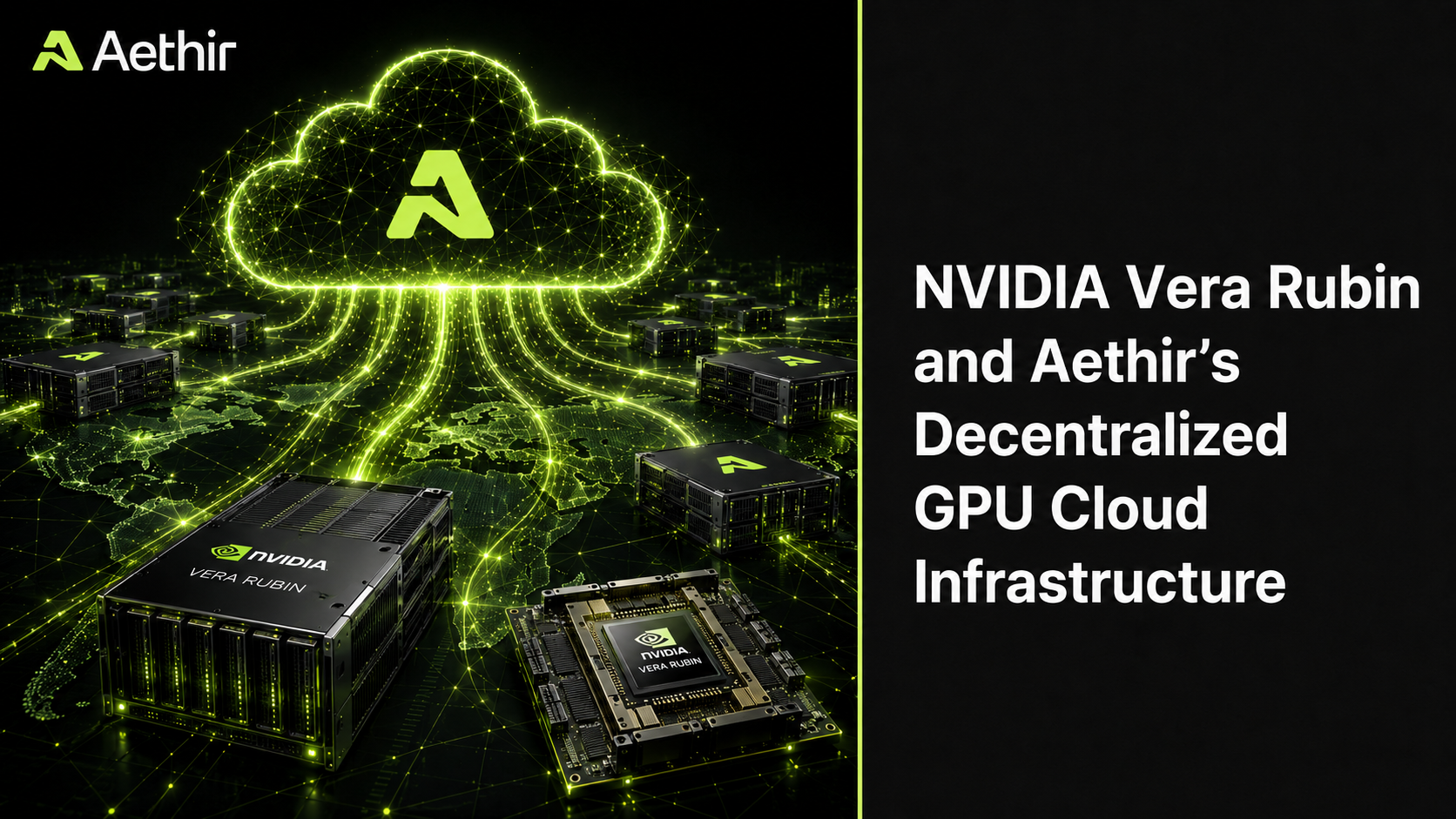
A single Vera Rubin NVL72 rack pairs 72 Rubin GPUs with 36 Vera CPUs in one NVLink 6 domain, delivering 3.6 exaFLOPS of NVFP4 inference and 20.7 TB of HBM4 memory. Each GPU delivers up to 22 TB/s of memory bandwidth, nearly three times that of Blackwell GPUs, which matters most for agentic AI inference workloads that maintain context across many reasoning steps.
NVIDIA reports up to 10x lower cost per generated token by Vera Ruben chips, compared with Blackwell, along with mixture-of-experts training that requires roughly 4x fewer GPUs. For any team tracking AI inference cost as a line item, that is the difference between an agent product that scales profitably and one that doesn’t.
Additionally, Vera Rubin NVL72 is the first rack-scale platform with full NVIDIA Confidential Computing, enabling bare-metal deployment for regulated or proprietary data workloads that previously had to remain on locked-down, single-tenant infrastructure.
Why Every Hardware Generation Creates the Same Capacity Crunch
NVIDIA allocates a new architecture to its largest cloud partners well before general availability, and Vera Rubin is no exception. CoreWeave has confirmed it will integrate Rubin-based systems into its cloud platform in the second half of 2026, and NVIDIA has already expanded the lineup with Rubin CPX, a GPU class built specifically for massive-context inference, with the NVL144 CPX configuration alone packing 8 exaFLOPS and 100 TB of fast memory in a single rack. That scale of supply gets committed to a handful of platforms first.
Enterprise Buyers Wait in Line: Outside the hyperscaler tier, enterprise customers typically face allocation reviews every quarter and delivery dates that shift without warning, a pattern that repeats with every new GPU generation regardless of how much total supply NVIDIA ships.
Hybrid Architectures Are Becoming Standard: Enterprises are increasingly routing flexible, burst-capacity inference to decentralized GPU cloud networks for cost arbitrage and availability, while keeping steady-state training on centralized infrastructure. This pattern shows up across the AI compute market as the supply crunch persists generation after generation.
Aethir’s DePIN GPU Network Can Absorb the Overflow: Aethir’s DePIN GPU network distributes hardware across many independent sites rather than a handful of mega-campuses, so new capacity can come online in days or weeks, rather than the months typical of a single centralized build.
Hands-On Use Case: Agentic Pipelines That Need Rubin-Class Memory
The workloads that gain the most from Vera Rubin are not one-shot prompts. They are long-running, context-heavy, agentic pipelines where models plan across steps, hold memory, and reason over long horizons, which is exactly the kind of workload Aethir Claw already runs in production today on Aethir’s GPU infrastructure through our proprietary Aethir Mesh open-source LLM API platform.
Multi-Agent Pipelines Are Already the Default: ClawHub has grown to more than 44,000 community-built skills and 1.5 million active agents by mid-2026, many of them running research-to-analysis-to-reporting pipelines where each stage is a separate agent with its own memory and context window.
Memory Bandwidth: Research on agentic inference systems shows that closed-loop, iterative reasoning shifts the primary bottleneck from computation to memory bandwidth and input-output throughput, the same property that defines the jump from Blackwell to Rubin-class hardware.
Isolation Keeps Multi-Agent Systems Clean: Aethir Claw assigns each agent instance a fully isolated VPS with its own memory, API keys, and session state, so coordination overhead in a multi-agent pipeline doesn’t turn into cross-contamination between agents handling different parts of a workflow.
Hands-On Use Case: Confidential Computing for Regulated Data
Full NVIDIA Confidential Computing support on Vera Rubin NVL72 is not an abstract feature. It directly serves the same regulated-data use cases that Aethir Claw already targets via isolated VPS instances and optional provider lockout, in which Aethir, as the infrastructure provider, can’t access what runs inside an agent.
Legal Document Review: Law firms and compliance teams processing confidential contracts need inference that stays inside a controlled environment, with client data kept out of third-party logging infrastructure and outside external retention policies.
Healthcare and Clinical Workflows: Clinical note-taking and patient data synthesis face strict data handling requirements, which is why isolating each agent instance on dedicated hardware, with an optional full provider lockout, matters more than raw model quality for adoption.
Financial Analysis at Scale: Asset managers running portfolio monitoring or risk modeling agents need both data privacy and predictable AI inference cost, since fixed-cost inference on dedicated capacity makes it far easier to forecast the cost of running these agents continuously.
The Proof Point: Aethir and Axe Compute Are Already Building the Next Wave
Axe Compute, the enterprise GPU provider now taking early-access reservations for Vera Rubin NVL72 capacity, runs part of its infrastructure through collaboration with Aethir’s distributed GPU cloud network. In 2026, Aethir began provisioning a portion of a 2,304-GPU NVIDIA B300 cluster for Axe Compute under a 36-month, $260 million take-or-pay enterprise contract, the largest single engagement in Axe Compute’s history, with full deployment targeted for Q3 2026.
The B300 deployment proves Aethir’s decentralized infrastructure network can support a NASDAQ-listed enterprise customer from signing through active provisioning, not just short-term spot rentals, which is the same bar next-generation Rubin capacity needs to clear.
Aethir spans more than 430,000 GPU containers across 94 countries, giving it the geographic redundancy to onboard new hardware generations without concentrating capacity in a handful of data centers competing with hyperscalers for the same regional power grid.
Finally, Aethir charges no data egress fees and imposes no proprietary lock-in, so as GPU compute cloud capacity shifts from Blackwell to Rubin-class hardware, workloads move without renegotiating the deployment or re-architecting the serving stack.
NVIDIA Vera Rubin sets a new bar for agentic AI inference, but clearing that bar depends on where builders can actually get the hardware. Aethir's decentralized GPU cloud has already proven it can bring frontier-generation AI GPU infrastructure to enterprise scale through the Axe Compute deployment, and Aethir Claw already runs the hands-on agent workloads that stand to benefit most. As Vera Rubin capacity moves from reservation to production, the decentralized GPU cloud path looks less like an alternative and more like the fastest way in.
Explore Aethir’s enterprise GPU compute offering here and follow our official blog for more news about our decentralized GPU cloud ecosystem and innovative product launches.
Frequently Asked Questions
What is NVIDIA Vera Rubin?
NVIDIA Vera Rubin is the successor to the Blackwell platform, built around the Vera Rubin NVL72 rack that combines 72 Rubin GPUs and 36 Vera CPUs in a single NVLink 6 domain.
How does Vera Rubin change the economics of agentic AI inference?
NVIDIA reports up to 10x lower cost per generated token than Blackwell, driven largely by a near-tripling of per-GPU memory bandwidth to 22 TB per second. Because agentic AI inference workloads hold context across many reasoning steps, memory bandwidth improvements translate directly into lower AI inference cost at production volume.
Why does Aethir’s decentralized GPU cloud matter for a new NVIDIA generation like Vera Rubin?
Every new NVIDIA architecture gets allocated to the largest cloud platforms first, leaving enterprise buyers facing quarterly allocation reviews and shifting delivery dates. Aethir’s decentralized GPU cloud spreads capacity across many independent sites, which historically has meant faster access to comparable hardware without waiting in the same centralized queue.