Key Takeaways
From Single-Agent to Multi-Agent: The market has shifted decisively toward multi-agent frameworks.
Isolation Is a Structural Advantage: Aethir Claw assigns a fully isolated, dedicated VPS to every agent instance. When running a coordinated swarm, this means each agent operates in its own environment.
Pipeline Is the Default Topology: The most reliable starting point for multi-agent deployment is the pipeline topology: the research agent feeds the analysis agent, and the analysis agent feeds the reporting agent.
Skill Composition Happens Per Agent: Each Aethir Claw instance can be loaded with a different subset of skills, matching that agent's role in the pipeline.
Coordination Overhead Is Real - Plan for It: Multi-agent systems introduce latency at every handoff and require explicit contracts between agents about the format and content of the artifacts they exchange.
Why Multi-Agent Pipelines Are Now the Default
The move from single-agent to multi-agent architecture happened in a compressed window. What was a research paper concept in 2024 is now a production requirement in 2026. The numbers behind this shift are not speculative.
ClawHub has grown to 44,000+ community-built skills and 1.5 million active agents as of mid-2026. This volume reflects production deployments handling research, execution, and reporting tasks in parallel across financial services, enterprise automation, and content pipelines.
The pattern of a research agent feeding an execution agent, which feeds a reporting agent, is now the baseline expectation in enterprise AI deployments. Multi-agent frameworks have moved from specialist implementations to the default architecture for any workflow that exceeds a single agent context window or requires parallel task processing.
The global multi-agent systems market is projected to reach $184.8 billion by 2034. The growth driver is not model capability alone, but the structural advantage of parallelism, specialization, and compartmentalization that only multi-agent architectures deliver at production scale.
Start orchestrating multi-agent systems on Aethir Claw now: claw.aethir.com
Aethir Claw’s VPS Isolation: Built for Agent Swarms
Most platforms treat isolation as a security feature. On Aethir Claw, it is also an architectural feature that makes multi-agent coordination structurally cleaner. The one-VPS-per-agent model was not designed for swarms, but it is ideal for them.
One Agent, One VPS
Every Aethir Claw instance runs on a dedicated Ubuntu 24.04 LTS VPS with no shared tenancy. When deploying three agents in a pipeline, a researcher, an analyst, and a reporter each operate in a fully compartmentalized environment with their own memory, API keys, and session state. A failure in one instance does not propagate to the others.
No Cross-Contamination by Design
Agent isolation eliminates the risk of one agent's state leaking into another, which is especially important in pipelines where the research agent processes sensitive financial or proprietary data before passing a sanitized summary downstream. The data never traverses a shared environment, because no shared environment exists.
Provider Lockout for Sensitive Pipelines
The optional provider lockout feature on Aethir Claw gives users root-level control over each VPS instance. For multi-agent deployments handling regulated data or private datasets, this means infrastructure staff cannot access what is running inside any agent in the pipeline. Each instance is sovereign by default.
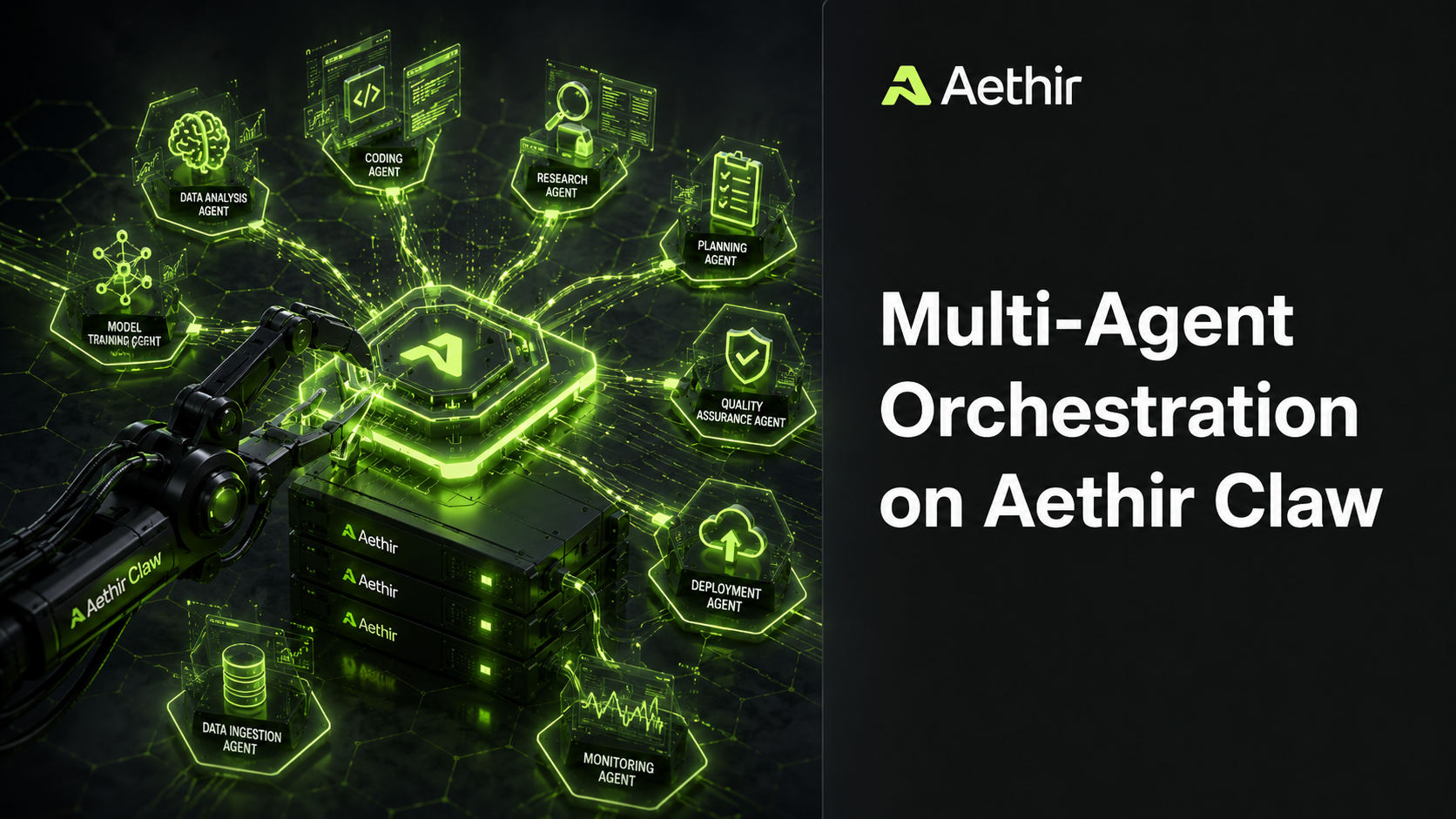
AI Agent Orchestration Topologies: Pipeline, Swarm, Hierarchical
Multi-agent systems run on distinct topologies. Choosing the right one for a given workload determines whether the system delivers consistent output or generates coordination overhead that exceeds the value of parallelism.
Pipeline
In a pipeline topology, the output of one agent becomes the input for the next. A research agent collects and processes data, then passes a structured brief to an analysis agent, which in turn passes recommendations to a reporting agent. Each stage is deterministic and straightforward to debug, making pipelines the most reliable topology for production workflows with defined handoff contracts between agents.
Hierarchical
A hierarchical topology places an orchestrator agent above a set of worker agents. The orchestrator breaks down a complex task, dispatches subtasks to specialized workers, and aggregates the results. This topology is the right choice when the parent task exceeds any single agent’s context window and requires modular decomposition with a coordination layer that tracks states across subtasks.
Swarm
In a swarm topology, agents operate without a centralized controller, communicating peer-to-peer and self-organizing around a shared goal. Swarms are suited for exploratory tasks such as parallel competitive research, distributed data collection, or open-ended analysis, where the structure of the problem is not known up front, and emergent coordination is an acceptable operational model.
Building a Research-to-Reporting Pipeline on Aethir Claw
The research-to-reporting pipeline is the canonical three-agent architecture in financial and enterprise AI deployments. Here is how each stage maps to an Aethir Claw instance in production.
Agent 1 - Research
The research agent runs continuously, monitoring defined data sources via AI agent skills. It collects structured outputs such as market data, on-chain signals, and news summaries. Then it writes them to a shared artifact or passes them via a delegation channel to the next agent in the pipeline. Each research agent instance runs on its own Aethir Claw VPS with its own API key configuration and independent memory context.
Agent 2 - Analysis
The analysis agent receives the research output as a structured handoff and applies a defined decision framework or model via the MaaS inference layer. In trading pipelines, signal generation occurs. In content pipelines, this is where the draft is produced. The analysis agent does not require visibility into the research agent’s environment because it operates only on the artifact it receives.
Agent 3 - Reporting
The reporting agent takes the analysis output and formats it for the end destination, such as a Telegram message, a dashboard update, an email, or an on-chain transaction. Keeping the reporting agent isolated from the upstream agents means that a failure in research or analysis does not corrupt the reporting layer, and the pipeline can resume from the last valid handoff without rerunning the full chain.
Multi-Agent Aethir Claw in Production
Deploying a multi-agent pipeline on Aethir Claw is no different in principle from deploying a single agent. Each agent is a separate Aethir Claw instance, with the same deployment process, same isolation guarantees, and same infrastructure.
Subscription Per Agent
Each agent in a multi-agent pipeline requires its own Aethir Claw subscription, because each runs on a dedicated VPS. The cost structure is predictable, LITE, STANDARD, or PRO per instance, and it scales linearly with the number of agents in the pipeline. A three-agent research-to-reporting pipeline requires three separate Aethir Claw plans.
Skill Composition Per Instance
Each Aethir Claw instance is loaded with a different subset of ClawHub skills matching the role of that agent in the pipeline. The research agent uses data connectors and web search skills. The analysis agent runs inference via the MaaS layer. The reporting agent uses messaging and on-chain payment skills. Per-instance skill loading prevents skill conflicts across agents operating in parallel.
Coordination via Delegation Channels
Aethir Claw agents can be set up to coordinate via delegation channels, structured handoff mechanisms in which one agent produces an artifact that triggers the next agent in the pipeline. This is event-driven orchestration rather than synchronous messaging, which means each agent can run on its own schedule and retry independently without blocking the rest of the pipeline. Defining the handoff schema before deployment is the step most production teams skip and later regret.
Deploy Your Multi-Agent Orchestration Project on Aethir Claw
Aethir Claw’s security-first, versatile AI agent deployment infrastructure is ideal for launching multi-agent systems across various industries and use cases.
By choosing Aethir Claw for multi-agent orchestration, you’re selecting the most trustworthy managed AI agent hosting platform on the market and the only crypto-native agentic solution for individual and business use cases.
Deploy your agentic team now at: claw.aethir.com
Frequently Asked Questions
What is multi-agent orchestration on Aethir Claw?
Multi-agent orchestration on Aethir Claw involves running multiple independent agent instances that exchange structured outputs to complete a coordinated task. Each agent operates in a fully isolated environment with no shared state or cross-tenant exposure. The typical starting topology is a sequential pipeline: one agent researches, another analyzes, and a third reports.
Why does the Aethir Claw’s isolated VPS architecture matter for multi-agent systems?
Isolation ensures that a failure or compromise in one agent does not propagate to others in the pipeline. When agents share a container or runtime environment, a malicious skill or runaway process can affect neighboring agents. Aethir Claw assigns a dedicated Ubuntu 24.04 LTS VPS to each instance, so each agent is structurally contained regardless of what it executes.
How do multiple Aethir Claw agents communicate with each other?
Agents communicate via delegation channels, structured handoff mechanisms in which one agent produces an artifact that triggers the next agent in the pipeline. This is event-driven coordination rather than real-time synchronous messaging, which means each agent operates on its own schedule and can retry independently. AI agent skills provide the connectors that enable agents to read from and write to shared data targets.