Key Takeaways
The frontier gap is narrowing: The 2026 Stanford AI Index puts 3.3% between the leading closed model and the leading open model, and the release lag behind the frontier has fallen from roughly 24 months in 2023 to six to twelve months.
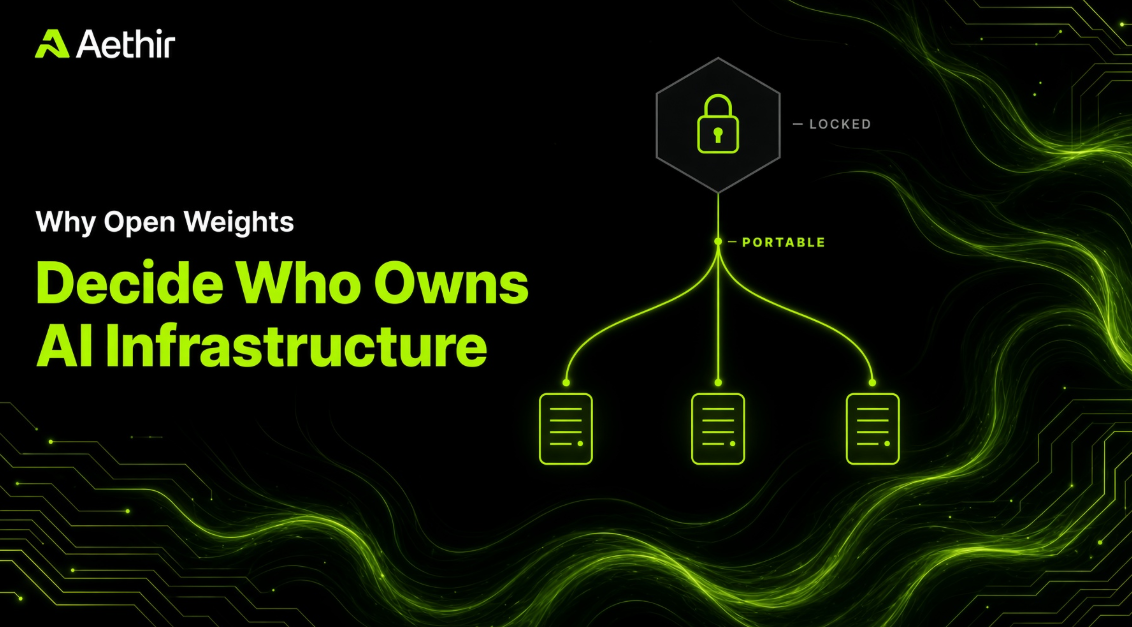
A closed model and its data center are one purchase: When weights never leave the provider, the model and the infrastructure it runs on are bought together. There is no second venue to price against, which is why the compute underneath a closed model is never really competitive.
AI model portability: Portable weights separate the model decision from the infrastructure decision. That separation is the precondition for a real market in inference capacity, and it is the reason open-weight models matter to infrastructure, not only to model quality.
Regulation is pulling regulated buyers toward open weights: Full obligations for general-purpose AI providers under the EU AI Act became enforceable on 2 August 2026, including fines.
What Actually Changed in Open Weight Models
The open-weight conversation stopped being about ideology sometime in 2026 and became a procurement conversation. The 2026 Stanford AI Index reports a 3.3% gap between the leading closed model and the leading open model, with the gap varying sharply by task: near parity in competition mathematics, wider in science and coding.
Open weight models trailed the closed frontier by roughly 24 months in 2023, about 12 months in 2025, and six to twelve months by 2026. A team planning a two-year product roadmap no longer has to treat open weights as a generation behind.
The remaining gap concentrates in frontier reasoning and hard-coding benchmarks. Document summarisation, structured extraction, support agents, and routine code assistance are where most production tokens are spent, and open-weight models clear that bar comfortably.
DeepSeek V4 ships under MIT with a mixture-of-experts architecture at 1.6 trillion parameters, and Kimi K2.6 is a 1 trillion parameter MoE with 32 billion active. Permissive licenses are what turn a downloadable model into an asset a company can actually build on.
A Closed Model and Its Data Center Are One Purchase
Here is the part the benchmark charts don’t show. When a model is closed, the weights never leave the provider, so buying the model means buying the infrastructure it runs on. The two are a single line item. Work on the economics of AI inference treats serving cost as an engineering variable.
Still, a buyer of a closed API cannot access that variable at all, because the shift toward inference-heavy demand is happening within an operating environment that somebody else controls.
No second venue to price against: With a closed model, there is exactly one supplier for the underlying compute. Whatever that supplier charges is the market, so AI compute costs for that workload can’t be competed down by moving the model somewhere cheaper.
Location is decided for you: Data residency, latency, and jurisdiction all follow the provider footprint rather than the requirement. Analysis of why enterprises adopt open-weight AI on-premises points to exactly this loss of control as the trigger for migration.
Migration risk compounds quietly: Every integration built against a closed endpoint deepens the dependency, and switching costs grow with usage rather than shrink. That is the opposite of how a healthy supplier relationship should age.
Portability Is What Makes Compute Contestable
Open weights break the bundle, and that is the whole infrastructure argument in one sentence.
Once the weights are portable, the model decision and the infrastructure decision come apart, and compute has to compete on price, location, and terms. The H1 2026 record across DeepSeek, Qwen, and Llama describes open weight models moving from early-mover engineering teams into procurement-bound enterprises, and the mechanism behind that shift is AI model portability rather than any single benchmark result. It also changes how a compute buyer guide should be read, because the model is no longer part of the vendor lock-in.
A portable model can be served on a hyperscaler, a neocloud, a decentralized GPU cloud, or on premises, and the workload can move between them. AI model portability turns inference from a subscription into a procurement category with real alternatives.
Coverage of open weight models in enterprise automation shows teams matching individual models to individual jobs rather than routing everything through one frontier endpoint. Open-weight model deployment lets the serving choice follow the workload rather than the contract.
When several suppliers can quote the same open-weight inference job, the buyer sets the terms of the comparison. That is the structural difference between a market and a subscription, and it only exists because the weights can move.
Regulated Buyers Reach for Open Weights First
Compliance is accelerating the same shift from a different direction. Under the Commission guidance on general-purpose AI obligations, full compliance for providers of general-purpose AI models became enforceable on 2 August 2026 in Europe, including through fines. An explainer on what the AI Act means for open source developers sets out the nuance carefully: models released under free and open source licenses are exempt from parts of Article 53, but every provider still needs a copyright policy and a sufficiently detailed training data summary, and the exemption does not reach models classified as carrying systemic risk.
EU AI Act obligations require evidence about how a system behaves and what it was built on. Teams that can inspect and host their own weights are in a materially better position to answer those questions than teams querying an endpoint they can’t see inside.
Sovereign AI inference means running the model inside a chosen jurisdiction on infrastructure the buyer selected, which is why sovereign cloud spending and national AI programs have grown so quickly. Open-weight models are the only category in which that choice is fully available.
Contractual promises about data handling are weaker than infrastructure that can’t see the workload, a principle already built into the isolated VPS security model. Combining open weights with isolated infrastructure removes the trust assumption rather than documenting it.
Where Open Weight Inference Runs Best
Portable weights need somewhere to land, and the economics favor distributed capacity. Open weight inference is steady, horizontally scalable, and latency-sensitive by region, which is a very different profile from large synchronized training. Specifications behind the DeepSeek V4 release underline how capable that class of model has become, while coverage of European sovereign compute strategy shows where regulated demand is heading.
Aethir Mesh serves open-source models, mostly on Aethir GPU infrastructure via a single API key, and is the most direct route for deploying open-weight models within the Aethir ecosystem.
An open-source model catalog on Aethir GPUs: Aethir Mesh serves models including DeepSeek V4, Kimi K2.6, GLM, MiniMax, and Qwen, all under MIT or Apache 2.0 licenses, and the Aethir Mesh LLM API layer runs them on Aethir hardware rather than reselling another provider endpoint. Migration is a base URL change because the API accepts both OpenAI and Anthropic request formats.
Distributed capacity for distributed demand: The Aethir network spans more than 430,000 GPU containers across 94 countries and 200+ locations at above 95% utilization so that clients can place open-weight inference close to users without regional premium pricing. Sovereign AI inference requirements are a placement problem, and placement is what a distributed network is for.
No lock-in as hardware turns over: With no egress fees and no proprietary runtime, workloads move as new hardware generations arrive. Portable weights on portable infrastructure means neither half of the stack can quietly become a switching cost.
The open-weight story is usually told as a model story, but the consequences fall on infrastructure. Portable weights are what turn inference into a market, and a market is what gives buyers leverage over AI compute costs, placement, and jurisdiction.
Aethir provides both halves: open-source models served through Aethir Mesh and enterprise GPU capacity on demand across 94 countries, with no long-term contracts, no minimum commitments, and no egress fees.
Explore the Aethir enterprise GPU offering to see where open weight inference can run today.
Frequently Asked Questions
What are open weight models?
Open weight models are models whose trained parameters are published under a license that allows others to download, inspect, and serve them on infrastructure of their choosing. That is distinct from fully open-source projects, which also publish training data and code, and from closed models, where the weights never leave the provider.
Why does AI model portability matter for infrastructure?
Because a closed model and the data center serving it are a single purchase, so there is no second venue to price the compute against. AI model portability separates the two decisions, allowing several suppliers to quote the same open-weight inference job and giving the buyer real leverage over AI compute costs and placement.
Where can I run open-weight inference on Aethir?
Aethir Mesh serves open-source models, including DeepSeek V4 and Kimi K2.6, mostly on Aethir GPU infrastructure via a single API key, using OpenAI- and Anthropic-compatible request formats. For larger or custom open-weight model deployments, Aethir provides on-demand enterprise GPU capacity across 94 countries and 200+ locations.