Key Takeaways
Graphs make agents readable: AI agent graphs break an agent's job into work nodes, handoff edges, and shared state for memory.
Orchestration: Agent orchestration frameworks such as LangGraph choose the next node from the current state, using conditional edges for each decision.
More agents burn more tokens: Multi-agent systems used about 15x the tokens of a chat in one published Anthropic study. Gartner expects agentic inference costs per workflow to rise more than fivefold through 2028.
Every node lands on a GPU: GPU compute for AI agents scales with how wide and deep the graph runs, not just with user count. Aethir’s decentralized GPU cloud spreads that inference across 430,000+ GPU containers in 94 countries.
The role of Aethir ACCELERATE: Our ACCELERATE program will bring online mid-sized data center capacity fit for agentic AI inference across the US and the EU.
What AI Agent Graphs Are and Why Agents Use Them
Up to 40% of enterprise applications will include task-specific AI agents by the end of 2026, up from less than 5% in 2025, according to an August 2025 Gartner forecast. Few of those agents run as one long prompt.
They run as AI agent graphs: a map of steps called nodes, hand-offs called edges, and a shared record of progress called state. An IBM explainer on LangGraph describes nodes as the actors in a workflow and edges as functions that decide which node runs next on a small research agent.
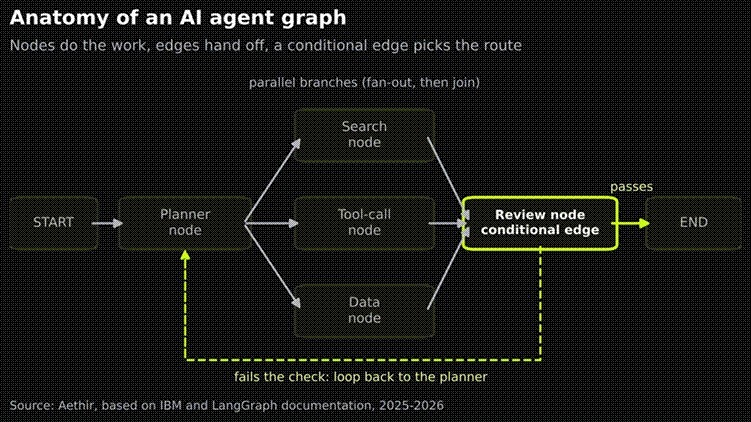
Nodes do the work: Each node is one step, such as a model call, a web search, a tool call, or a quality check. It reads state and writes back only what changed.
Edges carry the hand-off: A fixed edge always routes one node to the next. Conditional edges read the state and pick a path, which is how a graph branches, retries, or stops.
State is the shared memory: The state object travels through the whole graph and records messages, results, and flags.
If you’re new to the line between a model and an agent, our comparison of LLMs and AI agents covers the basics.
How Agent Orchestration Runs a Graph
Agent orchestration is the runtime that walks the graph. It starts at an entry node, runs whatever the edges allow, merges each result into state, and repeats until it hits an end node. The LangGraph persistence layer saves that state as checkpoints for each thread. That gives a run conversation memory, human-in-the-loop pauses, time travel, and fault tolerance. A failed step restarts from the last checkpoint. Aethir applies the same thinking one layer down, where GPU orchestration decides placement for every job on the network.
Conditional Edges and Parallel Agent Execution
A router function inspects state and returns the next node, for example, a tool node when the model asked for a tool and the end node when it didn’t. Loops are conditional edges that point backward, so a review node can send weak output back again.
Independent branches, such as three searches on different sources, run at the same time and meet at a join node. Treating calls as a dependency graph cuts latency by up to 3.7x and cost by up to 6.7x against a step-by-step ReAct agent in the UC Berkeley LLMCompiler paper.
An interrupt can hold a run until a person approves the next step. Teams place these before payments, deployments, or published content.
Why Multi-Agent Systems Multiply Agentic Inference Costs
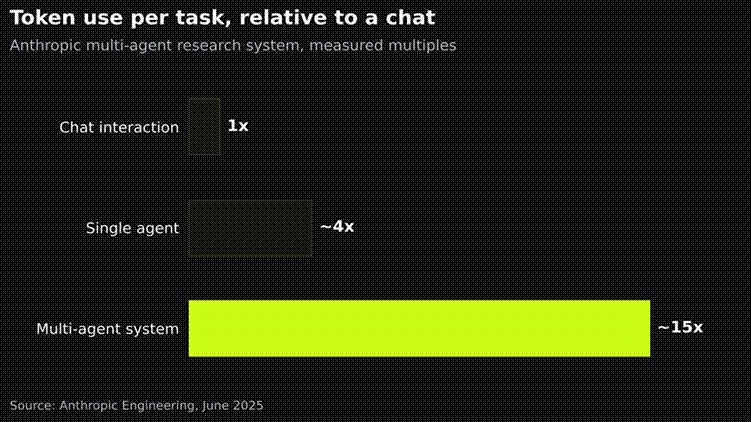
Every node that calls a model spends tokens, and multi-agent systems add many such nodes. In its June 2025 write-up of a multi-agent research system, Anthropic reported that agents used about 4x the tokens of a chat and multi-agent systems used about 15x.
Gartner expects agentic inference costs per workflow to rise more than fivefold through 2028, according to its August 2026 inference forecast, even as token prices fall. We’ve tracked the same pressure as inference spending passed training this year.
What Stateful AI Agents Hold Between Steps
Stateful AI agents carry messages, tools, results, and plans forward, so each later node reads a longer prompt. Longer prompts mean more prefill work and a larger KV cache sitting in GPU memory.
A graph with loops and review steps can keep one session alive for minutes. That ties up memory and scheduling capacity for the length of the run.
A fan-out node fires several model calls at once, and the join waits for the slowest branch. Capacity that absorbs short bursts keeps one lagging call from stalling the graph.
Compute for AI Agents on Aethir’s Decentralized GPU Cloud
Agent graphs turn one request into many model calls, so GPU compute for AI agents tracks graph shape more than user count. Inference will make up roughly two-thirds of all AI compute in 2026, according to Deloitte 2026 TMT Predictions.
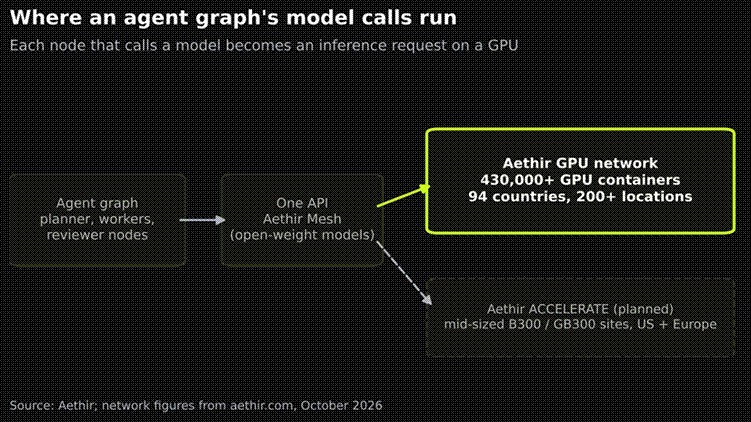
Infrastructure is struggling to keep up. In a survey of 1,402 decision-makers for the Google Cloud agentic infrastructure report, 83% said their stack needs upgrades to support agentic AI. The Aethir decentralized GPU cloud handles that load with distributed GPU inference across 430,000+ GPU containers in 94 countries and 200+ locations.
Aethir Mesh, ACCELERATE and Agent Orchestration
One API for open-weight models: Aethir Mesh serves 14 open-weight models from DeepSeek, Kimi, GLM, MiniMax, and Qwen through one API key, with OpenAI- and Anthropic-compatible endpoints. It runs mostly on Aethir GPUs. Each node in a graph can call a different model without a new vendor contract.
Routing and logs per request: Mesh routes requests by latency, fails over automatically, and logs latency, tokens, and cost for every call. Those logs map onto graph nodes, showing teams which branch drives their agentic inference costs.
Dedicated capacity for heavier graphs: Through Aethir ACCELERATE, Aethir plans to build mid-sized data centers in the US and Europe for NVIDIA B300 and GB300 clusters. That gives agent orchestration at enterprise scale a planned path to dedicated capacity next to the distributed network.
AI agent graphs give builders a structure they can read, test, and restart, with nodes for work, edges for decisions, and state for memory. The same structure multiplies model calls, which is why multi-agent systems keep steady pressure on inference capacity.
The Aethir decentralized GPU cloud, Aethir Mesh, and planned ACCELERATE capacity give teams room to run wider graphs without tying every node to a single provider.
FAQ
What are AI agent graphs?
AI agent graphs are workflows where each step of an agent is a node, and each transition is an edge, with shared state passed between them. They let agents branch, loop, run steps in parallel, and pause for human review. Frameworks such as LangGraph compile these graphs into a runnable application.
How does LangGraph differ from a simple agent loop?
A simple loop calls a model, runs a tool, and repeats, with little control over the path it takes. LangGraph makes every step explicit and saves state so stateful AI agents can resume at certain points after a failure or human approval. That makes long runs easier to debug and govern.
Why do multi-agent systems use more tokens than chatbots?
Each agent reads context, reasons, and writes output, and a lead agent also plans the work and merges results. Anthropic measured about 15x the tokens of a chat for its multi-agent research system. Gartner expects agentic inference costs per workflow to keep rising through 2028.
What GPU compute do AI agents need in production?
Agents need inference capacity for many short, bursty model calls, plus enough GPU memory to hold long contexts across a run. Delays between steps add up, so capacity close to users helps. The Aethir decentralized GPU cloud provides GPU compute for AI agents in 94 countries, and Aethir Mesh exposes open-weight models through one API.