Key Takeaways
Customers fund the start: On recent three-year contracts, IREN reports customer prepayments covering 45% to 55% of GPU CapEx. That cash arrives before the GPUs earn anything, so the operator borrows less from day one.
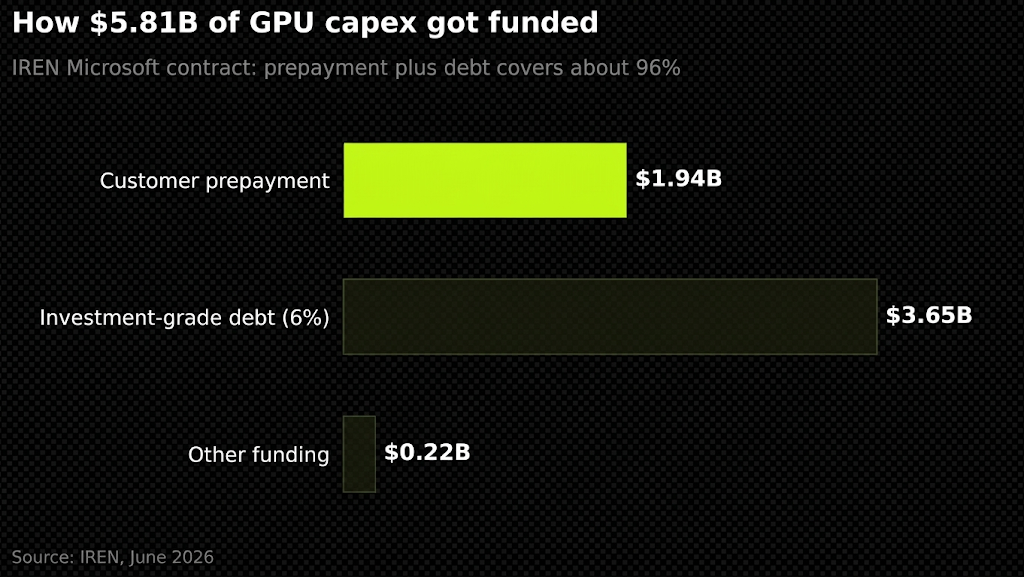
Credit sets the debt: Lenders secure GPU financing against the contracted GPUs. On the IREN Microsoft contract, investment-grade debt at about 6% plus prepayments funded 96% of GPU CapEx.
Payback beats the rate: Recent three-year deals above $20 million per MW pay back the GPUs in about two years. At that GPU payback period, a 9% loan instead of 6% barely changes the outcome.
Signed demand decides: Lenders now treat compute as financeable infrastructure, from a $40 billion GPU finance lease for SpaceX to a $63 billion vehicle for Anthropic.
How GPU Financing Works When a Customer Signs First
Credit markets are nervous about AI infrastructure overbuild. Global AI-related debt issuance fell from $113 billion in June to $23 billion in September 2026, according to Axios, citing FT data.
Who carries the bill if the GPUs sit idle? Aethir’s co-founder Mark Rydon answered that in a thread on IREN numbers, and the answer starts with the customer.
Why Customer Prepayments Carry Most of the Load
Step one - the contract: The customer signs a multi-year take-or-pay contract and pays part of it up front. On its recent three-year deals, IREN says customer prepayments covered 45% to 55% of GPU CapEx. That cash lands before a single GPU hour is billed.
Step two - the loan: A lender funds most of what remains, secured by the contracted GPUs and the cash they’re owed. That’s why GPU collateral value depends so heavily on who signed. A strong customer turns a depreciating chip into a bankable asset.
Step three - the building: The data center sits outside this stack as a separate, long-life asset. Mark Rydon notes IREN has paid for construction with cash so far, which keeps the GPU debt tied to the GPUs and nothing else.
The GPU Payback Period Behind a Three-Year Contract
The math on a signed contract is short. IREN says recent three-year contracts bring in more than $20 million of revenue per MW of IT load and pay back the GPUs in about two years. That GPU payback period sits well inside the term.
Why Investment-Grade Debt Barely Moves the Math
IREN closed a $3.65 billion facility at a blended 6% and paired it with a $1.94 billion customer prepayment. Together they fund $5.59 billion of the $5.81 billion GPU CapEx. That’s about 96%.
For customers without an investment-grade rating, IREN borrowed at 9% fixed, funding 90% of GPU CapEx. The Block reported that the A rating on the Microsoft facility is what brought its rate down to 6%.
On a two-year payback, Mark Rydon argues, a 9% rate instead of 6% hardly dents the return the contract locks in. Customer credit and cash terms decide the deal. It’s the same reason GPU cloud pricing on a signed plan behaves so differently from spot rates.
How a GPU Finance Lease Funds the Biggest Builds
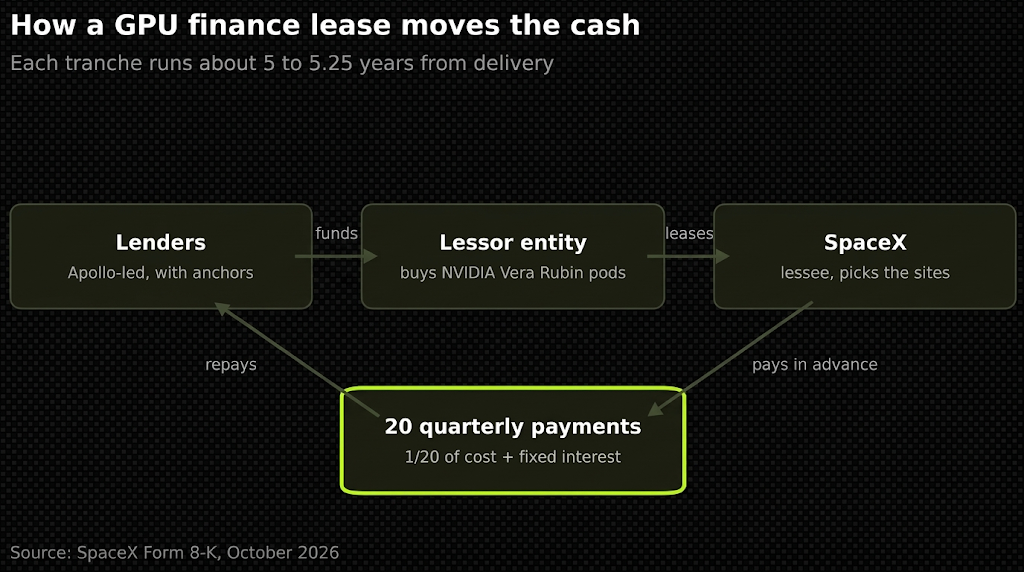
The largest buyers lease instead. SpaceX signed a binding commitment for a roughly $40 billion GPU finance lease with an Apollo-managed entity, according to its October 26 filing. The lessor buys NVIDIA Vera Rubin GPU pods and leases them to SpaceX for data centers SpaceX picks. SpaceX repays the full cost, so it’s buying on credit.
What Five-Year Terms Say About AI Infrastructure Overbuild
Each tranche gets its own lease of about 5 to 5.25 years from delivery, with the first expected in the first half of 2027. Rent is paid quarterly in advance: one-twentieth of the tranche cost plus fixed-rate interest. Across all tranches, that’s roughly $2 billion of principal a quarter once everything runs.
The SpaceX CFO says it’s seeing payback periods under a year on its AI infrastructure. If a GPU pays for itself inside 12 months, spreading the cost over five years keeps cash free to build faster.
Apollo leads, Goldman Sachs structured the deal, and BlackRock, Goldman Sachs Asset Management, and KKR-advised accounts are anchors. The same day, a $63 billion vehicle from Bank of America, Blackstone, Citi, and Morgan Stanley agreed to buy Broadcom chips and lease them to Anthropic. The five-year repayment term suggests lenders expect the chips to keep earning, which aligns with used GPU values.
Contracted Capacity, Live Capacity, and Signed Demand
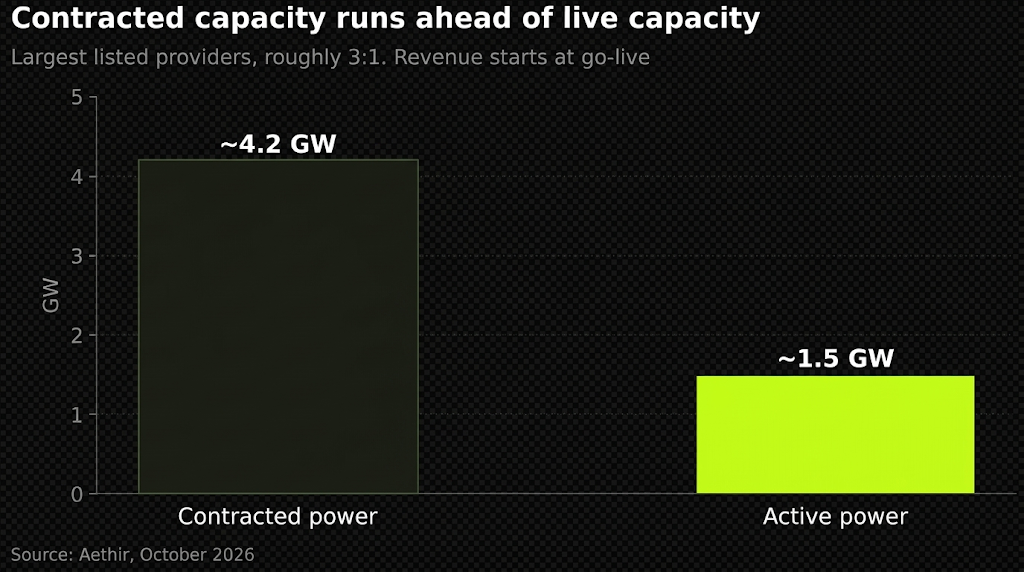
A signature starts the clock. Revenue starts at go-live. The biggest listed providers report about 4.2 GW of contracted capacity against 1.5 GW active. Gartner warned in October that more than $3.5 trillion of AI infrastructure spend could face impairment by 2030 if revenue lags, so the build schedule matters as much as the contract.
Aethir ACCELERATE Starts From Signed Demand
Axe Compute as public-market proof: Axe Compute, an infrastructure partner in Aethir ACCELERATE, has more than $3.45 billion in signed contracts and more than $184 million in prepayments received since its Q2 earnings call. Revenue only starts when each cluster goes live.
Where ACCELERATE plans to build: Aethir ACCELERATE plans to build multiple mid-sized data centers in the US and Europe for B300 and GB300 clusters. Aethir adds capacity in regions where its network already has demand, so each site starts with customers secured.
What signed demand means for buyers: Capacity that starts from signed demand reaches go-live with its financing logic settled. Enterprise buyers get dedicated B300 and GB300 clusters.
GPU financing follows the customer. Prepayments and credit carry most of the cost, a two-year payback absorbs a higher loan rate, and the largest lenders now price five-year GPU leases as infrastructure.
Aethir ACCELERATE applies that discipline by planning to build where demand is already signed, so new capacity arrives funded, placed, and ready to go live.
FAQ
How does GPU financing work for neoclouds?
Most GPU financing starts with a signed customer contract and a prepayment, followed by a loan secured by the contracted GPUs. On recent IREN contracts, customer prepayments covered 45% to 55% of GPU CapEx, and lenders funded much of the rest. The data center is usually financed separately as a long-life asset.
What is a take-or-pay contract for GPUs?
A take-or-pay contract commits the customer to pay for reserved GPU capacity whether or not it uses all of it. That fixed cash flow is what lenders secure their loans against. That’s why the customer's credit shapes the interest rate on the debt.
Does a GPU finance lease raise AI infrastructure overbuild risk?
A GPU finance lease ties repayment to a named lessee with its own credit, so lenders take on that customer rather than the whole market. The SpaceX lease repays each tranche over about five years, which signals that lenders expect the chips to keep earning. Overbuild risk sits mostly with capacity built without signed demand behind it.
Disclosure
Aethir Foundation is an Axe Compute shareholder, through its 2025 treasury transaction. We cover Axe as an interested holder. This article reflects Aethir's views and is not investment advice. For official company information, see Axe Compute's SEC filings (CIK 0001446159) and investors.axecompute.com.
Nothing in this article should be relied upon as a guarantee of future performance or results.