Key Takeaways
No compute reference price exists: Compute is one of the world's largest industrial inputs, and it still has no published benchmark rate.
Two quotes for the same silicon can differ by a multiple: Listed hourly rates for an H100 ran from roughly $1.25 on a spot marketplace to $12.29 at a hyperscaler in May 2026.
Expense bundling creates unclear pricing structures: Storage, egress, and interconnect sit inside the hourly rate at some providers and outside it at others, so the headline figure isn’t comparable.
Futures arrived before the spot market did: ICE and CME both moved during 2026 to list GPU compute futures against a GPU rental price index. The derivative layer is being built on top of an underlying market that still doesn’t publish a price.
Aggregated capacity behaves more like a cleared price: A network quoting continuous rates across capacity from many independent operators produces something closer to a market price than any single rate card can.
Compute Has No Reference Price Anywhere
In May 2026, Intercontinental Exchange (ICE) said it would list cash-settled GPU compute futures referencing a spot index, and in August CME set 5 October as the launch date for its own H100 and B200 rental contracts. Both announcements described the same market gap. The exchange release announcing GPU compute futures carries a line from Ornn co-founder Kush Bavaria: “Compute has grown past $1 trillion in scale yet still lacks the pricing and risk-transfer infrastructure every other major commodity relies on.”
That’s the whole problem in one sentence. Oil has Brent, gas has Henry Hub, metals have the LME, and compute has a sales call. Aethir has written before about how GPU cloud pricing keeps moving without a public reference, and the intervening year hasn’t produced one. The CME contract specification for H100 rental futures represents one month of rental cost per contract, listed under NYMEX rules.
Where the GPU Hour Cost Gets Set Today
The largest compute transactions of 2026 were negotiated privately between one buyer and one operator, and the price never left the room. A signed contract value gets announced, sometimes a term length, and the GPU-hour cost inside it rarely does.
Multi-year commitments are discounted against a list rate that itself has no independent standing. Without a compute reference price to anchor against, the discount is a number the seller chose, and the buyer accepted.
Additionally, egress, block storage, high-speed interconnect, and support tiers are folded into the hourly figure at some providers and billed separately at others. Comparing them means rebuilding both quotes from parts.
Why GPU Price Discovery Never Developed in Compute
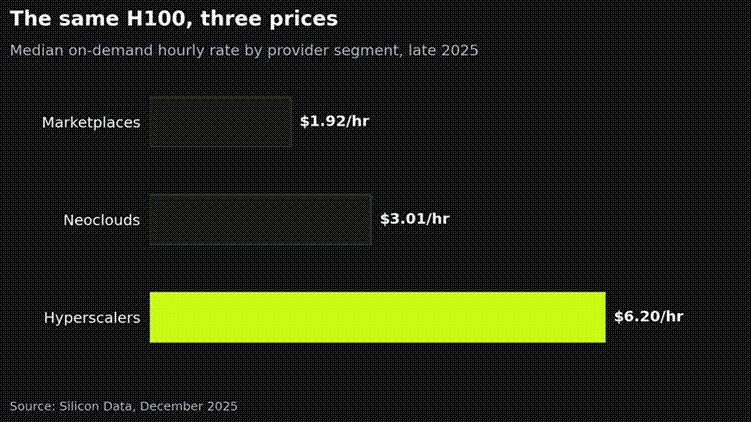
The market skipped the stage where the product gets defined. Commodities become tradable once everyone agrees what one unit is, such as a barrel of a named crude oil, at a named point, in a named month. A GPU hour has none of that, so quotes fragment along provider lines instead of converging. Silicon Data research on H100 rental prices over time puts late-2025 medians near $1.92 an hour on marketplaces, $3.01 at neoclouds, and $6.20 at hyperscalers.
One analysis of listed rates in May 2026 found a twelvefold spread on the same H100 silicon, from about $1.25 an hour on interruptible spot capacity to $12.29 an hour on hyperscaler on-demand GPU rates.
The Reserved Capacity Discount Claim
A reserved capacity discount of 30% sounds like a win until the list rate turns out to sit 40% above the going marketplace level. The percentage is knowable, and the base isn’t, which inverts the usual relationship between a discount and a saving.
Committing for three years means taking a view on where rates go, and until this year there was no published curve to take that view against. Aethir has argued that used hardware values feed straight back into rental economics, which is exactly the variable a long reservation locks the buyer into.
In a market with a benchmark, a quote that sits far off the reference becomes suspicious to potential buyers. Without one, an outlier quote is indistinguishable from a premium service, so the pressure that normally compresses a spread never arrives.
What a Working GPU Rental Price Index Requires
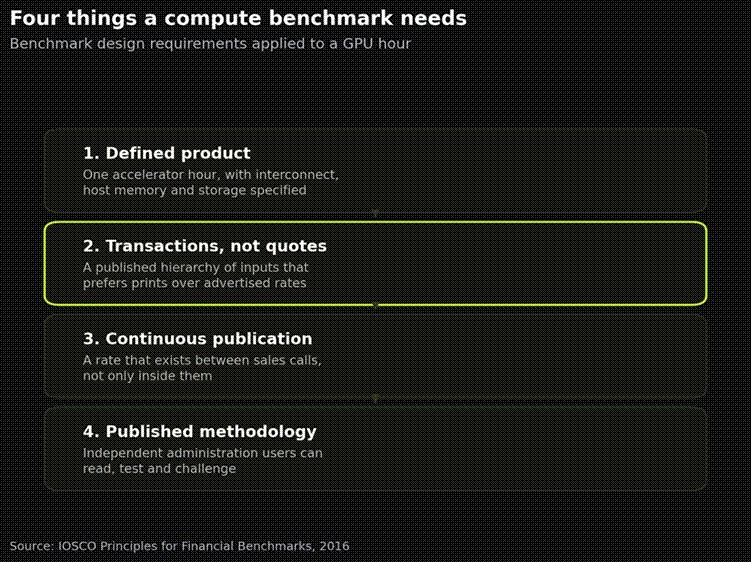
The IOSCO Principles for Financial Benchmarks require a benchmark to reflect a credible market, satisfy a data-sufficiency test, apply a published hierarchy of inputs favoring transactions over quotes over estimates, and publish the methodology so users can judge it themselves.
Applied to compute, that’s a very demanding list. The private indices publish hourly levels today, including the rental indices the exchange contracts reference, and sample observed and advertised rates, instead of reported numbers. The gap isn’t mathematical. Most volume trades privately, and the operators holding the print have little reason to publish it.
GPU Pricing Transparency Starts With the Product Specifications
One accelerator hour means very little without interconnect topology, host memory, local storage bandwidth, and whether the node is shared. A GPU rental price index that ignores those variables measures several different products at once and reports the average as if it were a price.
An index built from executed transactions can be audited, and one built from advertised rate cards can be gamed by publishing a rate nobody pays. GPU pricing transparency improves the moment providers state the input hierarchy openly, even if the sample stays small at first.
Furthermore, a rate that exists only when a salesperson quotes it can’t anchor anything. Continuous publication is what turns a number into a reference, and it’s the single change that would do most for buyers this year.
Reading On-Demand GPU Rates Without a Benchmark
Until an index earns trust, compute buyers need to manually gather pricing data across different verticals. Buyers need to collect on-demand GPU rates from several structurally different sellers, rebuild each quote to a single specification, and treat the spread as pricing-difference information. One comparison of listed H100 rates across more than fifteen providers found a range of $1.49 to $6.98 an hour, which is a usable band even without a reference.
Naming the gap plainly changes what a buyer asks for. When inquiring about a compute purchase, buyers should always ask what the unit includes, what the discount is measured against, and ask for the rate to be quoted the same way twelve months from now.
Aethir’s decentralized GPU cloud practice continuously quotes across many independent operators, which gets closer to a realistic market price, but the overall GPU compute sector still has a long way to go to get a transparent pricing mechanism.
Frequently Asked Questions
What is GPU price discovery?
GPU price discovery is the process by which a market arrives at a published, trusted price for an hour of accelerator time. Compute doesn’t have it yet, because most volume is negotiated privately and the resulting rates aren’t reported anywhere. That’s why two quotes for identical hardware can differ by a multiple with no way to judge either one.
Is there a compute reference price for GPUs?
Not in the same sense as oil or natural gas. Several private indices now publish hourly rental levels, and two exchanges are listing contracts against them, but no compute reference price yet has the standing to settle contracts across the whole market.
What are GPU compute futures?
They are exchange-listed, cash-settled contracts whose value tracks a published index of GPU rental costs. ICE announced contracts referencing the Ornn Compute Price Index in May 2026, and CME set 5 October 2026 for H100 and B200 rental index futures. They let a buyer hedge compute cost exposure without taking delivery of any hardware.