Key Takeaways
Short-Term Compute: The amended Anthropic S-1 reports $5 billion of short-term compute in Q3 2026, bought at a cost above its multi-year contracts. It’s the first public filing to quantify how fast it's outrunning its compute plan.
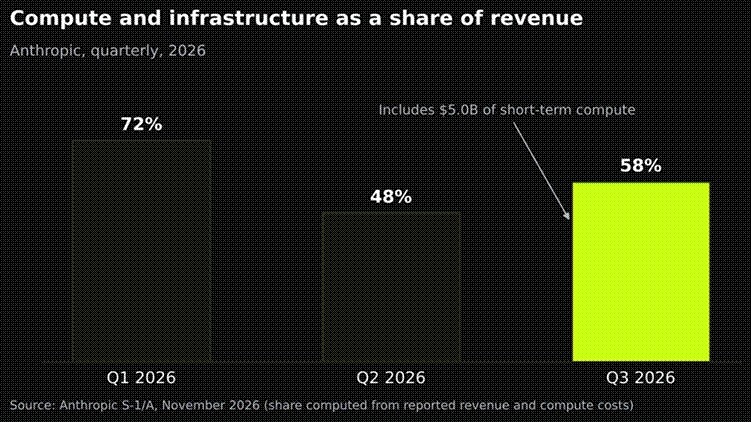
AI Lab Compute Costs Rose to 58% of Revenue: Compute and infrastructure took 58% of revenue in Q3, up from 48% in Q2. The quarter swung to a $567 million operating loss, which the filing ties to the short-term compute and $2 billion of non-cash donation charges.
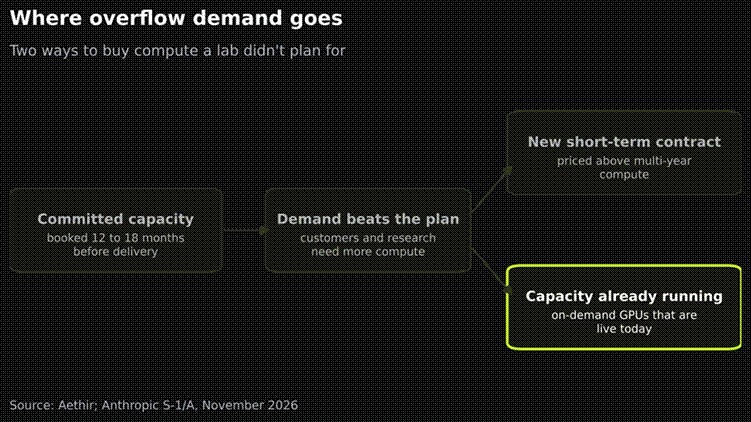
Compute Overflow: Most of the compute is booked 12 to 18 months before it arrives. When revenue grows 47% in one quarter, the gap gets filled at whatever short-term capacity costs.
On-Demand GPU Capacity Narrows the Compute Premium: Capacity that’s already running can absorb overflow without a new build. Aethir runs 430,000+ GPU containers in 94 countries with 48-hour enterprise GPU provisioning for selected GPU types, and Aethir ACCELERATE plans to add capacity against signed demand.
What the Anthropic S-1 Shows About Short-Term Compute
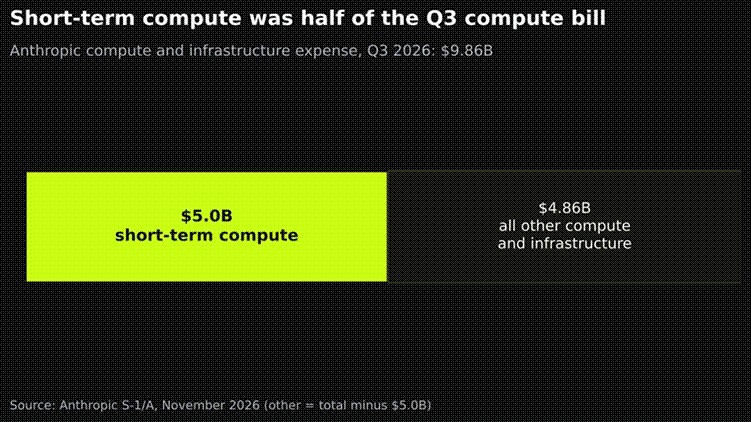
Anthropic filed its amended S-1 registration statement on November 2. Q3 revenue reached $16.96 billion, and compute and infrastructure expense hit $9.86 billion. Inside that bill sat $5 billion of short-term compute, which the filing says costs more than comparable compute under its multi-year commitments.
That gap is the overflow premium. A $974 million Q2 operating profit became a $567 million operating loss. Compute took 72% of revenue in Q1, 48% in Q2 and 58% in Q3. Fortune’s read of the first S-1 in October found revenue growing far faster than compute costs. The amendment shows the first quarter in which that lead narrowed, months after the Anthropic Lambda deal signaled how hard the lab is buying.
Inside $895.4 Billion in Multi-Year Compute Commitments
As of September 30, Anthropic held about $895.4 billion of purchase commitments and leases, nearly all of it compute and infrastructure. About $447.5 billion lands before the end of 2030, and most of the rest runs from 2031 to 2045.
Roughly $69.8 billion of those multi-year compute commitments falls due within twelve months of September 30. That capacity arrives on a fixed schedule, regardless of demand in the meantime.
Even with that book, Q3 needed $5 billion of short-term compute on top. A forecast this large still missed the quarter. That says more about how fast demand moved than about the planning.
Why AI Lab Compute Costs Jump When Demand Outruns Plans
Revenue rose from $11.56 billion in Q2 to $16.96 billion in Q3, about 47% in a single quarter. The S-1 lists the drivers of compute demand: research pace, training techniques, competition, and customer demand for inference.
Inference is the fastest-moving piece, and Deloitte’s 2026 compute outlook expects it to reach roughly two-thirds of all AI compute this year. Overbuilding carries its own cost. McKinsey’s data center CapEx analysis warns that overinvesting risks stranded assets while underinvesting means falling behind. So labs pick a number, and AI lab compute costs absorb the error. Signed capacity and live capacity also arrive on different dates, which is a gap we covered in our guide on how to tell contracted from live capacity.
Compute Overflow Starts 12 to 18 Months Before Delivery
Anthropic says most of its compute sits under multi-year commitments procured 12 to 18 months before availability. Capacity bought in early 2025 had to anticipate demand in mid-2026.
When customer or research demand exceeds that long-term capacity, the lab buys short-term compute. Each quarter of compute overflow then lands on the income statement at the short-term rate.
The filing expects short-term compute use to keep rising in the near term and to compress operating margin. Adjusted operating margin already slipped from 19% in Q2 to 15% in Q3.
What Short-Term Compute Looks Like in Neocloud Deals
In practice, short-term compute means contracts signed outside the long planning cycle.
TechCrunch’s read of the amendment names neocloud deals with SpaceX, Nscale, Akamai and Volta, putting the SpaceX arrangement at $1.25 billion a month and the other three in the billions. Short-term compute was about half of the $9.86 billion Q3 compute bill.
Gartner expects neoclouds to take 20% of a $267 billion AI cloud market by 2030, largely by selling flexible access to scarce GPU capacity. That flexibility is the product, and the neocloud model prices it in.
Where the Compute Premium Comes From
A short-term contract buys capacity someone else already financed, powered, and racked. The seller prices in the scarcity of having it ready now.
Multi-year contracts spread hardware cost across years of guaranteed use. Short terms leave the seller exposed to idle GPUs once the deal ends, and the rate reflects that.
The S-1 gives no per-unit compute premium, though revenue earned on each $1 of compute fell in Q3. TechCrunch puts that ratio at 1.72x.
How On-Demand GPU Capacity Lowers the Compute Premium
The cheapest overflow is capacity that’s already running. A new build can’t rescue a quarter that’s already short, because power, permits, and hardware take longer than the gap lasts.
Buyers can pay by the hour on demand instead of signing another multi-year agreement. Aethir operates that kind of on-demand GPU capacity: 430,000+ GPU containers in 94 countries, aggregated from enterprises and data centers into one network.
Aethir ACCELERATE and Fast GPU Provisioning
Running Capacity First: Aethir offers 48-hour enterprise GPU provisioning for selected GPU types, drawing on hardware that’s already live. A lab or enterprise can absorb a spike without waiting on a new contract cycle.
Building Against Signed Demand: Aethir ACCELERATE plans to build multiple mid-sized data centers in the US and Europe for B300 and GB300 clusters. It builds against signed demand, so new capacity arrives with an attached customer
Two Layers, One Plan: Running capacity handles this quarter’s overflow, while ACCELERATE plans to add dedicated capacity for demand that’s already contracted. Together they shrink the share of compute a buyer sources at short-term rates, the same logic behind building on signed demand.
The Anthropic filing puts a number on a cost every fast-growing AI buyer carries: compute bought late costs more. Booking 12 to 18 months ahead guarantees some misses.
On-demand GPU capacity that’s already running turns that miss into a smaller bill, and building against signed demand keeps the next shortfall smaller still.
FAQ
What is short-term compute in the Anthropic S-1?
It’s capacity Anthropic buys outside its multi-year commitments when customer or research demand exceeds the long-term plan. The S-1 reports $5 billion of short-term compute in Q3 2026 and says it currently costs more than comparable multi-year compute.
Why do multi-year compute commitments leave a gap?
They’re signed 12 to 18 months before the capacity arrives, so they reflect an older forecast. When demand grows faster than that forecast, the difference has to be bought at short notice, usually through neocloud deals. That late purchase is where AI lab compute costs climb.
How does on-demand GPU capacity reduce compute overflow costs?
You can provision capacity that’s already running without a new build or a long contract. Aethir offers 430,000+ GPU containers in 94 countries with 48-hour GPU provisioning for selected GPU types, and Aethir ACCELERATE plans to add dedicated capacity against signed demand.