Key Takeaways
The Anthropic-Lambda deal buys compute capacity: The agreement commits $35 billion over six years for roughly 350 megawatts at a Texas campus that hasn’t been energized yet. Nothing in it adds a single available GPU to the market this quarter.
A compute offtake agreement is a financing instrument first: Take-or-pay terms turn a buyer promise into collateral a lender can underwrite. That’s how megawatt-scale compute gets built years before the workloads arrive.
AI compute commitments have outrun AI lab revenue: Anthropic has disclosed more than $200 billion in AI compute commitments across 2026, against an annualized revenue run rate near $65 billion.
One supplier sits on three sides of the same transaction: NVIDIA supplies the chips, holds the lease on the building, and backs the provider. That’s the clearest example yet of AI infrastructure concentration inside a single NVIDIA-backed neocloud arrangement.
The AI compute market now clears on delivery: When forward capacity is pre-sold years out, the scarce good is a date. Buyers who aren’t signing $35 billion contracts have to plan around what’s already spoken for.
What the Anthropic Lambda Deal Actually Covers
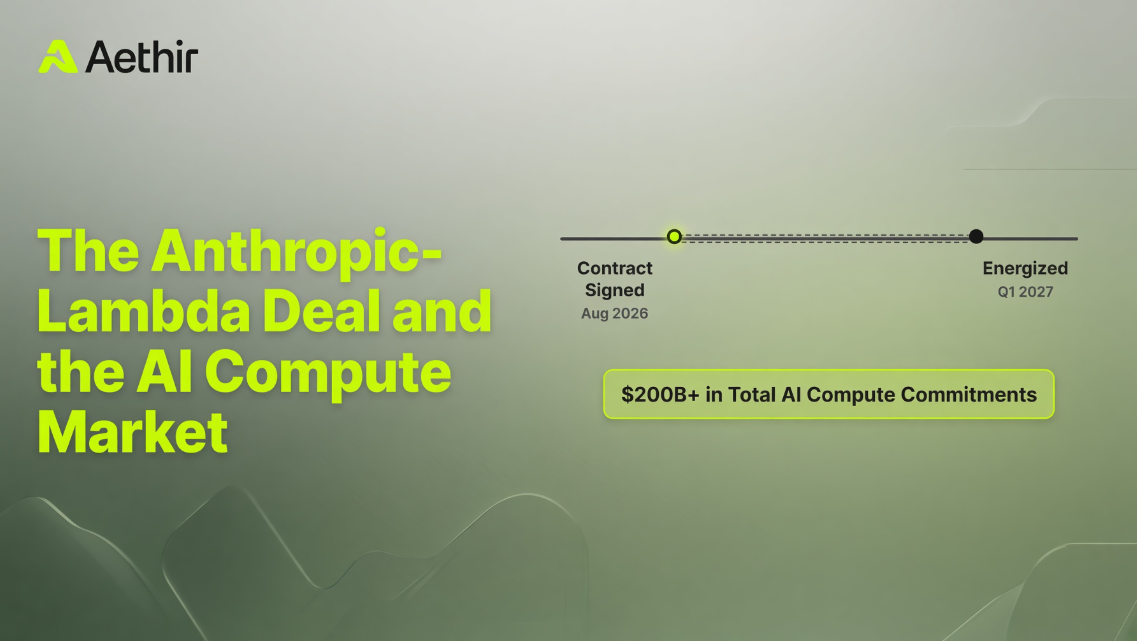
On August 31, 2026, Anthropic signed a $35 billion, six-year agreement with Lambda for roughly 350 megawatts of GPU capacity in Nueces County, Texas, first reported by Bloomberg. The Anthropic-Lambda deal doesn’t purchase hardware, and it doesn’t purchase a building. It purchases contracted access to compute on a site that energizes in the first quarter of 2027, which means the most interesting part of the announcement is the gap between the signature and the first working GPU. That gap is a procurement problem and a deal this size makes the point at scale.
Inside the Hut 8 Beacon Point and the NVIDIA Lease
Hut 8 owns and develops the campus, NVIDIA holds the IT lease on the site, Lambda installs and runs the GPUs inside it, and Anthropic buys the compute those GPUs produce. Every megawatt in the announcement passes through all four before it does any work.
Also, Hut 8 fully commercialized the site across two 15-year leases of 352 megawatts each, at a campus base-term contract value of $19.6 billion, according to the company announcement. The 350 megawatts behind the Anthropic Lambda deal is one part of a 1 gigawatt campus.
Initial energization at Hut 8 Beacon Point is targeted for the first quarter of 2027, with the second phase data hall arriving in the second quarter of 2028. This example shows how a contract signed in 2026 is a 2027 and 2028 delivery, and no amount of capital compresses that further.
A Compute Offtake Agreement Is a Financing Instrument
A compute offtake agreement is a multi-year commitment to buy capacity on take-or-pay terms, so the buyer owes the money whether or not its own revenue arrives on schedule. That obligation is the collateral. Research on how the AI buildout is being financed puts roughly $8.2 trillion behind 200 gigawatts of planned capacity between 2026 and 2032, and almost none of it is raised on the hope that tenants will turn up later.
How Megawatt Scale Compute Gets Underwritten
A signed offtake converts an unbuilt site into a predictable revenue stream, which is what a lender actually prices. Hut 8 disclosed three five-year renewal options and a 3% annual escalator on the Beacon Point leases, lifting campus value to $50.2 billion if every option gets exercised.
The leases run 15 years while the accelerators inside them carry a useful life closer to four to six, a mismatch covered in our analysis of what a used GPU is worth. Whoever signs the longer instrument carries the residual risk on the shorter one.
Additionally, project debt gets underwritten against the tenant rather than the technology, which is why the counterparties on these agreements are a very short list. Smaller buyers can’t access the same structure, so they meet the market at a different price.
NVIDIA-Backed Neocloud Deals Fold Three Roles Into One
NVIDIA supplies the accelerators Lambda installs, holds the lease on the building those accelerators sit in, and is an investor in both Lambda and Anthropic, as the deal coverage sets out. A single NVIDIA-backed neocloud arrangement therefore places one company in the supplier seat, the landlord seat, and the shareholder seat at once.
Where AI Infrastructure Concentration Shows Up
Demand and supply share a balance sheet: NVIDIA has also helped assemble more than $500 billion of third-party capital for AI compute infrastructure financing platforms. When a chip vendor participates in funding demand for its own chips, price signals get harder to read from the outside.
AI infrastructure concentration is a pricing question: No published rate card sets a reference price for a gigawatt-scale contract, so nobody outside the room can check the number.
The structure is legal, disclosed and rational: Vendor participation accelerates buildouts that wouldn’t otherwise reach financial close, and both Lambda and Anthropic get capacity they couldn’t assemble alone.
What $200 Billion in AI Compute Commitments Buys
Anthropic has disclosed AI compute commitments above $200 billion across 2026, including roughly $50 billion with Fluidstack, $45 billion with Nscale for 460 megawatts in West Virginia, $45 billion with SpaceX in Memphis, and up to $25 billion with Amazon for as much as 5 gigawatts of Trainium capacity. The Nscale agreement alone runs six years and doesn’t start serving traffic until late 2027.
The AI Compute Costs Behind a Six-Year Ledger
Anthropic reached an annualized revenue run rate near $65 billion by the end of July 2026, up from $47 billion in May. Growth at that rate is remarkable, and it still sits well below the AI compute commitments already signed.
Every gigawatt reserved under a six-year contract is a gigawatt nobody else can rent in 2028. Aethir’s analysis on where the 2026 shortage actually comes from traces the same effect through allocation queues rather than headline prices.
A compute buyer’s position in the queue now matters more than the size of an approved budget. Many buyers without a nine-figure commitment are pricing against capacity already claimed by someone with one.
What the AI Compute Market Looks Like From Here
Read together, these contracts describe an AI compute market where the scarce good is a delivery date rather than a GPU hour. Up to half of the data center capacity scheduled for 2026 could slip on permitting and grid connection. At the same time, Gartner expects worldwide AI spending to grow 47% in 2026. Demand keeps getting revised upward, and the supply answering it is largely pre-sold, so AI compute costs follow allocation rather than the bill of materials.
The Anthropic Lambda deal is a clean illustration of how the AI compute market now works. Capacity gets financed against a promise, delivered years later, and allocated by who committed first. For everyone outside that circle, the useful takeaway is simpler: megawatt-scale compute signed in 2026 serves 2028 roadmaps, so anything that answers a question this quarter has to exist somewhere already.
Frequently Asked Questions
What is the Anthropic Lambda deal?
It’s a $35 billion, six-year agreement signed on August 31, 2026 for roughly 350 megawatts of GPU capacity at the Hut 8 Beacon Point campus in Nueces County, Texas. Lambda operates the GPUs, NVIDIA holds the lease on the site, and Anthropic buys the compute those GPUs produce. Initial energization is targeted for the first quarter of 2027.
What is a compute offtake agreement?
A compute offtake agreement is a multi-year contract to buy a fixed amount of capacity, usually on take-or-pay terms. The buyer owes the payment whether or not it consumes the capacity, which turns the contract into a revenue stream a lender can underwrite. It’s the mechanism that gets unbuilt data centers financed.
How much has Anthropic signed in AI compute commitments?
Public reporting puts disclosed AI compute commitments above $200 billion for 2026, across providers including Fluidstack, Nscale, SpaceX, Lambda, Amazon, Volta and Riot Platforms. Most of those agreements run six years or longer, and much of the capacity behind them isn’t scheduled to come online until 2027 or later.
Why does an NVIDIA-backed neocloud structure matter?
Because it puts one company in several positions at once: NVIDIA supplies the chips, leases the facility, and backs the provider. Hence, a single NVIDIA-backed neocloud deal carries a degree of AI infrastructure concentration that a straightforward vendor relationship wouldn’t.