Key Takeaways
Speed of delivery is the scarce asset in 2026: Up to half of the global capacity scheduled to come online this year faces delays from permitting, grid connections, and local opposition. Data center delivery timelines matter more than the headline megawatt figure.
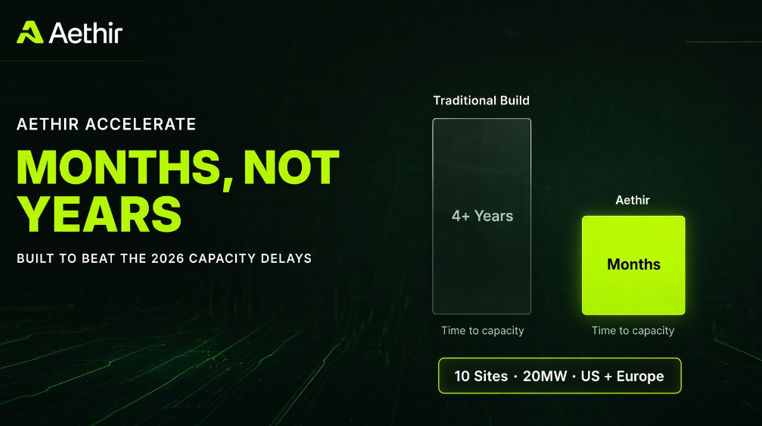
Aethir ACCELERATE targets months to data center deployment instead of years: Aethir’s facilities are designed to go from site selection to live capacity in months. That is achievable because the sites are midsized and the design is repeatable.
Time to first GPU decides more roadmaps than price does: A model that ships two quarters late costs more than a rate card that is 20% higher. Procurement rarely scores delivery latency, which is why it keeps surprising teams.
Nothing has to sit idle while a cluster gets built: Aethir’s GPU capacity already operating across more than 90 countries covers the gap between signature and capacity commissioning. Workloads can run on the decentralized GPU cloud in the meantime and move to the dedicated cluster when it lands.
Half of 2026 Compute Supply Faces AI Capacity Delays
The supply side of AI infrastructure has a scheduling problem, with up to half of the global capacity scheduled to come online in 2026 facing delays from permitting, grid connections, and local opposition.
Generators, chillers, and switchgear now carry equipment lead times that McKinsey research on the colocation race reports have more than doubled since 2019, with some past three years. Accelerators can arrive on time into a building that isn’t ready for them.
Furthermore, average waits for a grid connection now exceed four years in several major markets and reach a decade in the most congested ones. A site that clears that queue quickly is worth more than a larger site that doesn’t.
Also, reserved capacity at the large providers has repriced repeatedly this year, a pattern that Aethir’s analysis of why GPU cloud pricing keeps climbing analyzed in detail. A delayed project pays the new rate, not the one it was underwritten at.
The Data Center Delivery Timeline Is a Procurement Problem
Most procurement processes score price, specification, and contract terms carefully, then treat delivery as a footnote supplied by the vendor. That made sense when infrastructure arrived predictably. It stopped making sense when the schedule became the variable most likely to move. Research from Columbia Business School on financing the AI buildout showed how much of the sector runs on leverage that assumes revenue starts on time.
Pricing Project Schedule Risk Into the Deal
Put a number on a quarter of delay: Work out what one slipped quarter costs in delayed launches, extended interim capacity, and engineering time held in reserve. Once project schedule risk carries a figure, it competes properly against the rate card instead of being waved through.
Ask for the milestone chain: A credible data center delivery timeline names what has been ordered, what is permitted, what is energized, and what still sits with a utility. The Aethir view on capital-efficient access to GPUs explains why that sequence is what a buyer is really purchasing.
Budget cycles don’t wait: Global IT spending is on track to reach $6.37 trillion in 2026 according to Gartner forecasting, and approved budget that goes unspent tends to get reallocated. Capacity that lands inside the fiscal year it was approved for is worth more than capacity that doesn’t.
Time to First GPU Decides More Roadmap Milestones Than Price
The metric that actually governs an AI roadmap is how long it takes to get working capacity, from the moment a team decides it needs it. Quota requests, waitlists, reservation minimums and regional stockouts all sit inside that number, and none of them appear on a rate card. With Gartner forecasting a 47% rise in AI spending for 2026, competition for available capacity is what turns time to first GPU into a strategic variable.
A team waiting on a dedicated cluster still has to run something somewhere, usually on the most expensive short-notice capacity available. Those months of premium spend are a direct consequence of the delivery date uncertainty.
Teams held in a holding pattern lose momentum that no discount recovers. Our analysis of what the inference era changes about infrastructure covers why serving workloads in particular can’t simply be paused until capacity appears.
Additionally, meeting forecast demand requires grid investment to rise sharply from its current base, according to an IEA electricity analysis. Every year that investment lags, AI compute costs absorb more of the resulting scarcity.
Aethir ACCELERATE Compresses Capacity Commissioning
Aethir ACCELERATE has secured access to 10 sites totaling up to 20 MW across the United States and Europe, and the facilities will be purpose-built for high-density compute and rapid deployment.
They are designed to go from site selection to live capacity in months rather than the multi-year timelines that define traditional construction. Recent 55 MW of hosting agreements filed by Axe Compute in August show what that delivery model looks like in practice, with facilities designed around the density, cooling, and availability requirements of next-generation GPU systems.
A 20 MW program spread across 10 sites has ten short schedules rather than one very long one, and any single delay affects one site instead of the whole plan. Smaller facilities also clear local approval faster than a campus does.
Aethir ACCELERATE services include securing GPU hardware, arranging data center capacity, and engaging infrastructure partners with a delivery record. Our coverage of Axe Compute’s GPU cluster build in Q2 2026 funded by customer prepayments sets out how contracted programs convert into deployed infrastructure.
Furthermore, Aethir’s decentralized GPU cloud capacity already operating across more than 90 countries means a workload can start now and migrate to the dedicated cluster at capacity commissioning. That removes the worst outcome: paying for a build and standing still while it happens.
Write the Contract Delivery Date Into the Agreement with Aethir ACCELERATE
The cheapest way to manage schedule risk is to make it contractual. A contract delivery date with defined acceptance criteria converts vendor assurance into an obligation and forces both sides to be explicit about what has to happen first.
In a year when half of scheduled supply is slipping, delivery is the product. Aethir ACCELERATE builds small to midsized sites on repeatable designs to bring capacity online in months, writes the schedule into the commercial terms, and keeps the global network running underneath.
Explore enterprise GPU compute with Aethir and start on capacity that is already live.
Frequently Asked Questions
Why are AI capacity delays so common in 2026?
Up to half of the global capacity scheduled for 2026 faces delays from permitting, grid connections and local opposition. Equipment lead times for generators, chillers and switchgear have more than doubled since 2019, and average grid connection waits exceed four years in several major markets.
What is a realistic data center delivery timeline?
Traditional large-scale construction runs on multi-year timelines once permitting and grid connection are included. Aethir ACCELERATE targets months from site selection to live capacity by using midsized sites, repeatable designs, and long-lead equipment ordered early. The trade is scale for speed, which suits inference workloads well.
What does time to first GPU actually measure?
It measures the gap between deciding you need capacity and running a workload on it, including quota requests, waitlists, reservation minimums, and regional stockouts. Rate cards never show it, yet it usually determines whether a roadmap ships on schedule. Interim capacity spend during that gap belongs in any honest cost comparison.
What is capacity commissioning?
Capacity commissioning is the point at which a built facility or cluster passes performance testing and becomes usable, which differs from when it was announced or contracted. Some agreements only start billing after ready-for-service testing and written acceptance.
How does Aethir ACCELERATE shorten delivery?
It builds midsized sites, so ten short critical paths replace one very long one and a single delay affects one site rather than the whole program. Facilities are purpose-built for high-density compute and rapid deployment with partners that have a delivery record. Meanwhile, workloads can run on capacity already operating in more than 90 countries via Aethir’s decentralized GPU cloud network.
Disclosure
Aethir Foundation is Axe Compute's largest shareholder, through its 2025 treasury transaction. We cover Axe as an interested holder. This article reflects Aethir's views and is not investment advice. For official company information, see Axe Compute's SEC filings (CIK 0001446159) and investors.axecompute.com.
Nothing in this article should be relied upon as a guarantee of future performance or results.