Key Takeaways
The first industrial GPU fleets are aging out: Accelerators bought at scale in 2023 and 2024 are approaching the end of their premium service life at roughly the same time.
The GPU resale sector: An institutional venue for used and surplus accelerators opened in July 2026, quoting request volumes from hundreds of units to tens of thousands.
Aging GPU resale value: Once used GPU pricing is observable, depreciation schedules can be measured against something.
The same floor becomes a ceiling on rent: An owner who can sell a card for a known figure won’t rent it below its carrying cost, and a buyer who can see that figure won’t pay far above it.
The second-hand GPU market: A market with liquid second-hand supply prices very differently from one where every accelerator is either new or scrapped.
GPU Resale Value
For most of the AI buildout, the resale value of a used accelerator was a modeling assumption, but that changed quietly through 2026. Market analysis of used A100 and H100 hardware published in April describes a B2B ecosystem with sustained two-sided activity.
An eight-GPU H100 server was trading in the $150,000 to $180,000 range used, against roughly $500,000 for a new B300 system, while H100 rental rates had already fallen from $7 to $10 an hour at launch to $2 to $4.
Used and refurbished are separate products with separate buyers, and the gap between them is testing and warranty. Secondary-market request volume focuses on H100 and A100 GPUs, which is exactly what you would expect from buyers who want cost per token rather than peak throughput. Inference economics is setting used GPU pricing.
The Secondary Hardware Market
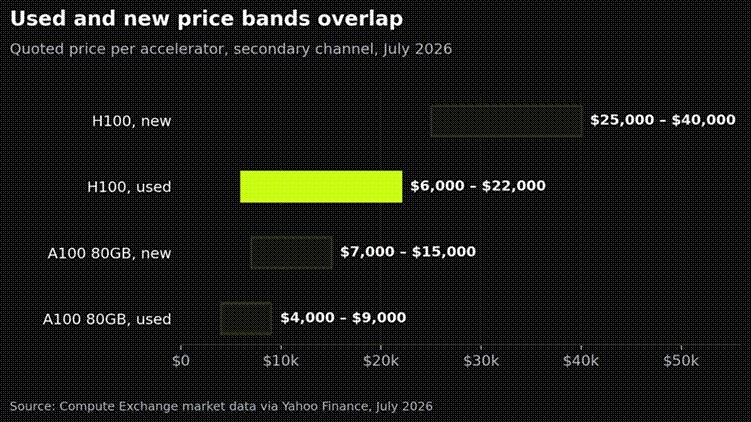
The institutional support for the secondary enterprise GPU market arrived in July 2026, when a marketplace for used, refurbished, and surplus accelerators opened alongside an existing reserved-capacity venue, quoting used H100 units at $6,000 to $22,000 against $25,000 to $40,000 new, and used A100 80GB cards at $4,000 to $9,000 against $7,000 to $15,000 new. Equipment in that channel was described as selling 40% to 60% below original list.
The listed inventory across H100, H200, B200, A100, L40S and V100 parts is what a two-sided market looks like from the outside, with several generations quoted at once and buyers choosing hardware by workload.
Operators refreshing on a fixed cadence create predictable supply, which lets a buyer plan around the channel. Hardware liquidity depends far more on that regularity than on any single large disposal.
An owner with a route to renting mid-life hardware has a second option, which changes what price they will accept. Aethir has written about the mechanics of monetizing owned accelerators through decentralized cloud hosting, and that option itself supports price.
How GPU Resale Value Sets a Residual Value Floor
Depreciation schedules were the subject of a long argument through 2025 and 2026 because nobody could check them. A resale quote ends that argument by providing the number the schedule estimated. Silicon Data research on H100 rental prices over time shows a 75% to 80% decline in marketplace hourly rates from the 2023 peak.
Lenders noticed first. Aethir analyzed how more than $20 billion of loans secured by accelerators depend on residual value holding. The same logic runs through the whole sector. Deloitte research puts 2026 AI data center capital expenditure at $400 billion to $450 billion, and the assets it buys now have a market that will eventually mark them.
A refurbished GPU carries a premium over an untested used one because someone has absorbed the failure risk and priced it in. A residual value floor tells an owner what the downside looks like, not that the asset held its value. Both facts are useful.
Every hardware generation reprices the fleet beneath it, so the residual-value floor resets periodically.
The Ceiling Over Previous Generation GPU Rental Pricing
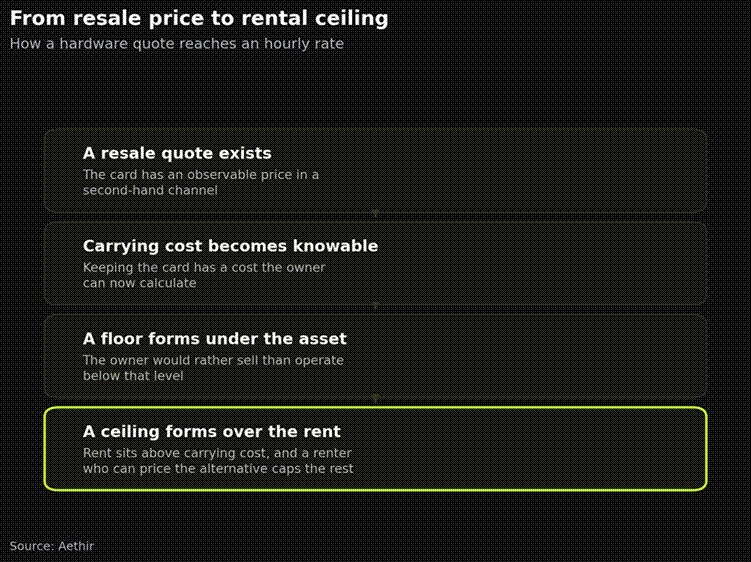
If a used accelerator has a known sale price, the cost of continuing to own it is knowable too, and an owner will rent it out above that carrying cost to earn profits. At the same time, a renter who can price the alternative refuses to pay far above it. GPU rental pricing for older parts gets bracketed from both directions.
New supply keeps pushing the bracket down. NVIDIA said Rubin-based products would reach partners in the second half of 2026, and each generation shifts the previous generation GPU fleet into the value tier. Aethir has tracked why headline compute costs keep rising even as older capacity gets cheaper, which is the same split viewed from the buyer side.
A major discount on last-generation capacity is a signal: When a provider cuts older parts hard, it usually means the fleet is turning over, and the older tier has to earn its keep against a resale quote. GPU fleet turnover shows up in pricing before it shows up in any announcement.
A forward curve for pricing GPUs: Exchange-listed contracts referencing hourly rental indices for the H100 and the B200 mean the older and newer tiers can be priced against each other on a screen.
Contract term is the exposure: A three-year commitment on previous-generation GPU capacity is a bet that the bracket holds. Axe Compute structured its $260 million cluster of 2,304 NVIDIA B300 GPUs as a 36-month take-or-pay agreement, and pairing a term with an asset life is the whole discipline.
What a Residual Value Floor Changes for Buyers
A market with liquid second-hand supply behaves differently from one where every accelerator is either new or scrapped, and the difference lands on buyers as optionality. With Gartner forecasting worldwide AI spending to grow 47% in 2026, the volume of workloads that could run perfectly well on last-generation parts keeps growing rapidly.
This is where a multi-vintage pool has a key advantage. Aethir aggregates enterprise GPU capacity from independent operators and Cloud Hosts into a single orchestrated pool spanning more than 430,000 GPU containers across 94 countries and 200+ locations, so it can quote several hardware generations at once rather than retiring one to make room for the next. The wider DePIN sector has been pushed toward revenue and fundamentals, and utilizing mid-life hardware is one of the few places that revenue is genuinely easier to earn.
An accelerator that still serves inference profitably has no reason to leave the fleet, and Aethir’s decentralized GPU cloud gives it somewhere to go. That demand helps set a floor for used GPU pricing in the first place.
A depreciation schedule used to be a judgment call defended in a footnote, and it is becoming a number somebody will quote you. That makes the secondary hardware market a pricing input and it brackets what previous-generation capacity can be rented for.
Aethir’s decentralized GPU cloud carries several hardware generations at once, putting it in a strong position, because nothing has to be retired to make room for what comes next.
Frequently Asked Questions
What is GPU resale value?
GPU resale value is what a used accelerator actually costs in a second-hand transaction, as distinct from the residual value an owner assumes in an accounting schedule. Until recently, the two were hard to compare because resale quotes were private.
Does a secondary hardware market change GPU rental pricing?
Yes, through the asset's carrying cost. Once an owner knows what a card sells for, they know what it costs to keep, and they will rent it above that. A renter who can see the same figure resists paying far above it, so a secondary hardware market brackets GPU rental pricing for older hardware from both sides.
What is a residual value floor for GPUs?
It’s the level below which an owner would rather sell the hardware than keep operating it, set by observable resale quotes. A residual value floor resets each time a new generation ships rather than holding indefinitely, so any figure should be dated.
Should buyers rent previous generation GPU capacity?
For a large share of production inference, yes, because cost per unit of useful work matters more than peak throughput. The main question is term: a long commitment to previous-generation GPU capacity takes on the risk that resale values and rental rates keep sliding underneath it. Short-commitment capacity shifts that exposure to the hardware owner.
Disclosure
Aethir Foundation is Axe Compute's largest shareholder, through its 2025 treasury transaction. We cover Axe as an interested holder. This article reflects Aethir's views and is not investment advice. For official company information, see Axe Compute's SEC filings (CIK 0001446159) and investors.axecompute.com.
Nothing in this article should be relied upon as a guarantee of future performance or results.