Key Takeaways
Permission is becoming harder to get than power: Roughly 75 projects worth about $130 billion were blocked or delayed in the first quarter of 2026 alone, and New York enacted the first statewide moratorium on new hyperscale data centers.
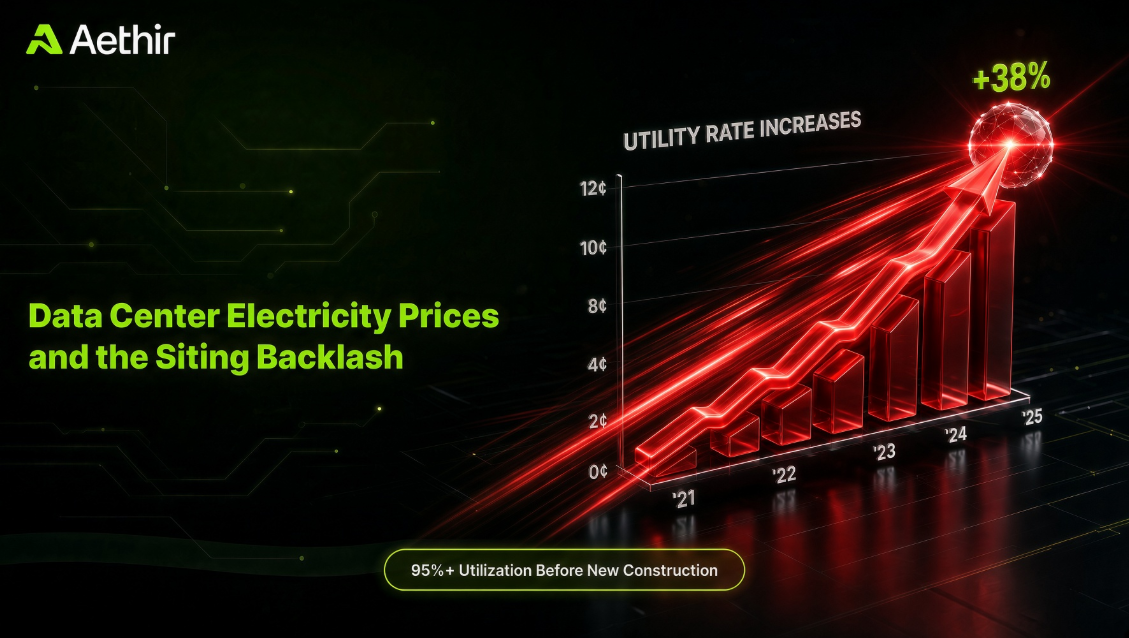
Utility bills are rising: Utilities sought a record $31 billion in rate increases in 2025, more than double the prior year, and residential rates have outpaced inflation since 2022.
The evidence of causes is mixed: Fact checks and academic work disagree on how much data centers have driven retail rate changes, and at least one study found that average US residential rates fell during a period of heavy construction. Anyone claiming certainty in either direction is ahead of the data.
Data center concentration: A single gigawatt campus is one visible load in one jurisdiction. Aethir’s decentralized GPU cloud spreads compute across hundreds of existing facilities, so no individual community absorbs a step change in local demand.
Instead of massive facilities, Aethir ACCELERATE plans to build mid-sized data centers, which are more viable and efficient than major hyperscaler campuses.
What Households Are Actually Paying
Reporting on the energy affordability crisis documents utilities requesting a record $31 billion in rate increases during 2025, more than twice the near-record set the year before, with residential prices outpacing inflation every year since 2022 and a federal analysis showing a 7.3% jump between April 2025 and April 2026.
Coverage of why utility bills keep rising is careful to spread the blame across aging infrastructure, extreme weather, natural gas prices, and new load. The same cost pressure shows up on the commercial side, where it continues to push GPU cloud pricing higher.
The $31 billion 2025 request total is the largest on record and roughly double that of 2024. Regulators now approve those cases before audiences paying close attention, which slows every proceeding.
Electricity prices have risen about 40% since 2001, and the recent acceleration is what turned electricity affordability into a hot topic. Data center electricity prices are rarely the largest driver, but they are the newest and the easiest to name.
The Evidence on Causes Is Mixed
A fact-check of claims linking data centers to rising electricity costs found the picture far more nuanced than either side tends to present, with effects that vary sharply by utility, tariff structure, and region.
There are some studies showing that data centers rates actually might not change retail electricity pricing, finding that average US residential rates fell over a decade of heavy construction, while public perception moved in the opposite direction.
Large loads can lower average rates: A big customer spreads fixed network costs across more kilowatt hours, which can reduce the per-unit share every other customer pays. That mechanism is real and is why several studies find a downward effect over the 2015 to 2024 period.
Large loads can also raise them: Where new demand requires transmission upgrades or expensive peaking generation, and where tariffs don’t fully assign those costs to the customer causing them, the balance falls on everyone else. Both effects are genuine, and which dominates depends on the locality.
Utility rate hikes arriving at the same time as a visible construction announcement create a causal story whether or not the accounting supports it. For anyone planning capacity, that perception is a scheduling risk regardless of what the studies eventually conclude.
Policy Moved Faster Than the Evidence
Regulation hasn’t waited for the economic metrics to settle. A federal ratepayer protection pledge arrived in March 2026, and reporting on the ratepayer protection bill advancing in the House describes bipartisan legislation that would require states to consider standards placing incremental costs on large technology customers rather than on households.
Debate over how to make data centers pick up the tab is now about mechanism. That adds to the capital already required to build AI-ready sites for current-generation hardware.
Special large-load tariffs, minimum take provisions, and cost-causation rules are all being rewritten in live proceedings. Ratepayer protection in practice means a large customer pays for the grid it makes necessary.
The New York data center moratorium on new hyperscale facilities is the first statewide measure of its kind and sets a template for other legislatures to follow. Hyperscaler data center siting has acquired a category of risk that did not exist two years ago.
Even where projects proceed, contested proceedings add months. Those months compound with grid and equipment lead times, and they raise AI compute costs for everyone waiting on capacity at the end of the process.
Compute Concentration Is the Main Problem
The objection is almost always to a specific very large load in a specific place. Consumer research on what AI data centers mean for local bills and resources is framed community by community, not industry-wide, and EIA tracking of data center server energy use shows that aggregate demand is driven by a small number of very large sites.
A single campus is legible, nameable, and locatable, which is exactly what makes it a target. A distributed compute footprint is none of those things.
Why Distribution Changes the Equation
No single community absorbs a step change: Aethir aggregates capacity from independent operators into more than 430,000 GPU containers across 94 countries and 200+ locations. A distributed compute footprint of that shape lands in small increments across many existing facilities rather than as one new gigawatt in one county, which is why it rarely attracts opposition at all.
Existing sites, existing connections: Aethir’s capacity comes from Cloud Hosts operating facilities they already run, with grid connections already in place and already reflected in local planning. Growth of that kind doesn’t trigger the hearings that greenfield hyperscaler data center siting does.
Utilization before construction: Running existing hardware harder is the least contentious way to add capacity, and network utilization above 95% against the 60% to 70% typical of centralized fleets means more inference served per installed megawatt. Capacity added this way needs no new local approval at all.
With the recent launch of Aethir ACCELERATE, we’ve entered the data center buildout sector and plan to launch mid-sized data center facilities purpose-built for high-density compute and rapid deployment, engineered to support NVIDIA B300 and GB300 clusters ranging from 64 to 256 nodes. These data centers are built for AI training and inference workloads, and designed to go from site selection to live capacity in months, not the multi-year timelines that define traditional data center construction.
What This Means for Compute Buyers
For anyone buying compute rather than building it, the practical question is whether the capacity you are counting on will exist when promised. Reporting on utilities trading flexibility for faster connection shows one path large projects are taking, and the IEA electricity outlook for 2026 makes clear how much investment the system needs either way.
Three Things to Check
Is your roadmap tied to an unbuilt site?
Capacity promised from a campus still in planning carries the full weight of data center community opposition and permitting risk.
How geographically concentrated is your provider?
A provider with a handful of very large sites has correlated exposure to moratoriums, tariff changes, and local politics. Aethir’s decentralized GPU cloud spreads that exposure across many jurisdictions by construction.
Are you paying for capacity or for optionality?
Long commitments against sites that may face contested approvals convert a schedule risk into a financial one, and AI compute costs agreed years ahead assume a delivery date nobody controls. On-demand access to already-installed capacity keeps the option open as new hardware generations arrive.
None of this makes data centers the villain of the electricity story, and the evidence genuinely doesn’t support that framing. What it does show is that very large, very visible, very concentrated new load has become slow and uncertain to permit, and that uncertainty lands on anyone whose plans depend on it.
Aethir delivers enterprise GPU compute on demand from more than 430,000 GPU containers across 94 countries and 200+ locations, drawing on existing facilities, with no long-term contracts, no minimum commitments, and no egress fees. With the launch of Aethir ACCELERATE, top-tier AI compute using B300s and GB300s will become even more easily to access for enterprises across the US and Europe.
Explore the Aethir enterprise GPU offering to see what is available without waiting on a hearing.
Frequently Asked Questions
Are data centers raising electricity prices for households?
The evidence is genuinely mixed and depends heavily on local tariff design. Large loads can spread fixed network costs across more kilowatt-hours and reduce per-unit rates. At least one study found average US residential rates fell between 2015 and 2024, while other analyses find upward pressure when new demand requires transmission upgrades or peaking generation that tariffs don’t fully assign to customers.
What is a data center moratorium?
A data center moratorium is a legislative or regulatory pause on approving new facilities, usually aimed at large hyperscale projects while rules on cost allocation and siting are worked out.
How does Aethir’s decentralized GPU cloud reduce siting risk?
Aethir’s decentralized GPU cloud adds capacity by using existing facilities rather than building new campuses, so incremental demand arrives in small amounts across many jurisdictions. Aethir spans more than 430,000 GPU containers across 94 countries and 200+ locations, spreading exposure to moratoriums, tariff changes, and local approvals rather than concentrating it in a handful of very large sites.