Key Takeaways
Hardware offerings are often quite similar: Every serious provider buys the same accelerators from the same supplier, on the same roadmap, and racks them in halls built to broadly the same spec.
Delivered performance is a software outcome: Two operators running identical silicon can deliver very different results depending on GPU scheduling, workload placement, and how fast a degraded node gets drained.
Placement and routing are becoming the pricing lever: Inference is latency-shaped and geographically sensitive in a way training never was, so multi-region routing turned into a factir that decides whether a workload is servable at all.
Aethir has been the GPU orchestration layer from the start: Aethir was an orchestration layer before it owned any capacity, which is why this argument reads as an observation about where the GPU-as-a-Service category is going.
GPU Commoditization Is Already Well Advanced
NVIDIA introduced the Rubin platform at the start of January 2026 and said Rubin-based products would reach partners in the second half of 2026, naming hyperscalers and neoclouds together.
Capacity is following the same pattern. Deloitte research on 2026 compute spending puts global AI data center capital expenditure at $400 billion to $450 billion this year, with inference now roughly two-thirds of all compute.
Also, allocation and power still gate the largest builds, but for the buyer of 64 to 256 nodes, the main question is what fraction of those nodes are usefully busy. GPU scheduling is what moves that number, and it improves without a hardware refresh.
Rack density, cooling loops, and network fabric now follow a small number of reference designs, so two facilities built a year apart look quite alike inside.
Additionally, a scheduler improvement earns its keep across every generation of accelerator that passes through the fleet. A hardware advantage stops earning the moment the next part ships, which under the current cadence is about a year.
What GPU Orchestration Actually Does
The clearest evidence that the orchestration layer is a key compute product is that the chip vendor keeps buying and open-sourcing it. NVIDIA donated its Dynamic Resource Allocation driver for GPUs to the Kubernetes community in March 2026 and put the KAI Scheduler into the CNCF as a sandbox project, alongside Grove for orchestrating clustered AI workloads. The announcement frames the problem as sharing accelerators effectively rather than acquiring more of them.
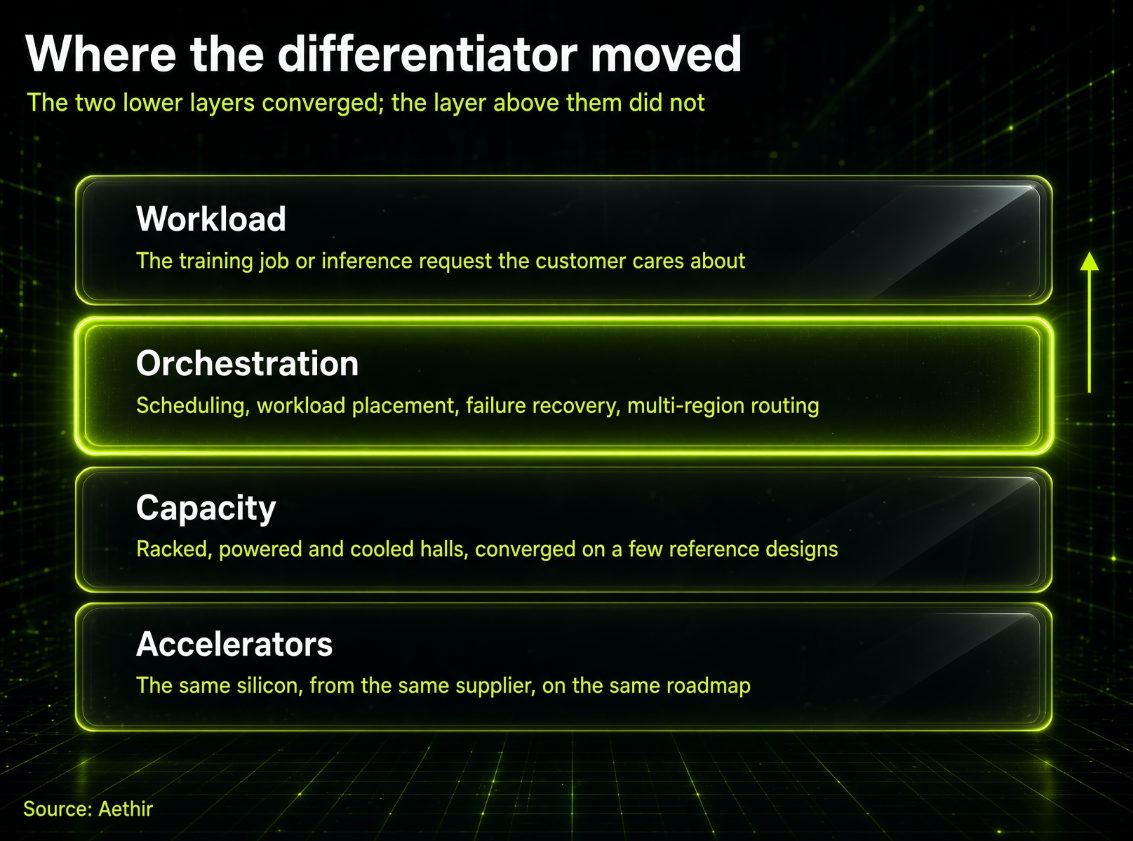
GPU orchestration is a critical part of the workload delivery pipeline. A distributed training job needs all its ranks at once, so a partial allocation holds hardware without doing work. Workload placement that packs jobs to topology instead of free slots is the difference between a busy fleet and an expensive one.
Small inference jobs scattered across a cluster leave gaps too narrow for the next large job. However, with adequate GPU orchestration that can defragment, live capacity recovers hours the buyer already paid for.
Whether a job lands next to its data, its checkpoint store, and its users changes throughput more than a modest difference in accelerator generation does. That’s how GPU orchestration workload placement is doing pricing work under a different name, and why efficient orchestration provides significant financial benefits to compute clients.
Multi-Region Routing Reaches Inference Placement
Training can tolerate being in one place, while inference can’t. Design analysis of training against inference facilities puts training campuses at 500 to 1,000 MW at full build against 20 to 100 MW for inference. It sorts latency into tiers of 50 to 200 ms regional, 20 to 50 ms metro, and under 20 ms at the edge. Inference placement is a geography problem.
The hardware is being designed around that split too. NVIDIA describes the GB300 NVL72 as purpose-built for test-time scaling inference rather than for training, which means the fleet mix a provider has to manage needs to include a variety of GPU models. Multi-region routing lets a job find the right node in that mix without the customer having to know it exists.
Where Neocloud Differentiation Goes Next
Moving a workload has to be cheap: If shifting a job between regions requires a new contract and a migration project, multi-region routing becomes a major advantage. Neocloud differentiation increasingly comes down to how quickly you can swap capacity without renegotiating anything.
The importance of GPU utilization rates. Most enterprise fleets run far below what their owners assume. Utilization is the single cleanest proxy for whether an orchestration layer works.
GPU fleet variety: A fleet with three accelerator generations is an inventory advantage for providers with efficient compute orchestration layers.
GPU Orchestration as an Essential Compute Product
Aethir already acts as a global orchestration layer for decentralized GPU compute. The network aggregates enterprise GPU capacity from independent operators, Cloud Hosts, into a single orchestrated pool spanning more than 430,000 GPU containers across 94 countries and 200+ locations, which means placement, routing, and failure handling were part of the product from day one. The decentralized part of the DePIN sector has been pushed toward revenue and fundamentals over the last two years, and orchestration is where that revenue is actually earned.
Also, Aethir is joining the physical infrastructure buildout sector through our Aethir ACCELERATE program, which adds data center sites across the US and Europe, up to 20 MW in total, targeting NVIDIA B300 and GB300 clusters of 64 to 256 nodes with Axe Build as a delivery partner. The program launch describes those sites entering the existing pool rather than forming a separate cloud.
The right accelerator for the job still matters, and so does having enough of it. What has changed is that buying the same parts as everybody else no longer distinguishes a provider.
Hence, the questions worth asking a vendor are about utilization, recovery time, and how quickly a workload can move. Neocloud differentiation is settling into the software layer, and Aethir’s decentralized GPU cloud, which has always lived there, is uniquely positioned to support AI innovation with essential compute orchestration services at scale.
Frequently Asked Questions
What is GPU orchestration?
GPU orchestration is the software layer that decides which accelerators a job runs on, in what order, and what happens when one of them fails. It covers scheduling, placement, health checking, draining and rescheduling, and multi-region routing. It’s the layer between a customer request and the hardware that eventually serves it.
How does workload placement affect AI compute costs?
Placement decides how much of the capacity you rent is actually doing work. Poorly packed jobs leave fragments too small for the next request, distributed jobs stall waiting for all their ranks, and locality problems cost throughput that never shows up on a rate card. Workload placement can move delivered cost per unit of work more than a difference in hourly price.
Why does multi-region routing matter for inference placement?
Inference has latency budgets that a single region often can’t meet, with tiers running from 50 to 200 ms regionally down to under 20 ms at the edge. Multi-region routing lets a request be served from wherever it can be served within budget, and it lets a provider fill capacity that would otherwise sit idle in the wrong time zone.
Disclosure
Aethir Foundation is Axe Compute's largest shareholder, through its 2025 treasury transaction. We cover Axe as an interested holder. This article reflects Aethir's views and is not investment advice. For official company information, see Axe Compute's SEC filings (CIK 0001446159) and investors.axecompute.com.
Nothing in this article should be relied upon as a guarantee of future performance or results.