Key Takeaways
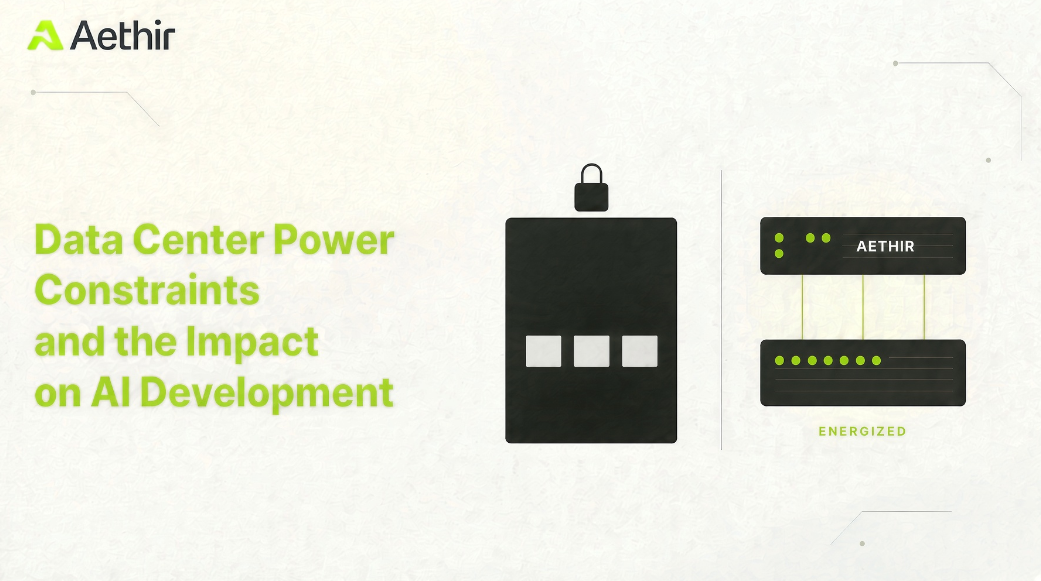
Power Is the New Constraint: The data center power constraint replaced silicon as the binding limit on AI compute capacity in 2026. Buyers who still plan procurement around chip allocation are solving last year’s problem, because megawatts now arrive later than accelerators.
The Queue Runs for Years: More than 2,060 GW sits in US interconnection queues, and the median project built in 2025 waited over five years from request to operation.
Announced Compute Isn’t Available: As much as half of the global data center capacity due online in 2026 could slip on permitting and grid connection.
Energized Sites Beat New Builds: Distributed GPU capacity assembled from sites that already have power availability doesn’t file an interconnection application.
Placement Is a Power Decision: AI workload placement now follows power procurement rather than the other way around. Inference in particular can be routed to wherever capacity is already live, which turns a grid problem into a routing problem.
Why the Data Center Power Constraint Replaced the Chip Shortage
Through 2024 and 2025, every AI team asked whether they could get accelerators. In 2026, the question is whether anyone can energize them. The spending curve makes the scale plain: Gartner puts AI-optimized IaaS at $42.276 billion for 2026, nearly double the prior year. Independent work on the $5.2 trillion cost of compute puts a capital figure on the same demand. Neither number clears without electricity, which is why the data center power constraint now stands between a signed hardware order and a running cluster, and why GPU cloud pricing keeps rising even as die output stabilizes.
AI data center power demand is projected to reach roughly 156 GW by 2030, with about 125 GW of that added from a 2025 base. Utilities can’t add generation and transmission on that curve, so AI compute capacity ends up rationed by the grid.
Furthermore, chip supply loosened through 2026 while transformers, substations and switchgear tightened. A data center power constraint is harder to unwind than a chip shortage, because the lead times sit with utilities and regulators instead of a single manufacturer.
Teams experience the data center power constraint as a quote with a 2027 delivery date, which is the moment AI data center power stops being an energy story and becomes a roadmap milestone.
How the Grid Interconnection Queue Stalls New Capacity
Every new AI campus has to ask its regional grid operator for a connection, and that request joins a line. Berkeley Lab counts more than 2,060 GW waiting in US interconnection queues across roughly 8,200 active projects. The median project that reached commercial operation in 2025 spent over five years getting there, and only 13% of the capacity that entered queues between 2000 and 2020 ever came online.
Power procurement now starts years ahead of any rack, because securing megawatts takes longer than securing hardware. Operators who lock power early can announce capacity long before it exists, a distinction which Aethir’s compute buyer guide treats as a procurement question.
You can pay more for GPUs and get them sooner. However, power procurement doesn’t work that way, because the grid interconnection queue is administrative, sequential, and largely indifferent to how much budget sits behind the request.
The AI Infrastructure Bottleneck Buyers Actually Feel
The AI infrastructure bottleneck shows up as a quota you can’t raise, a region with no stock, and a start date that keeps moving further away. With worldwide AI spending running at $2.52 trillion in 2026, demand is arriving faster than any construction pipeline can answer, and the shortfall lands on the buyer as waiting. It’s the same structural issue behind the hidden cost problem in AI compute: the price you see isn’t the price of the delay.
Where GPU Cloud Capacity Runs Into Power Availability
Regional Stockouts: GPU cloud capacity is advertised globally and delivered regionally. When power availability in one region is tight, that region simply has nothing to sell, and a workload with a residency requirement has nowhere to fall back to.
Reservations Hide the Gap: Long reservations exist partly to ration scarce GPU cloud capacity. They shift the AI infrastructure bottleneck onto the customer, who pays for a peak-sized commitment just to guarantee access to capacity that’s constrained upstream.
Uneven Grid Headroom: Reporting on grid flexibility and distributed inference notes that US grid operators use only about 53% of generation capacity on average. Power availability isn’t uniformly scarce, it’s unevenly distributed, and the headroom mostly isn’t where new campuses are being built.
How Distributed GPU Capacity Sidesteps the Queue
Distributed GPU capacity assembles compute from sites that are already energized and already connected, so no substation gets built and no application gets filed. Analysis of expanding data center capacity to meet demand frames the same trade-off from the utility side, where the fastest megawatt is the one that already exists. Aethir runs that model at scale, and the decentralized GPU advantage for inference shows most clearly there.
Aethir and AI Compute Capacity Across 94 Countries
Aethir coordinates 430,000 GPU containers across more than 200 locations in 94 countries, and has delivered 2+ billion compute hours to enterprise clients. That’s AI compute capacity measured by what has been served.
Adding distributed GPU capacity means onboarding operators who already hold power, cooling, and connectivity. The network grows on a procurement timeline instead of a construction timeline, which is exactly why it doesn’t inherit the grid interconnection queue.
Furthermore, with Aethir ACCELERATE, we are building 10 small to mid-sized data centers across the US and Europe, based on actual market demand, not assumptions. The data centers target already existing demand, instead of idling and consuming energy while doing so.
Frontier-class AI compute capacity that’s already energized beats frontier-class capacity that’s still being permitted, and an independent review of the Aethir network by Anyone Protocol walks through how that access works in practice.
Planning AI Workload Placement Around Power
Once power is the constraint, AI workload placement becomes a sourcing decision. Training wants one tightly coupled site, while inference doesn’t, and that difference decides where each workload can live. Coverage of the $500 billion AI infrastructure financing push shows how much capital is chasing the build-side answer, while work on the race to power AI explains why the build side stays slow. Buyers don’t have to wait for either one.
Power is the constraint that decides how fast AI plans actually run in 2026, and it’s the one buyers have least control over. Aethir’s distributed GPU capacity changes that by sourcing compute from sites that are already energized. Teams get AI compute capacity in days instead of quarters, in the jurisdictions they need, without carrying construction risk that belongs to somebody else.
Frequently Asked Questions
What is the data center power constraint in 2026?
It’s the point where electricity, not silicon, limits how much AI compute can actually run. Chip output has largely stabilized, but grid connections, transformers, and substations haven’t, so the data center power constraint now sets the pace for new AI capacity.
How long is the grid interconnection queue for a new data center?
Berkeley Lab found that the median project reaching commercial operation in 2025 waited more than five years from its interconnection request. More than 2,060 GW sits in the grid interconnection queue today, and historically only about 13% of queued capacity ever gets built.
Does AI data center power demand keep rising?
Yes. AI-related data center capacity demand is projected at roughly 156 GW by 2030, with around 125 GW of that added after 2025. AI data center power demand is growing faster than utilities can add generation and transmission to serve it.
How does Aethir’s distributed GPU capacity avoid new construction?
Aethir’s distributed GPU capacity is aggregated from data centers that are already built, connected, and energized. Because no new substation is required, adding capacity doesn’t enter an interconnection queue and doesn’t wait on a construction cycle to become useful.