Key Takeaways
Go-live is the start of the meter: A facility that powers up has spent its capital and earned nothing yet. The GPU cluster ramp between that moment and steady utilization is where the economics are settled.
Break-even utilization is higher than most operators assume: A fully costed cluster breaks even somewhere between 55% and 65% once you account for three-year depreciation.
Stranded GPU time is paid for either way: Depreciation runs from the day hardware arrives, and enterprise Kubernetes clusters average 5% GPU utilization, while Aethir’s GPU network runs at a constant 95%+ utilization rate.
Capacity with demand: The ramp is shortest when workloads wait at go-live with demand already present. That sequencing decision is made long before commissioning, and Aethir ACCELERATE plans to build out data centers exclusively when demand is present, instead of searching for clients after the buildout is finished.
The Go-Live Date and the GPU Cluster Ramp
A GPU cluster goes live, and the press release says capacity is online. However, depreciation starts when the hardware lands, and revenue starts when a customer job runs, while the gap between those two dates is the whole argument. Clifford Chance notes that value in a GPU infrastructure deal is carried by contracted revenue more than by residual hardware value.
Capacity absorption is the rate at which live capacity fills with paying work. It gets almost no coverage compared to construction milestones. Deloitte puts global AI capex for 2026 at $400 billion to $450 billion, rising toward $1 trillion by 2028.
Hardware, fit-out, and power contracts are all paid for on a schedule that ignores utilization. Once the building is finished, the ramp is the only variable left.
On the other hand, capacity built against existing demand begins its ramp with work waiting. That’s the advantage of Aethir ACCELERATE, our program to build mid-sized data centers in the US and Europe, tied to already existing compute demand. This means data centers won’t be built until demand is secured upfront.
The GPU Utilization Ramp Runs Through Several Stages
GPU racks are received and staged, anchored, connected to cooling and power, and every link is certified before a single benchmark runs.
Then the cluster has to prove it works under load. NVIDIA requires a 24-hour soak under representative inference load at a sustained power cap before a provider serves production traffic, along with NCCL throughput benchmarks, per-link RDMA testing, NVLink validation, and hardware attestation. Any GPU that fails to hold performance through burn-in testing gets replaced, which restarts part of the sequence.
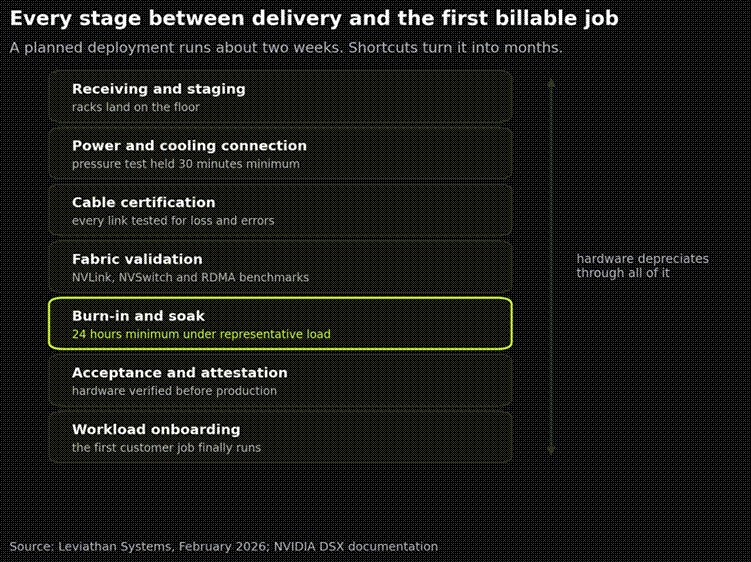
The image above is the part of a buildout nobody photographs. Aethir has written about the front half of this timeline, in its piece on beating 2026 AI capacity delays, where permitting and grid connections dominate the schedule.
A cluster that skips validation ships its faults to the first customer instead. Fixing them in production costs more than the two weeks it would have taken to find them.
Getting a customer job running means storage paths, networking, quotas, images, and scheduling policy. The cluster is technically live for all of it and billing for none of it.
Break-Even Utilization Sets the Ramp Target
The ramp has a number it needs to reach, and it is higher than operators tend to assume. A fully costed analysis puts break-even utilization for a node at 55% to 65% on 8x H100, once you account for three-year depreciation of roughly $7,000 to $10,000 a month. Below that line, the cluster is running and losing money.
Aethir traced what happens when financing assumes a faster fill than the market delivers, in our analysis of neocloud debt and collateral value.
Every month below the line compounds: A cluster that takes nine months to reach break-even has spent nine months of depreciation against partial revenue. That gap never gets recovered later in the asset life.
Contracted work shortens the curve: Capacity sold before it exists starts near its target instead of climbing toward it. That is the difference between a ramp and a launch.
Stranded GPU Time Is the Hidden Cost
Stranded GPU time is capacity that exists, draws power, and earns nothing, which makes it the most expensive idle asset in AI infrastructure and a remarkably common one. Cast AI measured average GPU utilization near 5% across enterprise Kubernetes clusters in 2026, with CPU at 8% and memory around 20%.
The gap between average and achievable is enormous. Data Center Knowledge reports the Meta Research SuperCluster running at 83% to 85% GPU utilization, and Salesforce lifting a fleet from 48% toward full use. At the same time, other organizations lock up capacity they aren’t using because scarcity is the expectation. Overprovisioning, weak scheduling, and storage that can’t feed the GPUs account for most of the difference.
The hardware keeps losing value the whole time, which is a point we made in detail in our work on what a used GPU is worth. Depreciation doesn't care whether a chip is busy.
Power, cooling, space, and the depreciation schedule all run whether or not a job is scheduled. Utilization is the only lever that changes the return, and it moves AI compute costs further than any hardware choice.
Teams that expect to lose access hold capacity they don’t need, which strands it twice over.
How Aethir ACCELERATE Shortens Capacity Absorption
Aethir ACCELERATE plans to bring GPU compute online in facilities purpose-built for high-density compute, engineered for NVIDIA B300 and GB300 clusters serving AI training and inference workloads. The relevant design decision for a ramp is upstream of the building: capacity is built against demand the network already sees.
The months after commissioning decide whether a GPU cluster ever earns what it cost. A facility that reaches its target in three months and one that takes twelve look identical in a launch announcement and nothing alike on a balance sheet.
Aethir ACCELERATE is built around the sequencing that shortens capacity absorption, with demand established before the capacity is. For anyone reading operator results this autumn, the ramp is the number worth asking about.
Frequently Asked Questions
What is a GPU cluster ramp?
The GPU cluster ramp is the period between a cluster going live and reaching steady, paying utilization. It covers acceptance testing, burn-in, workload onboarding, and customer migration. The hardware depreciates through all of it while earning little or nothing.
How long does burn-in testing take on a new GPU cluster?
NVIDIA requires a minimum 24-hour soak under representative inference load at a sustained power cap before a provider serves production traffic. That sits inside a wider planned deployment of roughly two weeks, which stretches to months of remediation when validation steps get skipped.
What does stranded GPU time cost an operator?
Stranded GPU time costs the full running cost plus depreciation, with no revenue against it. With enterprise Kubernetes clusters averaging around 5% GPU utilization while well-run fleets clear 80%, the gap between the two is what a slow ramp leaves on the floor.
How does Aethir ACCELERATE affect capacity absorption?
ACCELERATE plans to build capacity against demand the network already sees rather than finding customers after commissioning. That sequencing shortens capacity absorption. Workloads wait when capacity arrives rather than being sought afterward.