Key Takeaways
Aethir expands its AI inference offering: Aethir Mesh is how Aethir now sells AI inference directly. It went live on 3 June 2026 with one endpoint and one key, and now serves 40 open-source models to paying clients. Mesh expands Aethir’s AI inference offering, letting developers use hosted models through a simple API.
Inference revenue at scale: Aethir Mesh has processed $6M+ in revenue and over 29T tokens since its June launch, across a broad range of AI models.
Aethir runs most of the compute: Mesh is an open-weight model API whose inference runs mostly on Aethir GPUs. That makes Aethir an AI inference provider running real requests on its own network, with no reseller in between.
Revenue from real usage: Clients pay for tokens with credits, so Mesh revenue represents real AI inference demand rather than incentives, and anyone can track it on our GPU dashboard.
Built for the inference era: Agentic AI workflows burn far more tokens than chatbots. Mesh gives them an AI inference API with failover, request logs, and per-key limits, served from Aethir’s decentralized GPU cloud. For developers, AI teams, and enterprises, Mesh is the entry point to AI inference on Aethir.
What Aethir Mesh Is and How It Powers AI Inference
Aethir launched the Aethir Mesh API in June as its dedicated AI inference product: a practical way for AI teams to run leading open-weight models without managing GPUs. Developers buy credits, create a key, and call models from DeepSeek, Kimi, GLM, MiniMax, and Qwen through one endpoint. That open-source model inference runs mostly on Aethir GPUs.
Most model gateways work differently. OpenRouter forwards requests to 400+ models hosted by other providers and keeps about 5% of the spend that passes through. Mesh runs most of the work on hardware Aethir operates, so no reseller layer sits between the client and the GPUs. Aethir sells the inference itself, served from compute it operates.
Anyone can now monitor the tokens and revenue Aethir Mesh has processed on the Aethir GPU Dashboard here.
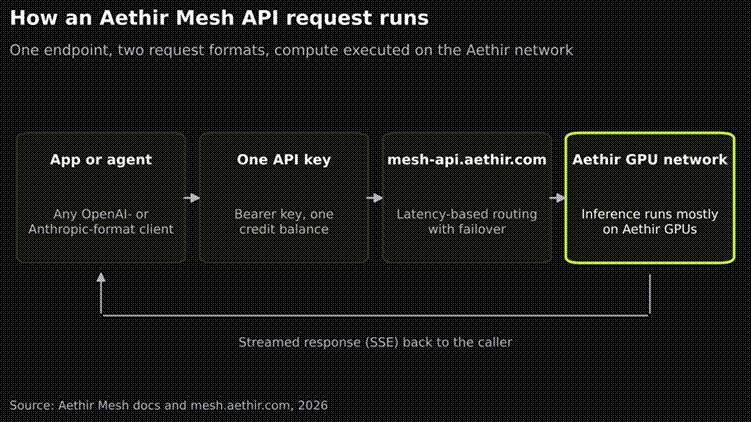
Inside an OpenAI-Compatible API Call on Mesh
One key, two formats: Mesh accepts the OpenAI Chat Completions format and the Anthropic Messages format, as the Aethir Mesh documentation lays out. Teams that are already operating on an OpenAI-compatible API usually swap the base URL and the key, then keep their request code as it is.
Credit & Tokens Mechanism: Clients top up a single credit balance, and each call draws it down based on the model and token count. One balance covers every model in the catalog.
Streaming by default: Responses come back as server-sent events, and the docs recommend streaming on every call. That suits large models like DeepSeek V4, with its 1M-token context, where long answers take time to finish.
Open-Weight Model API Features Built for Production Inference
The Aethir Mesh open-weight model API now lists 40 models, up from 11 at launch. That range matters because 31% of enterprises in a VB Pulse survey already send routine, high-volume agent tasks to cheaper models. A team can match each job to a model without opening five provider accounts. Five model families, one key.
The production layer around those models is what turns a model catalog into an inference service enterprises can run at scale.
DeepSeek V4 API Access Next to Kimi, GLM, MiniMax, and Qwen
The catalog includes models such as DeepSeek V4 Pro and Flash, Kimi K2.6, GLM-5.1, MiniMax-M2.5, and Qwen3.6, all on one key, along with numerous additional variants, for a total of 40 models. A DeepSeek V4 API call and a Qwen call differ only in the model field, so switching costs nothing in code.
Mesh routes each request based on real-time latency and automatically fails over when a node drops. Long agent jobs keep running when one machine goes offline.
Every request is logged with latency, tokens, cost, and model. Agents need that view, since they use 5x to 30x more tokens than a chatbot for the same task.
Keys carry granular permissions and their own rate limits, with audit logs behind them. Clients pay by card, USDT, or USDC, and the open-weights case explains why portable models reduce lock-in.
AI Inference Revenue: $6M+ and 29T Tokens Processed
Since its June launch, Aethir Mesh has processed $6M+ in revenue and over 29T tokens for a base of paying clients. Those numbers show Aethir already operating as an AI inference business, with all of it tied to tokens that clients actually ran.
That lines up with where DePIN is heading. Messari counted $72 million in DePIN on-chain revenue for 2025, and analysts now judge networks on whether someone pays for the service. Mesh passes that test, because every token it serves is bought with credits and the compute behind it runs mostly on Aethir’s decentralized GPU cloud.
Clients pay per token, so revenue tracks how much open-source model inference they actually run. An OpenAI-compatible API lowers the cost of trying Mesh, while price, uptime, and model choice decide whether a client stays. The same key works across models, so testing a second one doesn’t require a new account.
Why Aethir Is Building for AI Inference and Agentic AI Workflows
Inference is where AI cloud budgets now go. Gartner expects inference to take 55% of AI-optimized IaaS spending in 2026.
Agents push that share higher. Gartner also predicts inference costs per agentic workflow will rise more than fivefold through 2028. The Aethir network already runs 430,000 GPU containers across 200+ locations in 94 countries, and the shift in inference spending is why Aethir is putting inference at the center of its GPU cloud, with Mesh leading that push.
Mesh as an Inference Provider for AI Agents
Multi-step agent loops: Agentic AI workflows chain planning, tool calls, checks, and each step is another inference call. Kimi K2.6, built to coordinate up to 300 sub-agents, is one of the models Mesh serves for that work.
One AI inference API, many models: An agent can plan on DeepSeek V4 Pro and hand cheap sub-tasks to a small Qwen model through the same AI inference API.
The GPU cloud underneath: Mesh runs mostly on Aethir’s decentralized GPU cloud, the same network that serves enterprise AI workloads. As inference demand grows, Mesh draws on capacity Aethir already operates, so Aethir can scale its inference business on its own network.
Five months after launch, Aethir Mesh has processed $6M+ in revenue and over 29T tokens, with an inference stack that runs mostly on Aethir GPUs. Teams building agentic AI workflows get one key to 40 models, with routing, failover, and per-request cost. For Aethir, Mesh marks a clear expansion of AI inference services, built on the same decentralized GPU cloud that already serves enterprise AI workloads.
Developer teams can start from the Aethir Mesh console.
FAQ
What is Aethir Mesh?
The Aethir Mesh API is a single endpoint that serves 40 models from DeepSeek, Kimi, GLM, MiniMax, and Qwen with one key and one credit balance. Inference runs mostly on Aethir GPUs. It’s the AI inference service of the Aethir GPU cloud, built for developers, AI teams, and enterprises.
Which models does the Aethir Mesh open-weight model API serve?
The open-weight model API serves 40 models, including DeepSeek V4 Pro and Flash, Kimi K2.6, GLM-5.1, MiniMax-M2.5, several Qwen versions, and many other model variants.
How is an AI inference API like Mesh different from a model router?
A router forwards requests to models hosted by other companies and takes a cut of the spend. Mesh is an AI inference API that runs open-source model inference mostly on Aethir GPUs, with no reseller layer in between. That gives Aethir direct control over routing, failover, and capacity.
Why is Aethir moving into AI inference?
Inference is where AI compute spend is heading: Gartner expects it to take 55% of AI-optimized IaaS spending in 2026. Aethir already runs 430,000 GPU containers across 94 countries, so serving inference directly through Mesh puts that capacity to work on the fastest-growing part of the market.