Key Takeaways
Inference Now Leads AI Cloud Spending: Gartner expects $23.3 billion of 2026 AI-optimized IaaS spending to go to inference, against $19 billion for training. Picking the best GPU cloud for AI inference is now the bigger buying decision.
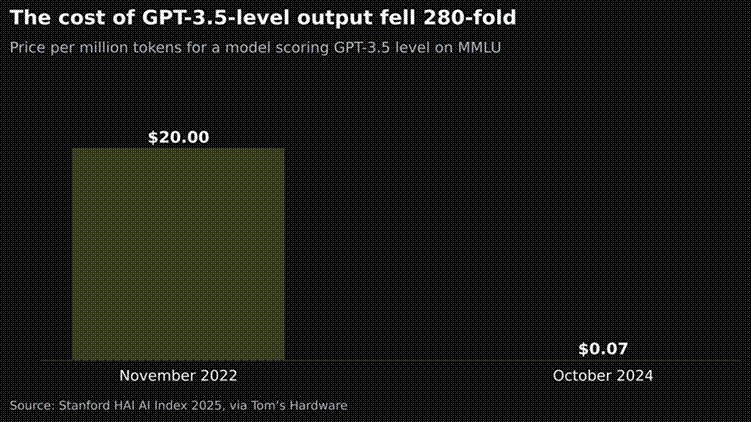
Cost per Token Keeps Falling: The cost of GPT-3.5-level output fell from $20 to $0.07 per million tokens in about 18 months, per the Stanford AI Index. Cheaper tokens drive more usage, so total inference costs still climb.
Latency Depends on Location: Inference latency depends partly on the distance between users and GPUs. GPU cloud providers with capacity in many regions can serve nearby users.
Aethir Covers Three Buying Models: Aethir Mesh sells open-source models by the token, the Aethir network rents capacity for bare-metal inference, and Aethir ACCELERATE plans to build dedicated clusters of B300 GPUs.
Why Picking the Best GPU Cloud for AI Inference Got Harder
Inference has overtaken training as the larger AI cloud workload. Gartner forecasts $23.3 billion in 2026 inference spending on AI-optimized IaaS, against $19 billion for training. Deloitte expects inference to take about two-thirds of AI compute this year.
More choice came with that growth. Buyers can rent raw GPUs, call a model API, reserve dedicated endpoints, or sign for a full cluster, and each option prices inference differently. Aethir traced the shift in its analysis of AI inference spending surpassing training.
Inference Costs Keep Falling Per Token
Cheaper Tokens: The Stanford AI Index found the cost of GPT-3.5-level output fell from $20 to $0.07 per million tokens between November 2022 and October 2024, as Tom’s Hardware reported. That’s a drop of more than 280-fold.
Higher Volumes: Volume rises. Cheaper tokens lead to more calls, longer prompts, and agents that loop through many steps, which is why Gartner expects inference costs per agentic workflow to rise more than fivefold through 2028.
Cost per Token as the Metric: Cost per token rolls hardware, utilization, and software into one number. It’s the fairest way to compare a per-token API price with the hourly bill for a GPU a team runs itself.
Inference Latency and Where GPU Cloud Providers Sit
Inference latency starts with physics. Every request travels from the user to a GPU and back, so distance adds delay before the model even runs. McKinsey expects inference to make up more than half of all AI compute by 2030, with more shifting to the edge to cut latency and bandwidth.
That favors GPU cloud providers with capacity spread across many regions. The Aethir network runs 430,000+ GPU containers in 94 countries, which lets a model sit closer to the people calling it.
Serverless Inference vs Dedicated Capacity
Serverless Inference: Serverless inference scales to zero and bills per request or per token. It suits spiky traffic and teams that don’t want to run servers.
Dedicated Capacity: Dedicated GPUs keep models warm and latency steady. Most production teams run them on Kubernetes, and the CNCF annual survey found 66% of organizations hosting generative AI models use it for inference.
Cold Starts: Large models take time to load onto a GPU. Serverless inference can add seconds to the first request, which hurts chat and agent workloads.
Matching Inference Costs to the Right GPU
Model size sets the hardware floor. A long-context model needs memory for its weights and the key-value cache, which grows with every token. Each Blackwell Ultra GPU carries 288 GB of HBM3e so a single B300 GPU can hold larger open-source models with long contexts.
B300 GPUs for Long-Context Open-Source Models
Memory First: B300 GPUs suit open-source models with large parameter counts and long contexts. More memory per GPU means fewer GPUs per model replica.
H100 and H200 for Smaller Models: H100 and H200 GPUs stay cost-effective for models that fit in 80 GB or 141 GB. Many inference fleets mix generations.
Utilization Drives Cost: An idle GPU still bills by the hour. Batching requests and sharing GPUs across models lower inference costs more than a small rate cut does.
How Aethir Mesh and Aethir’s Bare-Metal Inference Fit
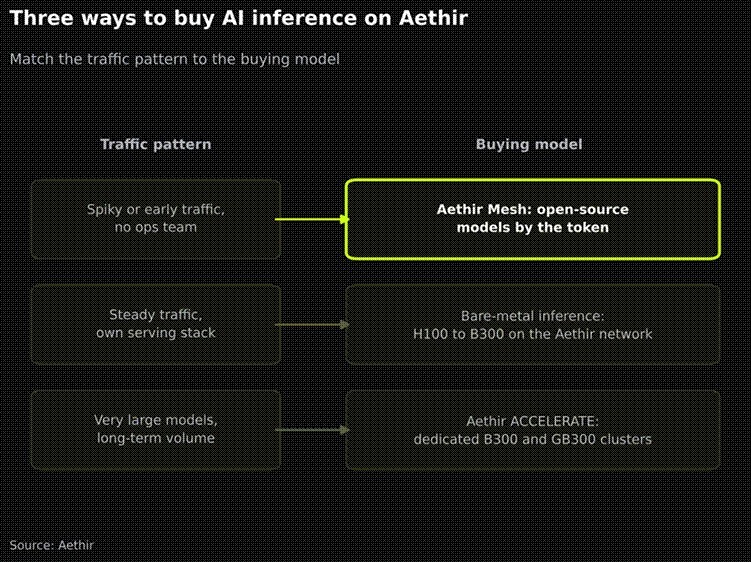
Aethir sells inference three ways. Aethir Mesh offers one OpenAI-compatible API key for 40 open-source models from the DeepSeek, Kimi, GLM, MiniMax, and Qwen families, running mostly on Aethir GPUs with latency-based routing and automatic failover.
For steady volume, bare-metal inference on the Aethir network gives a team its own H100 to B300 GPUs with no egress fees, on managed Kubernetes.
Aethir ACCELERATE plans to build dedicated B300 and GB300 clusters for the largest workloads. Each GB300 NVL72 rack links 72 Blackwell Ultra GPUs in one NVLink domain.
Comparing GPU Cloud Providers on Cost per Token
Normalize to Tokens: Divide the hourly GPU rate by the tokens a GPU produces per hour at the target latency. That puts an API price and a rented GPU on the same scale.
Check List Rates: List prices for the same GPU vary widely across GPU cloud providers. CoreWeave lists an 8-GPU HGX H100 node at $49.24 an hour, about $6.16 per GPU.
Start Small, Then Commit: Many teams start on an API such as Aethir Mesh and move to bare-metal inference once traffic settles. The same open-source models run on both.
The best GPU cloud for AI inference hits a latency target at the lowest cost per token for a given traffic pattern. Serverless inference suits spiky demand, bare-metal inference suits steady volume, and dedicated clusters suit the largest models.
Aethir Mesh, the Aethir network, and Aethir ACCELERATE cover all three on one GPU network.
FAQ
What is the best GPU cloud for AI inference in 2026?
It depends on traffic, latency targets, and model size. Spiky workloads fit a serverless inference API, steady workloads fit dedicated GPUs, and very large models fit a dedicated cluster. Aethir provides all three types of AI inference services.
Does inference latency depend on GPU location?
Yes. Each request travels from the user to the GPU and back, so nearby capacity cuts round-trip time, and networks with GPUs in many regions can place models closer to users.
When should a team use serverless inference?
Serverless inference fits spiky or early-stage traffic and teams without an operations function. Once traffic is steady, dedicated or bare-metal inference can cost less per token.