Key Takeaways
Dashboard is live: The ATH burn dashboard is live along with the first daily burns. The Aethir tokenomics update runs in public, one burn a day.
Burns follow real activity: Each ATH token burn is funded by a share of the network fees customers pay when they book compute. The published formula reads the prior 730 hours of revenue and a 30-day ATH TWAP, so busier months burn more.
Cloud Hosts stay protected: The floating network fee can never exceed the value of Cloud Host rewards. Emissions don’t change. Above the cap, hosts keep the full upside.
Every completed burn is publicly verifiable: Burned ATH lands at a public burn address. The dashboard shows daily, monthly, and cumulative totals, plus the full burn transaction history so that anyone can check each one on-chain.
The ATH Burn Dashboard Is Live
The ATH burn dashboard is live at this link: https://dashboard.aethir.com/protocol/onchain-metric
Burns are conducted on the Arbitrum network. This is the burn contract: https://arbiscan.io/address/0xf8ec8e8ecdbfbba4d073090152dfc6559c7ef531
This moves the Aethir tokenomics update, first set out on 21 October, from announcement to operation.
Burns are live on a published schedule: ATH is burned on a published schedule. A formula sets each size.
A floating fee replaces the fixed one: The fixed platform fee is retired, and the floating network fee now funds the burn while it moves with market conditions.
An audited mechanism: CertiK audited the ATH burn mechanism before launch. Aethir contract reviews, including a service fee burner, are listed on the CertiK Skynet page for Aethir. Max supply stays at 42 billion ATH.
How Each Daily ATH Token Burn Is Funded
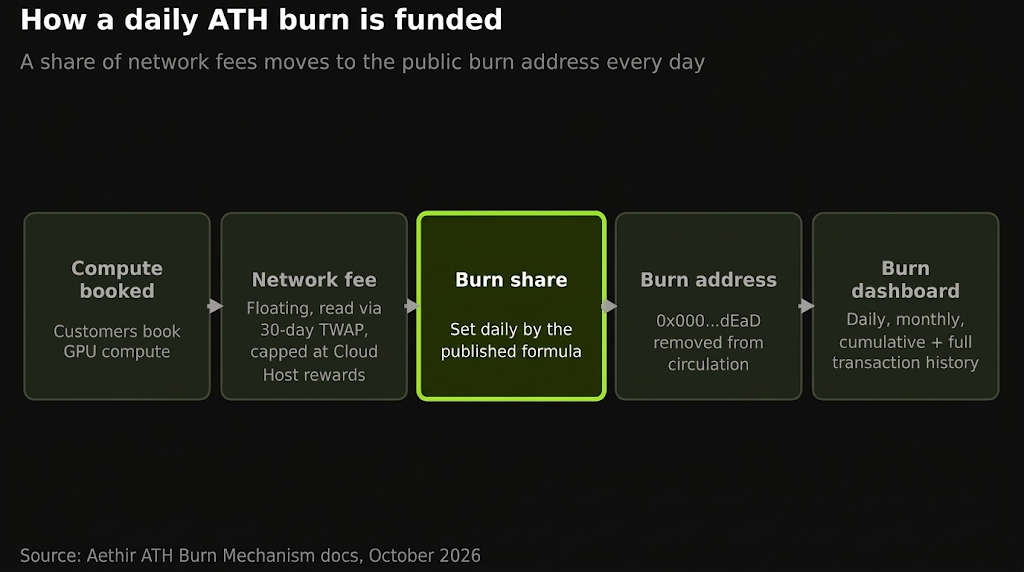
Every ATH token burn starts with compute that customers have booked and paid for. A share of the network fees from those bookings goes to the burn, as set out in the ATH Burn Mechanism docs.
Cumulatively, 4,364,413 ATH has been burned so far, with 629,516 ATH in the last 24 hours, and everyone can now check it. We've done daily burns, and those burns offset 18.48% of total emissions over the past week and support the long-term stability of the ATH network.
The Floating Network Fee Is Capped at Cloud Host Rewards
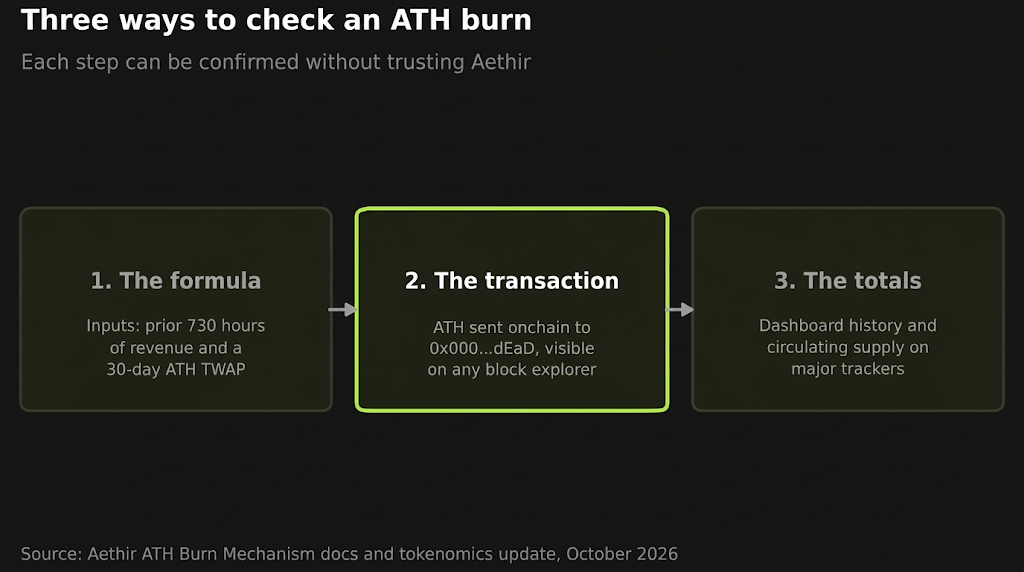
Two formula inputs: The daily amount comes from a published formula with two inputs: the prior 730 hours of network revenue and the ATH price, read through a 30-day time-weighted average price. Averaging over a month stops one volatile day from setting the burn. All these burns contribute to 25% of protocol fees being burned.
Weaker market, bigger burn share: When the market weakens, the floating network fee falls and the share of that fee that’s burned rises. The fee has no floor. In weak conditions, it can reach zero.
A hard ceiling for Cloud Hosts: The floating network fee can never exceed the value of Cloud Host rewards, and that ceiling is written into the formula. Host ATH emissions follow the same schedule as before, and Cloud Hosts earn ATH the same way.
The ATH Burn Mechanism Is Publicly Verifiable
Every completed burn is publicly verifiable. The ATH burn mechanism was built around that principle, and it follows the same rule Aethir uses for reading an AI capacity announcement: check the record, not the claim.
Each burn is a standard on-chain transfer.
Check the Public Burn Address and Burn Transaction History
Burned ATH goes to 0x000000000000000000000000000000000000dEaD, an address nobody holds a key for.
The dashboard lists every burn with daily, monthly, and cumulative totals. The full burn transaction history is visible, so every total traces back to its transactions.
The formula and its inputs are public, so anyone can recompute a day and compare it with the on-chain burn. That record sits beside the existing Aethir protocol dashboard for network activity.
Burns Reported Against Protocol Fees & ATH Emissions
Each reporting period, the ATH burn dashboard gives two ratios: the share of ATH emissions that burns offset, and the share of protocol fees that went to burns.
Where Cloud Host Rewards and New Sites Fit
Burns offset a percentage of ATH emissions daily. That’s the clearest read on net new supply. ATH emissions to Cloud Hosts keep running on the unchanged schedule.
Burns consume a percentage of protocol fees daily. Protocol fees are the network fees customers pay to book compute, so the ratio shows what percentage of earned revenue became a burn.
Compute revenue from each of the planned new Aethir ACCELERATE sites will run through the same fee and burn mechanism once it goes live. More booked compute feeds the same formula, and Cloud Host rewards stay protected by the same cap.
The burn dashboard makes the Aethir tokenomics update something anyone can check day by day. Burns follow booked compute, Cloud Host rewards stay protected by a hard cap, and contract max supply stays 42 billion ATH.
Track every burn, and the transaction behind it, at: https://dashboard.aethir.com/protocol/onchain-metric
For more details on ATH burn mechanics, refer to our official docs.
FAQ
When does the ATH burn dashboard go live?
The ATH burn dashboard is live, along with the first daily burns. The dashboard shows daily, monthly, and cumulative ATH burned, with the full transaction history.
How is the ATH token burn amount set?
A published formula determines each ATH token burn amount. Its inputs are the prior 730 hours of network revenue and the ATH price read through a 30-day TWAP, so the burn tracks what the network actually earns.
Can the floating network fee fall to zero?
Yes. The floating network fee has no minimum and can fall to zero in weak markets, while its ceiling is the value of Cloud Host rewards. When the market weakens, the fee falls, and the share burned rises.
Where can I see the burn transaction history?
The full burn transaction history is on the burn dashboard. Every burn also lands at the public burn address 0x000000000000000000000000000000000000dEaD so that you can confirm each transaction on the Arbiscan block explorer.