Key Takeaways
Daily ATH Burns, Live From November 2026: Aethir will be burning ATH every day, drawn from network fees. The burn model goes live in November 2026, and burns will run daily from then on.
Burns Follow Real Activity: The size of each daily ATH burn tracks what the network actually earns.
A Floating Network Fee: A floating network fee replaces the fixed platform fee, set by a published formula that reads market conditions, using a time-weighted average price (TWAP). When the market weakens, the fee falls, and the burn share rises.
Cloud Hosts Are Protected by Design: The underlying Cloud Host emissions schedule remains unchanged. The update changes the fee mechanism applied around those protected rewards.
Verifiable by Everyone: A public burn address and a burn dashboard, live in November, will let the community track execution, while a fee cap protects Cloud Hosts. The community can follow how network activity feeds ATH burns and verify the execution. The mechanism is audited by CertiK.
A Daily ATH Burn From Network Fees
We’re making a major change to how ATH supply works. Starting in November 2026, we’ll burn ATH daily, funded by network fees, and send every burn to a public burn address where tokens are permanently removed from supply. Real compute activity now links to a transparent ATH burn mechanism.
Burns come from one source: Daily ATH burns are funded by a share of collected network fees.
Daily burn amounts are determined by the published formula and its inputs.
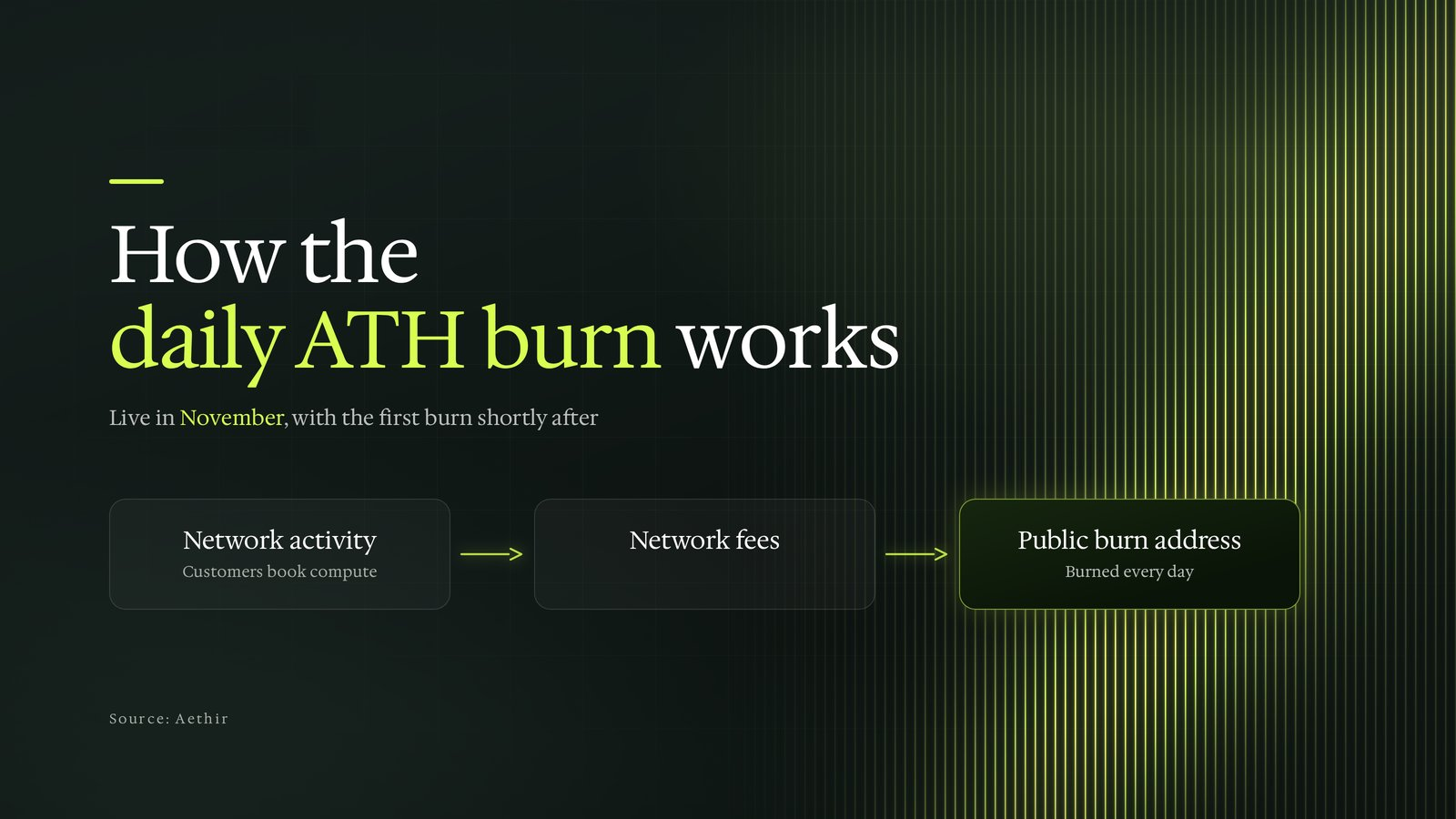
What Gets Burned: One thing feeds the ATH token burn. Network fees charged when customers book compute.
How Often It Runs: Every day. Weekly reference numbers are published in the official tokenomics docs, so anyone can check the running totals.
Why It Follows Activity: Tying the burn to usage means supply reflects the activity of Aethir’s compute network.
The Floating Network Fee Replaces the Fixed Platform Fee
Today we charge a fixed platform fee. We’re replacing it with a floating network fee, so we can better protect Cloud Hosts on our network and ensure sustainable supply of compute for our enterprise customers.
When the market weakens, the floating network fee falls, and the share that gets burned rises. A fixed fee does the opposite by staying put. The formula reads the market through a time-weighted average price (TWAP).
We’re building compute capacity to meet demand we can see, which is the basis of demand-led capacity planning. A fee that responds to market conditions follows the same approach.
Cloud Host Rewards Are Protected by Design
Cloud Hosts supply the GPUs our network runs on, so any fee change has to answer to them first. The floating network fee is capped. It can never exceed the value of Cloud Host rewards, and the formula includes that ceiling. Above the cap, the host keeps the full upside. The host emissions schedule doesn't change. The update changes the fee applied to those protected rewards, and part of that fee is burned.
Whatever the market does, the fee stays below the value of what a host earns. That removes the failure mode operators worry about: a charge that grows faster than the work pays.
Operators who run more capacity, or run it better, keep what that earns. Value in GPU infrastructure sits in contracted revenue, and predictable operator economics keep that revenue coming.
Nothing changes in how hosts earn ATH.
Verifiable by Everyone: The Burn Mechanism
Every part of this will be checkable. Every burn goes to a public burn address. A burn dashboard will go live in November, alongside the first burn and the burn model, showing daily, monthly, and cumulative ATH burned, plus the full transaction history.
Our published tokenomics set ATH contract supply at a fixed 42 billion, and that has never changed. Burns are sent to a verifiable public burn address and reflected in circulating supply on major trackers, so every burn reduces net new ATH supply.
Official ATH Burn Mechanism docs here.
Verifiable burn mechanics: The formula, the public burn address, and the weekly reference numbers will be available to everyone. The first burn will be in November. Anyone can check a burn against the formula from the very first one, which is the standard we want to be held to.
Every burn lands at a public address: 0x000000000000000000000000000000000000dEaD
The Burn Dashboard: Live in November, with daily, monthly, and cumulative ATH burned, plus the full transaction history, in one place.
The burn mechanism is audited by CertiK.
We’ve spent this year building out compute capacity, and this update connects that work to the token. Every day, burns drawn from network fees will go to a public burn address where tokens are permanently removed from supply. The floating network fee moves with the market instead of standing still, and Cloud Host rewards stay protected by a cap written into the published formula. The fee can never exceed the value of Cloud Host rewards.
The fee has no minimum, so in weak markets it can fall to zero.
More network activity is on the way over the next few months as we keep building out compute capacity through ACCELERATE. Aethir represents the offtake for that capacity and puts its compute and revenue onchain, so when our site goes live, that activity runs through the same fee and burn mechanism.
The burn model goes live in November 2026, together with the burn dashboard. When it does, anyone can follow ATH burns in real time.
Track every burn.
Frequently Asked Questions
What is the ATH tokenomics update?
The ATH tokenomics update changes how ATH supply works. Every day, we’ll burn ATH drawn from network fees, send it to a public burn address, and replace the fixed platform fee with a floating network fee. The burn model goes live in November 2026.
How does the ATH token burn work?
Network fees fund a daily ATH token burn. The amount follows real activity, so daily burn amounts are determined by the published formula and its inputs. Every burn lands at a public address: 0x000000000000000000000000000000000000dEaD
What does the update mean for ATH token holders?
ATH token holders get supply that responds to network usage, plus a way to check it. Burns reduce net new ATH supply. The burn dashboard, live in November, publishes the full history from launch, and the mechanism is audited by CertiK.
Will ATH emissions change for Cloud Hosts?
No. The host emissions schedule doesn't change. The update changes the fee applied to those rewards, and part of that fee is burned. The fee carries a cap: it can never exceed the value of Cloud Host rewards, and hosts keep the full upside above it.