Key Takeaways
Neocloud debt became a buyer-side question: CoreWeave, the largest listed neocloud, reported roughly $35 billion of debt on its balance sheet at the end of the second quarter of 2026. Debt of that size is no longer just an investor story, because the contracts written to service it are the contracts enterprise compute buyers are asked to sign.
GPU-backed debt rests on a depreciation assumption: More than $20 billion of loans across the sector are collateralized by NVIDIA accelerators. Every one of those structures assumes the hardware holds enough value over five to six years to secure the borrowed money against it.
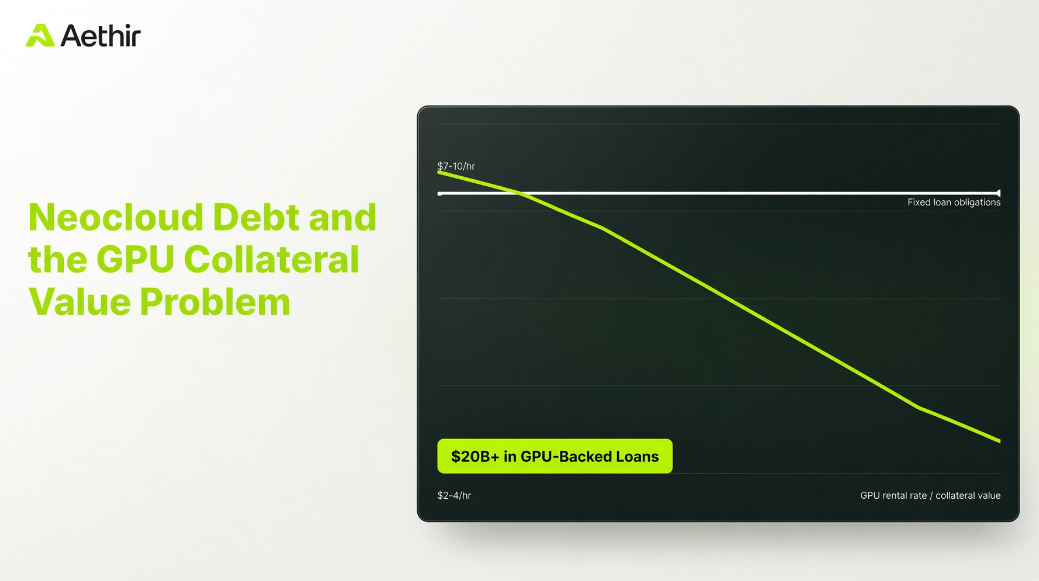
GPU collateral value is about to get a public price: Rental rates for H100-class capacity fell from roughly $7 to $10 per hour in early 2024 to $2 to $4 by late 2025. Exchange-traded GPU compute futures now in development would, for the first time, publish a forward curve on that same question.
GPU cloud counterparty risk sits inside long contracts: Loan maturities in the sector run roughly five years while the customer contracts pledged against them average closer to three. A buyer signing a multi-year reservation is extending credit to the operator, effectively buying capacity from it.
A decentralized GPU cloud has no single balance sheet: Aethir aggregates enterprise GPU capacity from independent operators across 94 countries into one orchestrated pool. With Aethir ACCELERATE, we are adding 10 proprietary mid-sized data centers to our AI compute roster for even more versatile enterprise compute services.
AI Infrastructure Financing Ran on One Assumption
The compute buildout of 2025 and 2026 was financed rather than funded from operating cash flow, and lawyers tracking GPU infrastructure financing and contracting describe a market that shifted from underwriting stable real estate to underwriting a contract, a cash flow, and a service performance model. AI infrastructure financing works only while one number holds: the residual value of the accelerator at the end of the loan. Aethir looked at the buyer side of that same question in an earlier piece on capital-efficient access to GPUs.
How GPU-Backed Debt Is Structured
Chips serve as the collateral: Reporting on GPU-collateralized lending puts more than $20 billion of outstanding loans directly secured by NVIDIA hardware. The lender isn’t underwriting a building or a land lease but a depreciating box that a competitor can buy new in eighteen months.
Customer contracts serve as the credit support: Credit agreements in this market typically require the borrower to hold service contracts with large, creditworthy customers sufficient to cover scheduled repayments. That makes the enterprise buyer an input into the loan, not merely a customer of the operator.
The maturities don’t line up: Loans in the sector run roughly five years, while the customer contracts pledged against them average closer to three years. The gap has to be refilled by future demand at future prices, which is a forecast rather than a commitment.
Neocloud Debt Grew Faster Than Neocloud Revenue
Scale arrived quickly and so did leverage. CoreWeave, the largest listed operator reported roughly $35 billion of debt alongside a contracted backlog of about $129 billion in its second quarter 2026 results, and analysts covering the sector now describe the buildout as vendor-financed rather than customer-financed, a shift examined in coverage of the neocloud gold rush. Aethir wrote about the early version of this market in a look at the CoreWeave IPO.
Depreciation Absorbs About Half of Revenue
Analyst work on the neocloud business model puts fleet depreciation at roughly half of revenue at the two largest listed operators, and none of the major names is profitable on a GAAP basis. Neocloud debt service therefore competes directly with the depreciation charge for the same dollar.
Utilization Has to Stay Near Full
The model prices capacity on the assumption that it is sold. Idle hardware still depreciates and still owes interest, so a utilization shortfall shows up twice on the same income statement.
Refinancing Windows Cluster Together
Loans from several of the larger operators mature between 2026 and 2028 among a small and highly correlated group of lenders. Correlated maturities mean the sector refinances into the same market conditions at the same time.
The Market Sets GPU Collateral Value
A depreciation schedule is an estimate. The rental rate is the mark. H100 class capacity that rented for roughly $7 to $10 dollars per hour in early 2024 was clearing at $2 to $4 dollars by late 2025, and guidance on whether enterprises should rent or own AI compute now treats that decline as the central variable. GPU collateral value moves with the rate card, not with the useful life a finance team selected, which is the same force behind recent GPU cloud pricing moves.
Intercontinental Exchange announced plans with Ornn to launch GPU compute futures contracts referencing a compute price index built on live spot pricing across H100, H200, B200 and RTX 5090 capacity. The contracts are cash settled in US dollars and subject to regulatory approval.
Other exchanges have announced compute futures plans for 2026 as well. When several venues publish a forward price for the same hardware, the argument about GPU collateral value stops being an internal accounting matter.
A published curve gives lenders a mark-to-market reference for collateral they previously valued on schedule. It gives buyers the same reference for judging whether a multi-year rate quoted today is competitive in year three.
GPU Cloud Counterparty Risk Reaches the Buyer
Financial structure ceases to be abstract the moment it appears in a procurement decision. A legal review of GPUaaS contracts, capital, and compute puts solvency first among the questions an enterprise should ask a provider. Furthermore, a litigation counsel warning about financing risks in the data center boom notes that distress at a single node can propagate across counterparties and financing layers.
Where GPU Depreciation Risk Actually Lands
A long reservation fixes a price against hardware that won’t stay current for the whole term, so the buyer absorbs the difference between the contracted rate and the market rate in the later years.
Many projects depend on a very small number of counterparties, so the loss of a single anchor customer can destabilize a financing structure. A buyer inside that structure inherits the consequences of decisions made by other customers.
Loan terms in this sector are frequently cross-triggered, meaning a breach on one facility can cascade across the rest. Service continuity for a workload is inseparable from the credit agreement above it.
How Aethir’s Decentralized GPU Cloud Spreads the Risk
Aethir aggregates enterprise GPU capacity from independent operators into a single orchestrated pool of more than 430,000 GPU containers across 94 countries and 200+ locations. Because the economics of AI inference reward steady distributed demand, that capacity is matched to workloads continuously rather than reserved against a forecast, and the supply itself comes from many independent Cloud Hosts monetizing their GPUs.
No Single Balance Sheet Stands Between Clients and the Hardware
Supply on Aethir’s decentralized GPU cloud comes from many independent operators rather than one borrower, so no single financing structure gates access to capacity. Investors have flagged that neocloud equity carries more risk than other AI exposures, and buyers can decline to take that exposure through a contract.
Short Terms Keep the Risk With the Hardware Owner
With no minimum commitment, no long-term contract, and no egress fees, residual value exposure stays with the operator who chose the hardware. AI compute costs then track actual usage rather than a five-year bet made on a balance sheet you don’t control.
Supply Grows Without One Company Borrowing
Aggregate capacity rises whenever any operator anywhere adds GPUs to the network, which means a single credit facility doesn’t finance expansion. That is a structurally different way to add compute than raising debt against the fleet you already own, and it is part of why hidden AI infrastructure costs behave differently on a distributed network.
Aethir ACCELERATE: Adding Fresh Data Center Capacity
With the recent launch of our Aethir ACCELERATE program, we are joining the data center buildout sector by securing 10 sites for mid-sized data centers across the US and Europe. These data centers will be purpose-built for B300 and GB300 clusters with 64 to 256 chips each.
Our mid-sized data centers are designed to come online quickly, in months, not years, and we are expecting up to $700 million in customer prepayments for the new data centers in 2026. Instead of building data centers and then searching for clients, we are building capacity for already existing data center demand.
Debt is a legitimate way to build infrastructure, and the operators carrying it are delivering real capacity that the market needs. The question for a compute buyer is simply which risks travel with the contract. Aethir delivers enterprise GPU compute on demand across 94 countries with no long-term commitments and no egress fees, so capacity, price, and term remain separate from any one balance sheet.
Explore the Aethir enterprise GPU offering to see how it compares with the commitments already on your roadmap.
Frequently Asked Questions
What is neocloud debt?
Neocloud debt is the borrowing used by specialist GPU cloud providers to buy the accelerators they rent out. The loans are usually secured against the hardware itself and supported by customer service contracts, which is why neocloud debt is closely tied to both GPU resale values and enterprise demand.
How does GPU-backed debt work?
In a GPU-backed debt structure, the borrower pledges its accelerators as collateral, often alongside the customer contracts those accelerators will serve. Lenders size the facility against an assumed useful life for the hardware, so the loan is effectively a position on how much a used GPU will be worth several years out.
Why is GPU collateral value hard to estimate?
GPU collateral value depends on rental rates, which have moved far faster than any anticipated depreciation schedule. H100 class capacity fell from roughly $7 to $10 dollars per hour in early 2024 to $2 to $4 dollars by late 2025, and each new hardware generation re-prices the fleet behind it.
What is GPU cloud counterparty risk for a compute buyer?
GPU cloud counterparty risk is the exposure a buyer assumes to the financial condition of the provider that serves its workloads. It matters most in multi-year reserved contracts, where service continuity and pricing both depend on the provider's ability to fund and operate the fleet for the duration of the term.
How does Aethir’s decentralized GPU cloud reduce GPU depreciation risk?
Aethir’s decentralized GPU cloud lets buyers consume capacity on demand rather than commit to it for years, leaving residual value exposure with the operator who selected the hardware. Aethir sources supply from independent operators across 94 countries, so pricing reflects competition within the pool rather than a single depreciation policy or credit agreement.