Key Takeaways
The AI Gateway Just Got Expensive: Stripe has finalized an agreement to buy OpenRouter for more than $7 billion, roughly five times the $1.3 billion valuation the company carried in May. An AI gateway is now treated as strategic infrastructure rather than developer convenience.
AI Inference Costs Drive the Bill: Inference passed training this year as the larger share of AI-optimized cloud spending. Falling per-token prices don’t lower total AI inference costs when agentic workloads consume far more tokens per task.
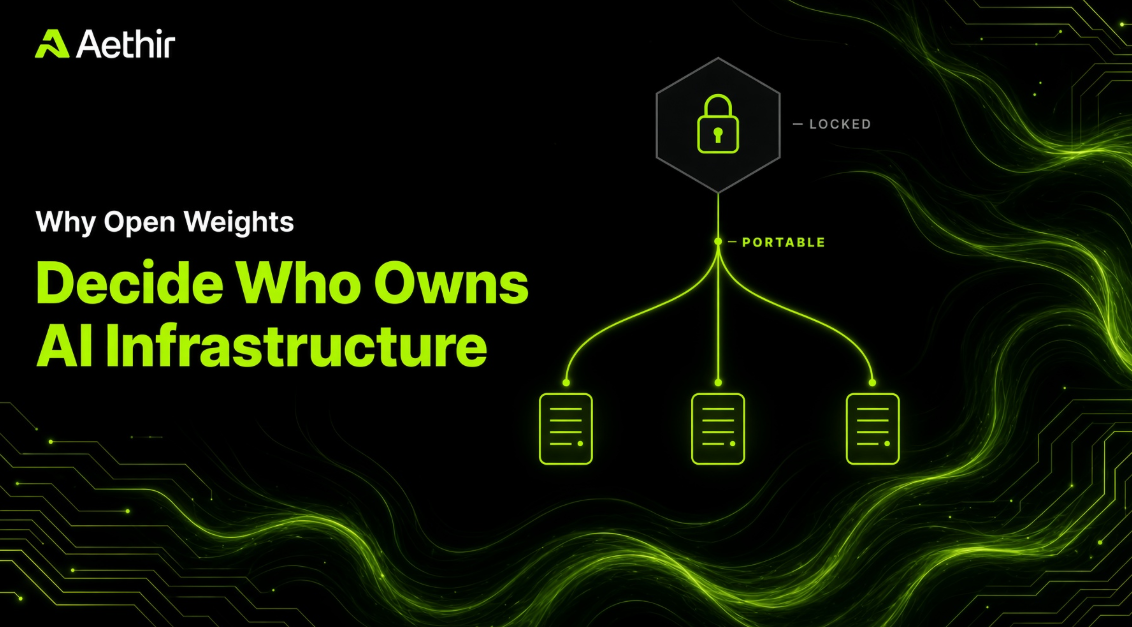
Routing Softens but Doesn’t Remove Vendor Lock-In: A router spreads requests across model providers, which genuinely reduces single-model dependency. It doesn’t change who owns the GPUs underneath, so the vendor lock-in moves one layer down instead of disappearing.
Aethir Mesh Runs Open Models Directly: Aethir Mesh is an open-source model API serving 14 leading open-weight models, mostly on Aethir GPUs. There’s no reseller in the request path, so the token price reflects compute rather than a markup on capacity another company owns.
One Unified AI Stack, One Bill: Aethir pairs the GPU network with Aethir Mesh for open-source inference and Aethir Claw for agent hosting. That unified AI stack removes the separate keys, separate bills, and separate vendors a routing layer still leaves in place.
What the AI Gateway Deal Actually Buys
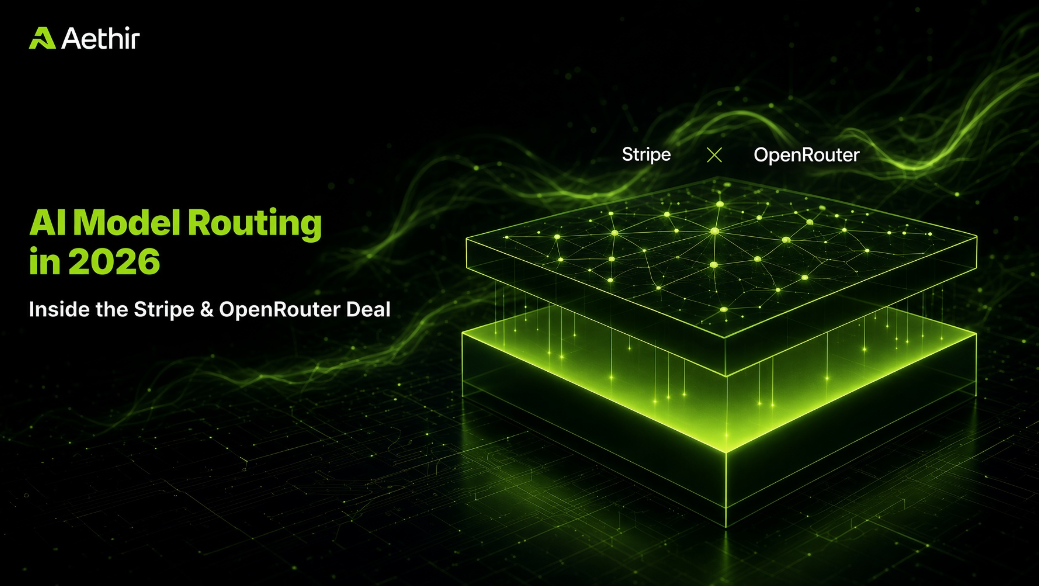
Stripe has finalized an agreement to buy OpenRouter for more than $7 billion, according to Bloomberg’s report on the deal, and the number matters more than the logo. OpenRouter raised at a $1.3 billion valuation in May, so the price is roughly a fivefold move in three months. What Stripe is buying isn’t a model and isn’t a data center. It’s an AI gateway: the layer between an application and 400+ models that picks one, meters the tokens, and sends the bill.
OpenRouter serves roughly 8 million developers by reselling capacity it doesn’t own, which is why the Gartner AI platforms and models forecast treats model access and routing as one fast-growing layer. AI model routing is a distribution business, and distribution businesses scale on breadth rather than on hardware.
Furthermore, the gateway earns on the spread between what a provider charges and what a developer pays. That makes billing accuracy, failover, and uptime the actual engineering problem, which is the problem Stripe has already solved once in payments.
Every request a router forwards lands on a GPU owned by a hyperscaler or a model lab. The economics of the shift from training to inference therefore sit with whoever operates that hardware.
Why AI Inference Costs Now Set the Agenda
Inference stopped being the cheap part of AI this year. The Gartner AI-optimized IaaS forecast puts inference at $23.3 billion of a $42.3 billion market in 2026, or 55% of the total, against $19 billion for training, with the inference share heading to 59% next year. AI inference costs are now the line item finance teams question, and they behave differently from training budgets because they never stop.
Where GPU Cloud Economics Break Down
Per-Token Prices Fall While Bills Rise: The Gartner inference cost prediction has inference on a trillion-parameter model running more than 90% cheaper by 2030 than in 2025. Agentic workloads demand 5 to 30 times more tokens per task than a chatbot, so cheaper tokens and larger invoices arrive together.
Reserved Capacity Keeps Repricing: Reserved accelerator rates moved up roughly 20% in July after a 15% rise in January, a pattern traced in GPU cloud pricing in 2026. Teams that budgeted on falling hardware costs are rebuilding their models mid-year.
Egress and Idle Time: GPU cloud economics get decided by the charges that never appear on the headline rate, including data transfer and capacity that’s paid for but unused. That’s the heart of the hidden cost problem in AI, and no routing layer touches it.
Routing Layers Don’t Fix Vendor Lock-In
A router is a real improvement over one hard-coded model. Swap a string, keep the application, and a team can move providers in an afternoon. But Gartner's AI spending forecast projects worldwide AI spending growing 47% in 2026, and almost all of that money still terminates on hardware owned by a handful of companies. AI model routing gives buyers a choice of model while leaving vendor lock-in intact one level down.
A gateway can find the cheapest listed endpoint, but every listing already includes the operator margin. AI inference infrastructure costs are set by whoever owns the GPUs, so a router optimizes inside a price band it can’t move.
Requests pass through a third party that sees the prompt, the response, and the usage pattern, which is why a native model layer with no separate API keys reads differently to a compliance team. For regulated workloads, that extra hop restates the vendor lock-in question instead of answering it.
The gap between frontier and open-weight models keeps narrowing across the benchmarks the Stanford AI Index tracks, which makes self-hosted open models a first choice rather than a fallback. Running them well is an infrastructure problem, and a routing layer isn’t infrastructure.
How Aethir’s Decentralized GPU Inference Answers the Gap
Inference is the workload that suits a distributed network, and the reason is architectural rather than ideological. Training needs tightly interconnected GPUs in one building while inference doesn’t, which is why IEEE Spectrum reporting on distributed inference sites describes operators placing small inference facilities next to spare grid capacity. Aethir’s decentralized GPU inference works on the same principle: each request is self-contained, so it can run wherever capacity is closest and cheapest.
Aethir Mesh as an Open-Source Model API
14 Models, One Endpoint: Aethir Mesh is an open-source model API serving DeepSeek V4, Kimi K2.6, GLM-5.1, MiniMax-M2.5, Qwen3.6-27B, and nine more through a single key and dashboard. The models mostly run directly on Aethir GPUs, so there’s no reseller markup between the request and the silicon.
Scale That Isn’t Theoretical: The Aethir network runs 430,000 GPU containers across more than 200 locations in 94 countries and has delivered 2+ billion compute hours. That footprint is what makes decentralized GPU inference viable at enterprise latency, as the Aethir inference advantage sets out in detail.
Aethir Offers a Unified AI Stack for Agent Builders
Most teams shipping agents right now hold three separate relationships: one for hosting, one for models, one for payments. AI agent infrastructure gets expensive at the seams, and IEEE Spectrum's agentic AI crunch shows how fast agent workloads reshape capacity planning. A unified AI stack collapses those streams into one provider, one key and one bill.
Aethir Claw and AI Agent Infrastructure for Companies
Aethir Claw for Companies: With Aethir Claw, enterprise clients can deploy company-wide agentic AI solutions for various business use cases through Aethir’s AI agent platform.
Agents That Can Transact: A2A payments on Aethir Claw let one agent pay another on-chain and verify the transfer by transaction hash before a deliverable ships. AI agent infrastructure that settles its own invoices removes the honor system from multi-agent work.
One Provider Across Every Layer: Compute, open-source inference through Aethir Mesh, and agent hosting for Aethir Claw all sit inside a single account.
A $7 billion price on a routing layer tells buyers where the market thinks the leverage sits, and it’s worth reading carefully rather than reactively. Model choice is table stakes now. The durable advantage belongs to whoever owns the compute the tokens run on. Aethir gives teams that position through one network, open-source inference on Aethir Mesh and agent hosting on Aethir Claw.
That’s a shorter path from prototype to production, priced by compute instead of by markup.
FAQ
What is AI model routing, and why did Stripe buy OpenRouter?
AI model routing sends each request to whichever model best fits the task and the budget, through one API. Stripe agreed to buy OpenRouter for more than $7 billion because that routing layer sits exactly where AI usage turns into a billable event. It’s a metering and distribution business, which Stripe already understands.
How does an AI gateway differ from decentralized GPU inference?
An AI gateway resells access to models hosted by other companies, so it optimizes price inside a band someone else sets. Aethir’s decentralized GPU inference runs the model on the network that owns the hardware, which is where that band gets set in the first place. One is a routing decision while the other is an infrastructure position.
Do routers reduce AI inference costs for enterprises?
Routers help by finding the cheapest suitable endpoint and by avoiding dependency on a single provider. They don’t reduce AI inference costs below the operator margins already priced into every listing, and they don’t touch egress or idle capacity. AI inference infrastructure and GPU cloud economics improve when the compute layer changes, not when the addressing layer does.
What does Aethir Mesh offer as an open-source model API?
Aethir Mesh is an open-source model API serving 14 leading open-weight models, including DeepSeek V4 and Kimi K2.6, from a single endpoint and key. The models run mostly on Aethir GPUs rather than third-party capacity. Developers can use it standalone or alongside Aethir Claw.