Key Takeaways
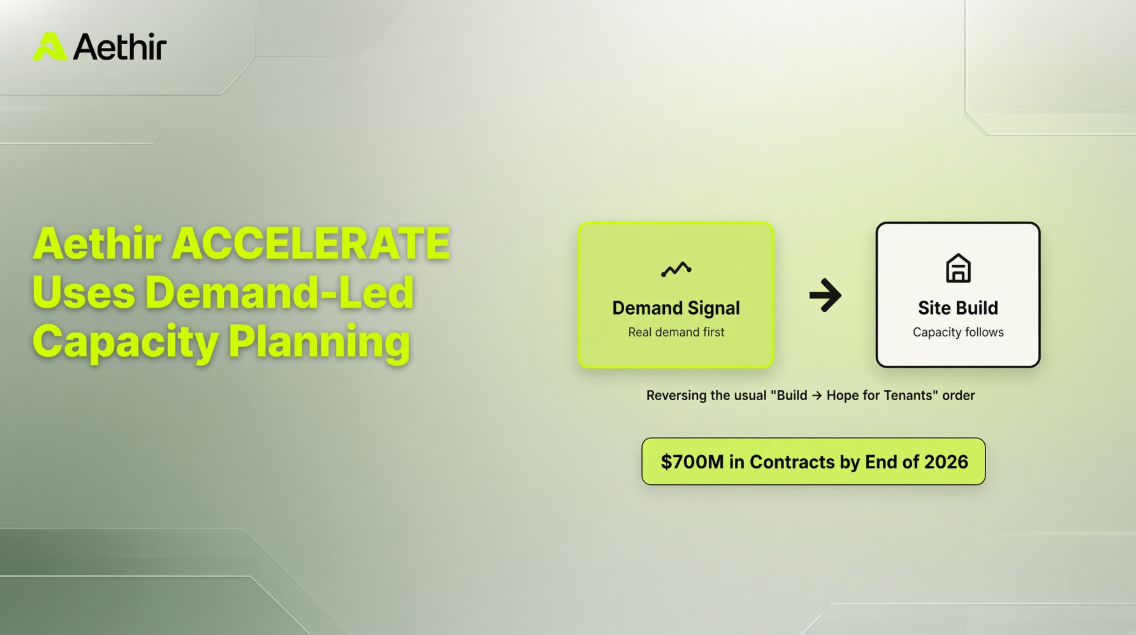
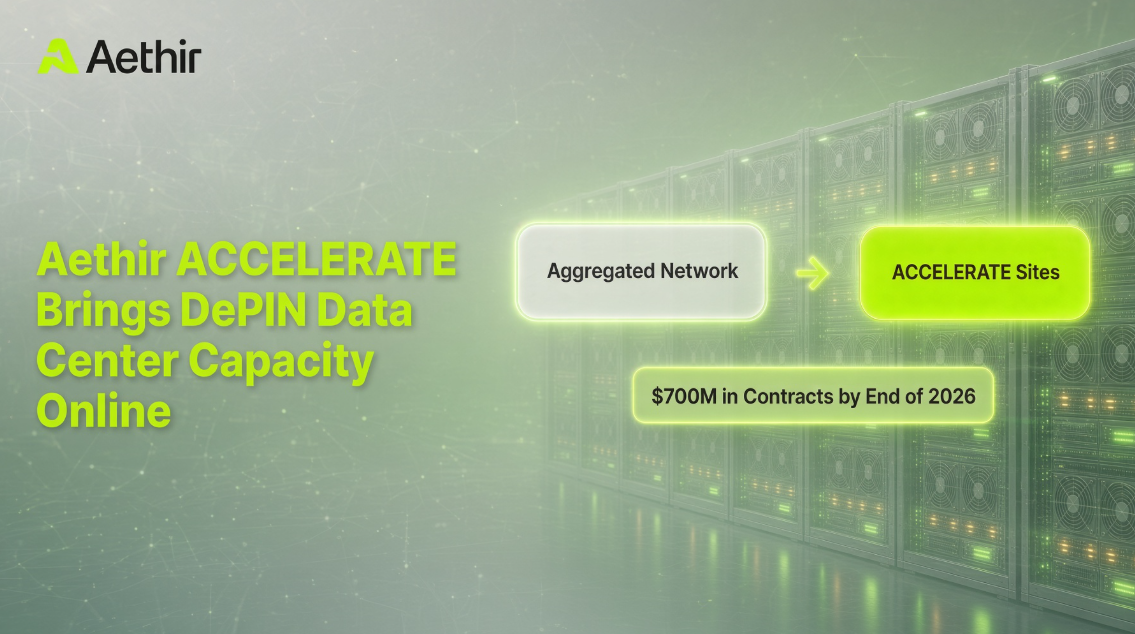
Aethir ACCELERATE has secured access to 10 sites totaling up to 20 MW: The program brings GPU compute capacity online in AI data centers across the United States and Europe. Building those sites out is projected to generate up to $700 million in contracts by the end of 2026, and over $2 billion in total contract value at full buildout.
This is a decentralized compute network moving into physical AI infrastructure: Until now, Aethir aggregated and orchestrated third-party GPU compute across hundreds of thousands of containers in more than 90 countries. ACCELERATE adds the layer underneath that.
The sites are engineered for high-density inference and rapid deployment: Facilities are purpose-built to support NVIDIA B300 and GB300 clusters ranging from 64 to 256 nodes, for both training and inference.
The DePIN data center buildout feeds the Aethir network: Aggregated third-party supply and directly developed capacity serve different parts of the same demand curve. Buyers keep on-demand access through the decentralized GPU cloud, while contracted clusters land against existing commitments.
Aethir ACCELERATE Takes the Network Down the Stack
Aethir ACCELERATE is a program to bring GPU compute online in AI data centers across the United States and Europe, starting with access secured to 10 sites totaling up to 20 MW.
For years, the decentralized model was defined by what it didn’t own: no buildings, no substations, no construction schedule. That worked because the constraint was coordination. In 2026 the constraint moved, and with Gartner forecasting a 47% rise in AI spending for the year, the supply side is what gives way first.
What Aethir’s Compute Orchestration Layer Already Knows
Demand telemetry: Aethir’s compute orchestration layer routing enterprise jobs across hundreds of thousands of GPU containers sees which regions run short, which workloads get turned away, and which customers ask for capacity that isn’t there. That signal is a live operating record.
The aggregation layer hit its ceiling: Orchestrating third-party GPU compute capacity works until the third parties themselves run out of supply to orchestrate. Research from Columbia Business School on financing the AI buildout sets out how much of the sector now runs on asset-level leverage, and a network can only route what somebody else financed.
Pricing pressure: Reserved capacity at the large providers has repriced repeatedly this year, which is a pattern we covered in the Aethir analysis of why GPU cloud pricing keeps climbing. Bringing capacity online directly is how a network stops importing pricing power that belongs to somebody else into its own AI compute costs.
Why a Decentralized Compute Network Sites Capacity Better
Most AI capacity siting starts with land, power and a projected demand estimate. Aethir’s decentralized compute network starts the buildout differently, because it already has customers running workloads and can see where those workloads need more compute capacity.
Interactive inference is judged on round trip, so the useful site is the one near the users. Aethir’s GPU network already serves traffic in more than 90 countries and knows which workloads generate request volume, which is a sharper AI capacity-siting input than a regional growth projection.
Sites that can be energized quickly beat theoretically larger sites, and grid conditions vary enormously between markets. Ten sites of up to 20 MW combined can be sequenced, re-ordered, and matched to different customers as commitments firm up. One very large campus is a single bet placed years before the demand it serves is contracted.
Furthermore, work on data center flexibility documented by the EPRI-led DCFlex collaboration shows operators can shape demand meaningfully when workloads are schedulable. Aethir’s distributed compute placement gives the network more flexibility across balancing areas.
Aethir’s DePIN Data Center Is a Different Building
A DePIN data center built for the Aethir ACCELERATE program isn’t a smaller copy of a hyperscale campus. Aethir ACCELERATE facilities are purpose-built for high-density compute and rapid deployment, engineered to support NVIDIA B300 and GB300 clusters ranging from 64 to 256 nodes for AI training and inference workloads.
McKinsey research on the colocation race puts AI data center demand on a path from roughly 44 gigawatts toward more than 150 gigawatts by 2030, and notes that lead times for generators, chillers, and switchgear have more than doubled since 2019.
Designing Around the B300 and GB300 Cluster
A GB300 cluster concentrates far more power into a rack than legacy enterprise workloads ever did, and the NVIDIA rack-scale platform specification makes clear the building has to be designed backward from the rack. Retrofitting an air-cooled hall to that profile costs more and takes longer than building for it from the start.
Clusters of 64 to 256 nodes cover the band where most enterprise fine-tuning and production inference actually lands. Sizing the hall to that band means capacity can be sold as whole clusters instead of sitting half empty waiting for one enormous tenant.
Additionally, going from site selection to live GPU compute capacity in months requires a repeatable design, long-lead equipment ordered early, and a partner who has delivered before.
Bringing GPU Compute Capacity Online in Months
The commercial case for the whole ACCELERATE program is delivery speed. Building out the 10 secured sites is projected to generate up to $700 million in contracts by the end of 2026 and over $2 billion in total contract value once all of them are fully built out, and those numbers only work if capacity arrives while the demand behind them is still live.
Depending on the site, Aethir services include securing GPU hardware, arranging access to data center capacity, and engaging key infrastructure partners, including Axe Compute, whose Axe Build program designs, deploys, owns, and operates dedicated AI infrastructure and has publicly reported more than $3 billion in signed contracts in 2026.
Where the Decentralized GPU Cloud Wins on AI Compute Costs
Two supply lines, one demand curve: Directly developed capacity serves contracted, dedicated workloads with a known shape. The aggregated decentralized GPU cloud capacity keeps serving burst, inference, and short-horizon jobs where committing to a reservation would raise AI compute costs.
Prepayment and project finance: Large dedicated deployments in this market are increasingly funded by customer money rather than equity issuance, a mechanism examined in the Aethir coverage of the prepayments behind the Axe Compute Build program. That structure only opens up once the contracts are signed.
The spending backdrop: Global IT spending is on track to reach $6.37 trillion in 2026 according to Gartner forecasting, and a rising share of it is committed years ahead of delivery. Capacity that lands against existing contracts carries a different risk profile from capacity built on a forecast.
Buyers keep the decentralized GPU cloud as an additional option: Adding physical AI infrastructure doesn’t change the commercial promise underneath the network: capacity without a minimum commitment. A customer that outgrows a cluster or wants to move a workload still moves it.
What Aethir’s Physical AI Infrastructure Changes About the Decentralized Compute Model
Capacity built against demand already running on a network has a known workload shape, a known customer, and a revenue date. Capacity built against a market-sizing projection has none of those, and the sector is currently producing a great deal of the second kind. Every Aethir ACCELERATE site is sequenced against demand the network can already observe, which is a structurally different position from building toward an addressable market.
Energized capacity is worth more than planned capacity, and the gap is widening. Meeting forecast demand requires grid investment to rise sharply from its current base, according to IEA electricity analysis, which means the constraint on planned capacity isn't intent or capital but the pace at which power actually arrives.
Aethir’s GPU network already serves workloads in more than 90 countries and has no idle period while new clusters come online, because compute continues to flow while the buildout proceeds behind it. That continuity, more than any single site, is what Aethir’s decentralized compute network brings to physical AI infrastructure.
Frequently Asked Questions
What is Aethir ACCELERATE?
Aethir ACCELERATE is the Aethir program for bringing GPU compute online in AI data centers across the United States and Europe. It has secured access to 10 sites totaling up to 20 MW, projected to generate up to $700 million in contracts by the end of 2026 and over $2 billion in total contract value at full buildout. Facilities are engineered for NVIDIA B300 and GB300 clusters of 64 to 256 nodes.
How does Aethir’s decentralized compute network decide where to build?
Aethir reads demand off the traffic it already carries. A compute orchestration layer running enterprise workloads across hundreds of thousands of GPU containers can see which regions run short of GPU compute capacity and which customers are asking for capacity that isn’t available. That evidence drives AI capacity siting ahead of construction.
How fast can new GPU compute capacity go live?
Aethir ACCELERATE sites are designed to go from site selection to live capacity in months instead of the multi-year timelines that define traditional data center construction. Achieving that depends on a repeatable facility design, long-lead equipment ordered early, and infrastructure partners with a delivery record. That's why midsized sites are the target rather than gigawatt campuses.
Disclosure
Aethir Foundation is Axe Compute's largest shareholder, through its 2025 treasury transaction. We cover Axe as an interested holder. This article reflects Aethir's views and is not investment advice. For official company information, see Axe Compute's SEC filings (CIK 0001446159) and investors.axecompute.com.
Nothing in this article should be relied upon as a guarantee of future performance or results.