Key Takeaways
Every Aethir ACCELERATE site launches against demand that already exists: Enterprise customers on the Aethir network are already seeking capacity that traditional providers can’t deliver at the speed they need.
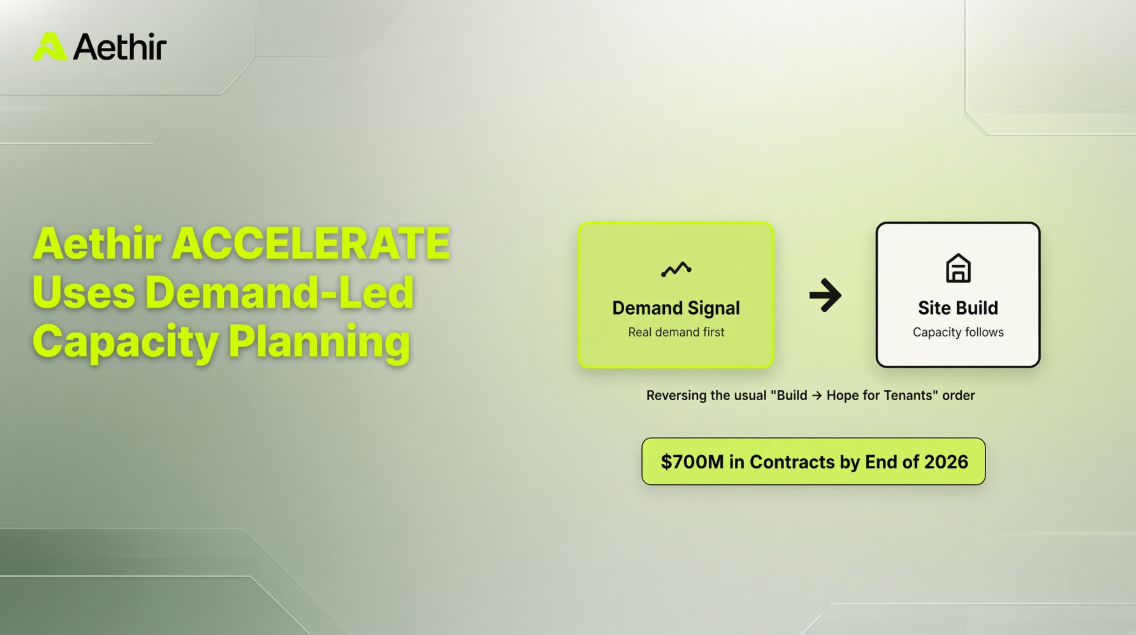
Speculative data center capacity is a sequencing choice: Most capacity gets sited on a forecast and sold afterward, which is why the overbuild argument and the shortage argument both look credible at once. Demand-led capacity planning inverts that order.
A live network produces a GPU demand signal a developer can’t buy: Routing enterprise AI workloads across hundreds of thousands of GPU containers in more than 90 countries shows which regions run short and which requests go unserved. That evidence sits underneath every siting decision in the program.
Contracted capacity changes how the build gets funded: Signed agreements unlock prepayments and project-level financing that speculative capacity can’t access on the same terms.
Building out the 10 secured sites is projected to generate up to $700 million in contracts by the end of 2026 and over $2 billion at full buildout.
Most AI Data Center Demand Forecasts Come Before the Contracts
The standard sequence for building AI capacity is land, power, a demand projection, then customers. That worked when demand was predictable, and construction was cheap, and it stopped working when both changed at once. McKinsey research on the colocation race puts AI data center demand on a path from roughly 44 gigawatts toward more than 150 gigawatts by 2030, a 3.5x expansion in five years, which is exactly the kind of curve that makes speculative building look rational right up until the moment it doesn’t.
Where Data Center Overbuilding Comes From
Trade coverage in 2026 carries a capacity shortage and a data center overbuilding warning in the same week, and readers assume one of them must be wrong. Both are accurate because they describe different things: aggregate demand is growing while individual speculative projects are mispriced.
Enterprise appetite keeps rising, with Gartner forecasting a 47% increase in AI spending for 2026. However, aggregate growth doesn’t rescue a facility built in the wrong place for the wrong workload shape.
Furthermore, two-thirds of AI compute in 2026 is expected to be inference, and Aethir’s analysis of why inference reshapes infrastructure choices covers what that does to siting. Capacity planned for training economics can be technically fine and commercially wrong.
Speculative Data Center Capacity Carries the Risk
When a site is built ahead of its customers, somebody has to carry the empty months, and that somebody is almost always financed. Research from Columbia Business School on financing the AI buildout shows how heavily the sector now leans on asset-level leverage and outside capital, with technological obsolescence among the named risks. Speculative data center capacity concentrates all of that into one bet placed years before the revenue arrives.
Who Pays When Enterprise AI Workloads Don’t Arrive
The delay tax lands first: Up to half of the global capacity scheduled for 2026 faces delays from permitting, grid connections, and local opposition. A speculative project that slips two years doesn’t just arrive late, it arrives into a different market than the one it was underwritten against.
Hardware ages on the balance sheet: Accelerators start depreciating whether or not a tenant is running on them, which the Aethir piece on what a used GPU is actually worth explains in detail. Idle capacity is the most expensive to own because it only produces expenses, without any revenue.
The cost reaches the buyer eventually: Empty capacity has to be paid for by the capacity that isn’t empty, which shows up in rates, minimum commitments, and contract terms. Enterprise AI workloads end up subsidizing the mispriced projects around them through higher AI compute costs.
Aethir ACCELERATE Inverts the Order
Aethir ACCELERATE has secured access to 10 sites totaling up to 20 MW across the United States and Europe, and each one launches against existing demand.
Mark Rydon, Co-founder and Chief Strategy Officer at Aethir, framed the whole program around that point: “The winners in this market won’t be whoever plans the biggest campus, they’ll be whoever delivers working capacity first, and the network tells the team where demand is before the first foundation gets poured.”
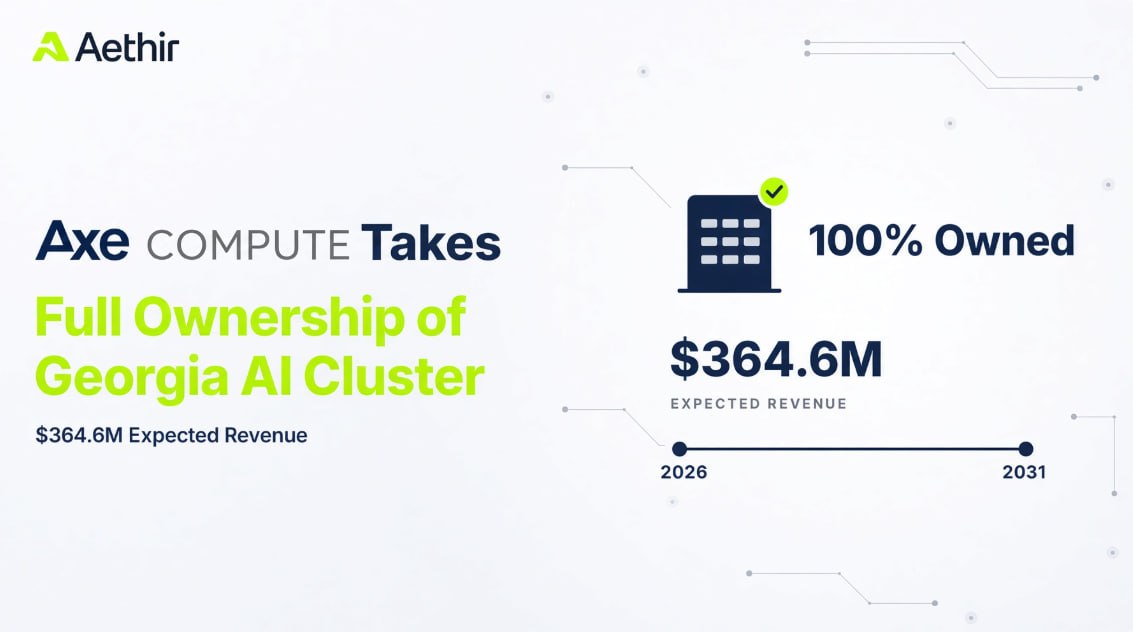
Aethir services include securing GPU hardware, arranging data center capacity, and engaging infrastructure partners, including Axe Compute, which has publicly reported more than $3 billion in signed contracts in 2026.
Spreading capacity across sites avoids concentrating one enormous synchronized load at a single interconnection point, a dynamic that Aethir’s blog on AI training power spikes examines closely. Work on data center flexibility documented by the EPRI-led DCFlex collaboration points the same way, and smaller sites also clear local approval faster than a campus does.
Demand-Led Capacity Planning Changes the Economics
Building against signed agreements changes what the project can be financed with. Large dedicated deployments in this market increasingly run on customer prepayments rather than equity issuance, as seen in the Axe Compute quarterly results filed in August. Contracted capacity makes that structure available, because prepayment presupposes a customer.
What Contracted Capacity Does to AI Compute Costs
Financing cost flows into the rate card: Capacity funded on expensive leverage has to price that leverage into every GPU hour it sells. Prepayments funding Axe Compute’s build program show how a contracted-first structure changes the arithmetic before a single rack is energized.
Utilization starts high instead of climbing: A cluster that opens against an existing commitment doesn’t spend its first year hunting for tenants. Demand-led capacity planning is why the utilization curve starts near the top rather than at the bottom, which is the single biggest lever on AI compute costs.
The spending backdrop rewards discipline: Global IT spending is on track to reach $6.37 trillion in 2026 according to Gartner forecasting, and much of it is committed years ahead of delivery.
Demand-Led Capacity Planning Is Aethir ACCELERATE’s Market Advantage
Demand-led capacity planning is an order of operations today. Most GPU buildouts run the other way: pour the concrete, energize the racks, then go looking for tenants and carry the depreciation on every idle hour in between. Aethir ACCELERATE puts the customer before the concrete.
A site is committed once there's contracted demand behind it, so capacity arrives while that demand is still live rather than eighteen months after the buyer's requirement has moved on or been filled elsewhere. That sequencing is what makes the program's scope legible instead of speculative.
Aethir expects up to $700 million in contracts by the end of 2026 and more than $2 billion in total contract value once all 10 sites are built out. Those are forward figures tied to a pipeline, not recognized revenue, but they're anchored to a model where each increment of capacity has a named customer attached rather than a forecast.
For buyers, the practical difference is who absorbs the risk of a wrong guess. In a speculative build, someone pays for the empty racks, and it's usually priced into what tenants are quoted. Demand-led capacity planning removes that line item because the capacity wasn't built on a hunch in the first place.
The first wave of ACCELERATE contracts is expected to close in the coming months. Explore enterprise GPU compute with Aethir and run on capacity that already has a customer.
Frequently Asked Questions
What is speculative data center capacity?
Speculative data center capacity is capacity built before its customers are signed, on the expectation that demand will arrive by the time the facility is ready. It is the default model for most of the AI buildout, and it concentrates delay, financing, and obsolescence risk into a single bet. The alternative is building against agreements that already exist.
What is demand-led capacity planning?
Demand-led capacity planning means the decision to build is triggered by demand a provider can already observe rather than by a projection it has purchased. For Aethir ACCELERATE, that observation comes from live enterprise traffic across the network. The site follows the customer, not the other way around.
Is AI data center demand actually outrunning supply?
Aggregate AI data center demand is growing quickly, with research pointing to roughly a 3.5x expansion in AI data center power demand between 2025 and 2030. Supply is constrained less by appetite than by permitting, grid connections, and equipment lead times. That combination creates a real shortage and, at the same time, genuine data center overbuilding in different places.
Disclosure
Aethir Foundation is Axe Compute's largest shareholder, through its 2025 treasury transaction. We cover Axe as an interested holder. This article reflects Aethir's views and is not investment advice. For official company information, see Axe Compute's SEC filings (CIK 0001446159) and investors.axecompute.com.
Nothing in this article should be relied upon as a guarantee of future performance or results.