Key Takeaways
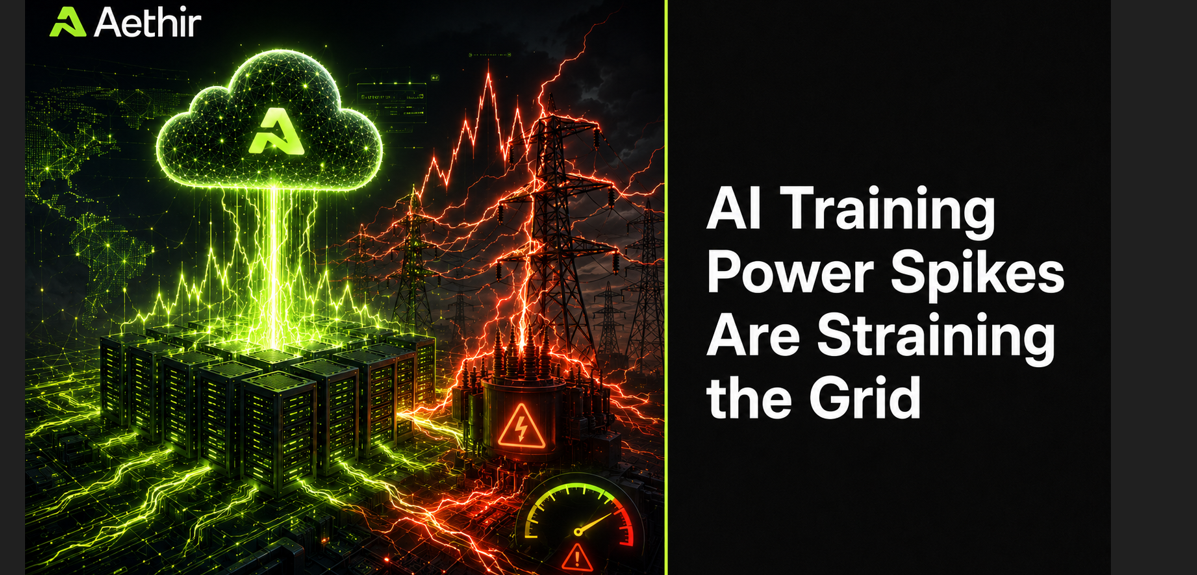
AI training power spikes are a physics problem: When thousands of GPUs finish a phase together, a large campus can shed hundreds of megawatts in moments and ramp back just as fast.
Data center load volatility now registers as a reliability risk: Regulators have issued rare high-severity alerts after equipment failures linked to erratic training loads.
Low-inertia grid conditions make it worse: Systems dominated by inverter-based generation carry less mechanical inertia to absorb sudden swings. Rapid load ramping can then produce voltage sag and frequency excursions without any generator fault on the system.
Single-campus fixes mitigate the symptom: Batteries, staggered job launches, tighter load forecasts, and smoothing power electronics all help. None of them change the fact that one interconnection point is absorbing the entire swing.
Distribution removes the synchronization: Spreading distributed AI inference across hundreds of independent sites means no single feeder ever sees the step change. Aethir’s decentralized GPU cloud is a different topology rather than a smaller version of the same one.
What a 300 Megawatt Swing Does to a Grid
Work on the physical power paradox of extreme AI training loads describes what happens when thousands of accelerators synchronize their compute cycles: high-frequency pulse loads that produce voltage sag, frequency oscillations, and, in the worst case, an interrupted run. Analysis of training load fluctuation at gigawatt scale puts numbers on it, with the demand of a large campus plunging by 300 megawatts in moments as a phase completes and ramping back just as abruptly when training resumes.
That is a different load profile from the steady inference demand that now dominates AI compute.
Pulse Loads
A training cluster is effectively one machine, so its GPU cluster power draw rises and falls together rather than averaging out. AI training power spikes therefore arrive as a coordinated step rather than as noise the system can absorb.
The Swing Can Exceed a Generating Unit
A 300 megawatt movement is comparable to tripping a mid-sized power plant, except it happens by design and repeats. Grid equipment and protection schemes were specified for faults, not for a customer that behaves like one on a schedule.
Inference Behaves Differently
Request-driven inference is statistically smoothed across many users and many sessions, so data center load volatility is far lower. The same total energy delivered as inference, rather than synchronized training, is a much easier load to serve.
Why Low-Inertia Grids Feel It Hardest
The severity depends heavily on what is generating the electricity. Research on instability risks from programmable AI load ramping finds that rapid ramps in grids dominated by inverter-based resources can trigger voltage depressions, rate-of-change-of-frequency spikes, and system-wide instability without any generator failing.
Meanwhile, rack densities keep climbing, and AI-ready sites built for Blackwell-class hardware concentrate more load behind each connection than any previous generation.
The Mechanics in Plain Terms
Inertia is the shock absorber: Spinning turbines store rotational energy that briefly resists changes in frequency, buying operators seconds to respond. A low-inertia grid running mostly on inverters has far less of that buffer, so the same swing produces a larger excursion.
The rate of change of frequency is the tell: It is not only how far the frequency moves but how fast it moves, because protection relays trip on the rate itself. Load ramping from a large cluster can push that rate past thresholds never intended for programmable demand.
Density concentrates the exposure: Higher power per rack means more megawatts sitting behind a single point of common coupling. AI data center grid stability degrades as the same campus footprint carries progressively more GPU cluster power draw.
Regulators and Operators Are Already Responding
Reporting on high-likelihood, high-impact grid risks from AI power demand describes reliability bodies treating volatile demand from large compute clusters as a direct threat, and a rare high-severity alert followed a wave of equipment failures linked to erratic training loads.
Coverage of the power problem behind AI and how to fix it sets out the mitigation menu operators are now working through, which arrives as each new hardware generation raises the power of every rack.
Tighter Forecasts and Staggered Launches
Grid operators are asking large campuses to submit far more granular load forecasts and to avoid synchronized job starts across clusters. Scheduling has become a grid interface, not just an internal engineering concern.
Tariffs That Price the Shape of Demand
Some operators are piloting rates that reward flat consumption or penalize sharp peaks. When AI training power spikes incur a tariff, the volatility shows up directly in AI compute costs.
Buffers, Schedulers, and Power Electronics
Battery systems that absorb the swing, schedulers that spread training starts, and electronics that smooth harmonics all reduce the symptom. They add capital and complexity to a site that was already expensive to build.
Distribution Removes the Synchronization
There is a structural answer and a mitigation menu. The problem is not that AI uses electricity, it is that a very large amount of it changes state at one point on the network simultaneously. Work on safety criteria for AI training clusters treats that concentration as the variable to manage, and the IEA electricity outlook for 2026 makes clear how much new load the system has to absorb regardless.
Aethir aggregates enterprise GPU capacity from independent operators into more than 430,000 GPU containers across 94 countries and 200+ locations, thereby changing the shape of the load before any mitigation is applied.
One workload, many feeders: When a job is spread across hundreds of sites, no individual interconnection sees a step change worth reacting to. Diversity rather than suppression by batteries smooths data center load volatility at the network level.
Inference is the flatter half of AI demand: Most 2026 AI compute is inference rather than training, and distributed AI inference is exactly the workload that tolerates placement flexibility. Moving that half of demand off concentrated campuses reduces the share of demand that is volatile.
Independent sites, independent interconnections: Capacity in Aethir’s decentralized GPU cloud comes from many Cloud Hosts operating their own facilities, each with its own grid connection and its own local supply. That is a fundamentally different exposure profile from that of a single campus, whose economics also drive the wider GPU cloud pricing picture.
What Compute Buyers Should Do About It
Grid stability sounds like somebody else's problem until an interrupted run or a demand charge lands on your invoice. Analysis showing that flexible data centers could unlock 76 gigawatts of grid capacity points at where the incentives are heading, and reporting on utilities trading flexibility for speed shows those incentives already being written into contracts.
Three Questions to Ask Your Provider
Where does my load physically land?
A single-campus provider concentrates your demand behind one connection alongside every other tenant, while Aethir’s decentralized GPU cloud spreads it across many. Knowing which one you are buying tells you how exposed the workload is to local grid events and how AI data center grid stability problems show up on your invoice.
Am I paying for volatility I do not create?
Demand charges and peak-shaped tariffs are socialized across a site, so a steady inference workload can end up carrying part of the bill for a synchronized training run next door and paying AI compute costs it never generated. That is one of the hidden costs in centralized AI infrastructure that never appears on a rate card.
Can training and inference be separated?
Large synchronized training genuinely benefits from a single tightly coupled campus, and that is the right home for it. Steady inference and burst capacity don’t need that topology, and running them there imports volatility risk for no performance gain.
The grid is being asked to serve a customer that behaves unlike any it was designed for, and mitigation at a single site can only soften that. Aethir delivers enterprise GPU compute on demand from more than 430,000 GPU containers across 94 countries and 200+ locations, at over 95%+ utilization, with no long-term contracts, no minimum commitments, and no egress fees.
Spreading distributed AI inference across many independent interconnections turns a synchronization problem into a routing decision.
Explore the Aethir enterprise GPU offering to see how that capacity is distributed today.
Frequently Asked Questions
What causes AI training power spikes?
Large training clusters operate as a single coordinated machine, so thousands of GPUs raise and lower their draw at the same moment rather than averaging out. When a training phase completes and results are compiled, the campus can shed hundreds of megawatts in seconds and ramp back just as quickly, which is why AI training power spikes look like a step change rather than normal demand variation.
Why is AI data center grid stability a concern in 2026?
Reliability bodies have begun treating volatile demand from large compute clusters as a direct risk, and a rare high-severity alert followed equipment failures linked to erratic training loads. The concern isn’t total energy use but the speed of change, because protection systems and generation reserves were specified for faults rather than for programmable demand that swings by design.
What is a low-inertia grid and why does it matter here?
A low-inertia grid is one where much of the generation comes from inverter-based resources such as solar and wind, which don’t store rotational energy the way spinning turbines do. With less mechanical inertia to absorb sudden changes, the same load ramping produces greater voltage sag and faster frequency changes, so the same cluster causes more disturbance than it would in a conventional system.
Does inference cause the same problem as training?
No, and that difference is the practical takeaway. Inference is request-driven and statistically smoothed across many users and sessions. Hence, its data center load volatility is far lower than that of a synchronized training run delivering the same total energy. Distributed AI inference spread across many sites is the least disruptive shape AI demand can take.
How does Aethir’s decentralized GPU cloud reduce grid impact?
Aethir’s decentralized GPU cloud splits a workload across hundreds of independent sites, each with its own grid connection, so no single interconnection point absorbs the full swing. Aethir spans more than 430,000 GPU containers across 94 countries and 200+ locations, smoothing load through diversity rather than suppressing it with batteries at a single campus.