Key Takeaways
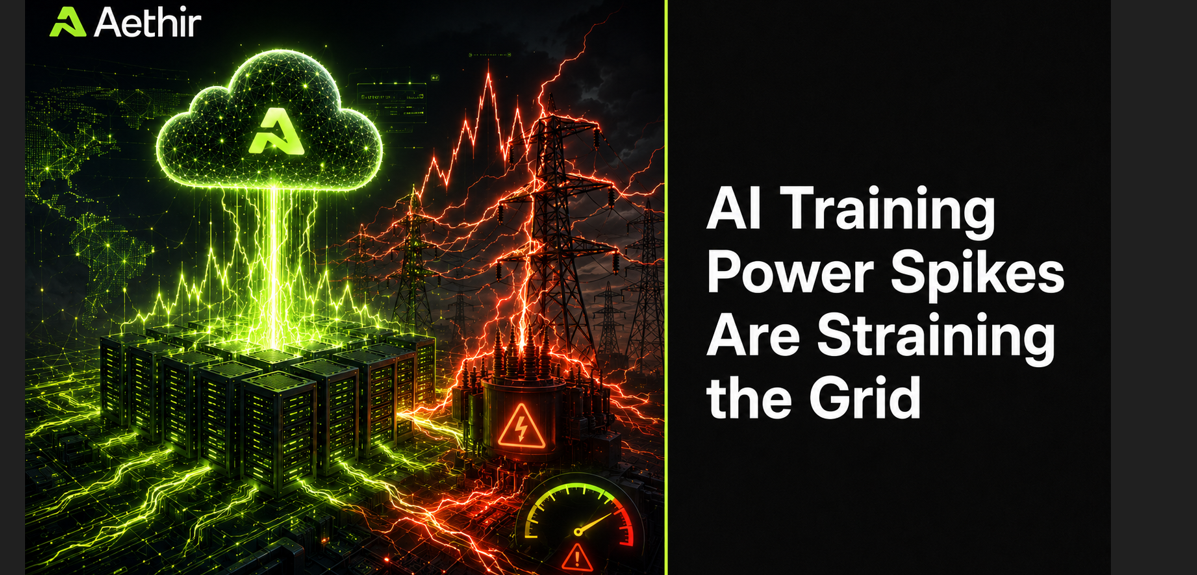
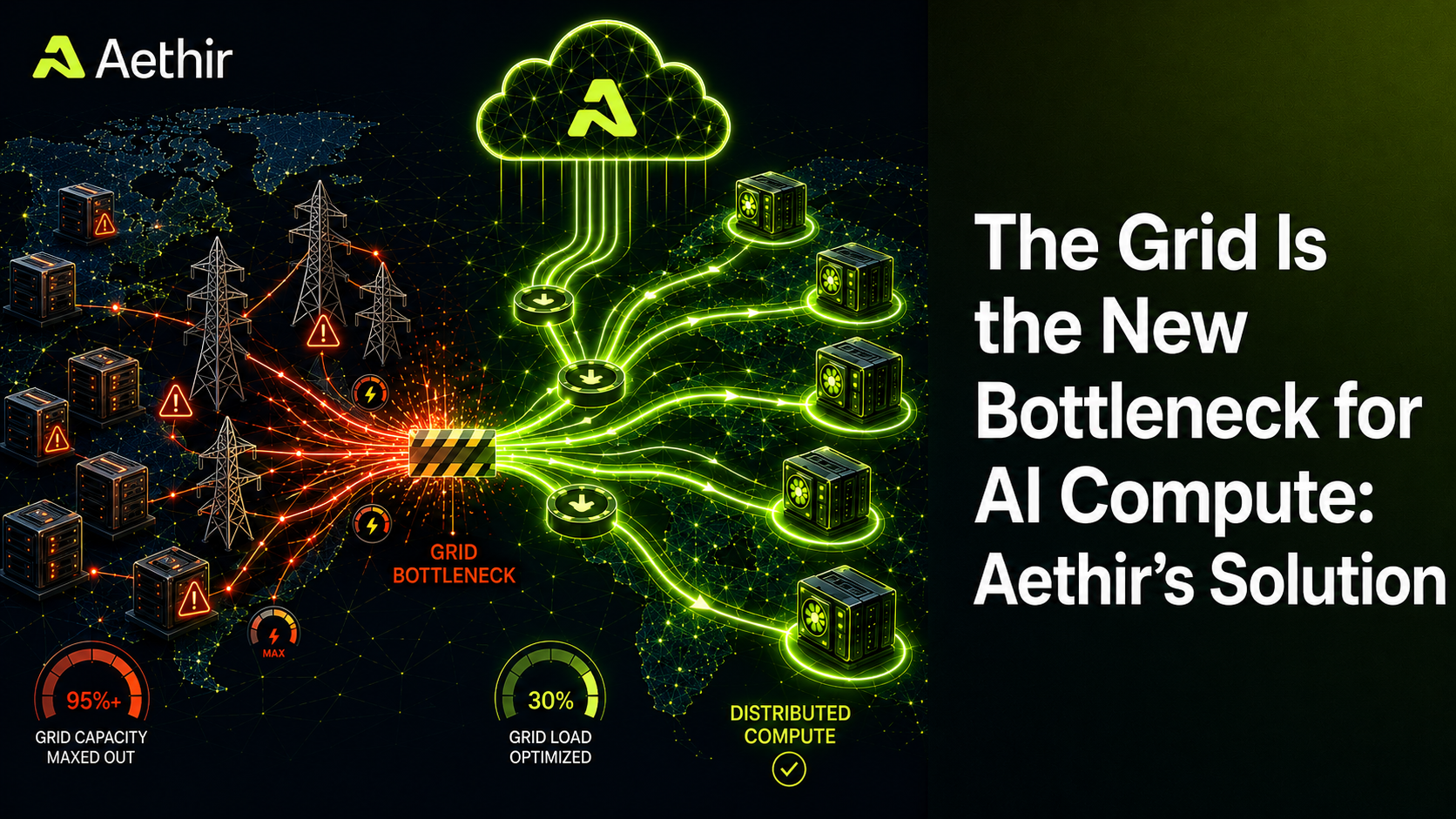
Power replaced silicon as the binding constraint: GPU supply has loosened while AI data center power hasn’t. Utilities now field interconnection requests measured in tens of gigawatts against peak demand a fraction of that size.
The grid interconnection queue is the long pole: New high-capacity connections in the largest hubs run four to seven years, and projects average roughly five years in queue before commercial operation.
Escaping the queue costs capital and years: Behind-the-meter power, fuel cells, and dedicated generation are real answers to the same shortage. They also convert a compute decision into an energy development project with a multi-year timeline attached.
Distributed compute uses power that is already energized: Aethir’s decentralized GPU cloud places workloads across 200+ locations in 94 countries, drawing on capacity that is already connected. For a power-constrained data center market, that is a different response to the same shortage, not a cheaper version of the same build.
Stranded power becomes compute supply: Curtailed renewable energy and flared gas represent electricity with no buyer at the point it is produced. Distributed GPU capacity gives that stranded power a customer without requiring a hyperscale campus first.
Power Replaced Silicon as the Binding Constraint
For two years, the AI infrastructure conversation was about chips. In 2026 it is about electricity. The IEA electricity outlook for 2026 describes highly concentrated loads such as data centers growing fast enough that meeting forecast demand through 2030 would require annual grid investment to rise by roughly 50% from a base near $400 billion.
A separate analysis of US data center power demand projects a climb from 31 gigawatts in 2025 to 41 gigawatts in 2026 and to 66 gigawatts the year after. The constraint has shifted from the fab to the substation, which is a different problem than the supply squeeze that is pushing GPU cloud pricing higher.
US power consumption is set to reach record highs in 2025 and 2026 after 15 years of nearly flat demand, with data center servers identified as the leading driver. AI data center power is no longer a rounding error inside utility planning, it is the planning assumption.
Furthermore, accelerator availability has improved through 2026 while grid capacity hasn’t moved at anything like the same speed. When one input scales and the other doesn’t, the slower input sets the ceiling for everyone.
Also, industry projections indicate that a large share of AI data centers will be in a power-constrained posture by 2027. That turns siting from a real estate question into an energy procurement question.
The Interconnection Queue Is Now the Long Pole
A grid interconnection queue isn’t a waiting list that money can skip. Work on the speed and security tradeoff for AI data centers documents a February 2026 Dominion filing showing roughly 70 gigawatts of large-load interconnection requests against an all-time peak demand near 24 gigawatts, alongside American Electric Power reporting approximately 190 gigawatts in queue with 89% of incremental load tied to data centers.
That is the arithmetic every new campus runs into, and it is why each new hardware generation arrives into a capacity crunch regardless of how many chips ship.
Four to Seven Years in the Major Hubs
New high-capacity grid connections in Northern Virginia, Dublin, Singapore, and Amsterdam now face four to seven-year waits, and projects average roughly five years in queue before reaching commercial operation. A compute roadmap measured in quarters can’t be built on a connection measured in half-decades.
Approval Runs 24 to 36 Months Even Where Capacity Exists
Reporting on how power constraints are reshaping data centers describes approval timelines for new grid capacity in major US and European markets running two to three years before construction begins. Every month of that timeline is a month the workload isn’t running.
Utilities Can’t Commit to Delivery Dates
Where the grid interconnection queue is deepest, utilities increasingly decline to guarantee energization timing at all. Buyers are being asked to commit capital against a date nobody will underwrite.
What Centralized Operators Are Building to Escape the Queue
The response from large operators has been to stop waiting and start generating. Analysis of natural gas behind-the-meter power for data centers describes on-site generation shifting from a contingency to a primary strategy, while EIA tracking of data center server energy use shows why the pressure is structural rather than cyclical.
Behind-The-Meter Generation
On-site gas turbines and fuel cells bypass the grid interconnection queue by not using it, which is why a $25 billion partnership between Brookfield and Bloom Energy positioned fuel cells as a preferred behind-the-meter power answer. The tradeoff is capital, permitting, and fuel logistics attached to a compute decision.
Midstream Operators Becoming Power Developers
Williams has committed more than $5 billion to a power innovation line including a $1.6 billion project aimed squarely at data center load. When pipeline companies become compute landlords, the shortage is clearly no longer temporary.
Hybrid Self-Generation While Staying in Queue
Many operators now self-generate and hold their queue position simultaneously, hedging a date they can’t control. That approach works, but it still leaves the cooling and rack-density questions that make AI-ready sites expensive to build from scratch.
Aethir’s Distributed Compute Uses Power That Is Already Energized
There is a second response to the same shortage: stop moving power to the workload and start moving the workload to the power. Aethir aggregates enterprise GPU capacity from independent operators, Cloud Hosts, into a single orchestrated pool spanning more than 430,000 GPU containers across 94 countries and 200+ locations, and the case for stranded power monetization rests on exactly that inversion.
Capacity that is already connected, already cooled, and already underused doesn’t need a new interconnect to serve an inference workload.
Aethir’s DePIN GPU network draws on sites that cleared their interconnection years ago, which is why new capacity can come online in days or weeks rather than the years it would take at a greenfield campus. The AI data center power problem is a siting problem before it is a generation problem.
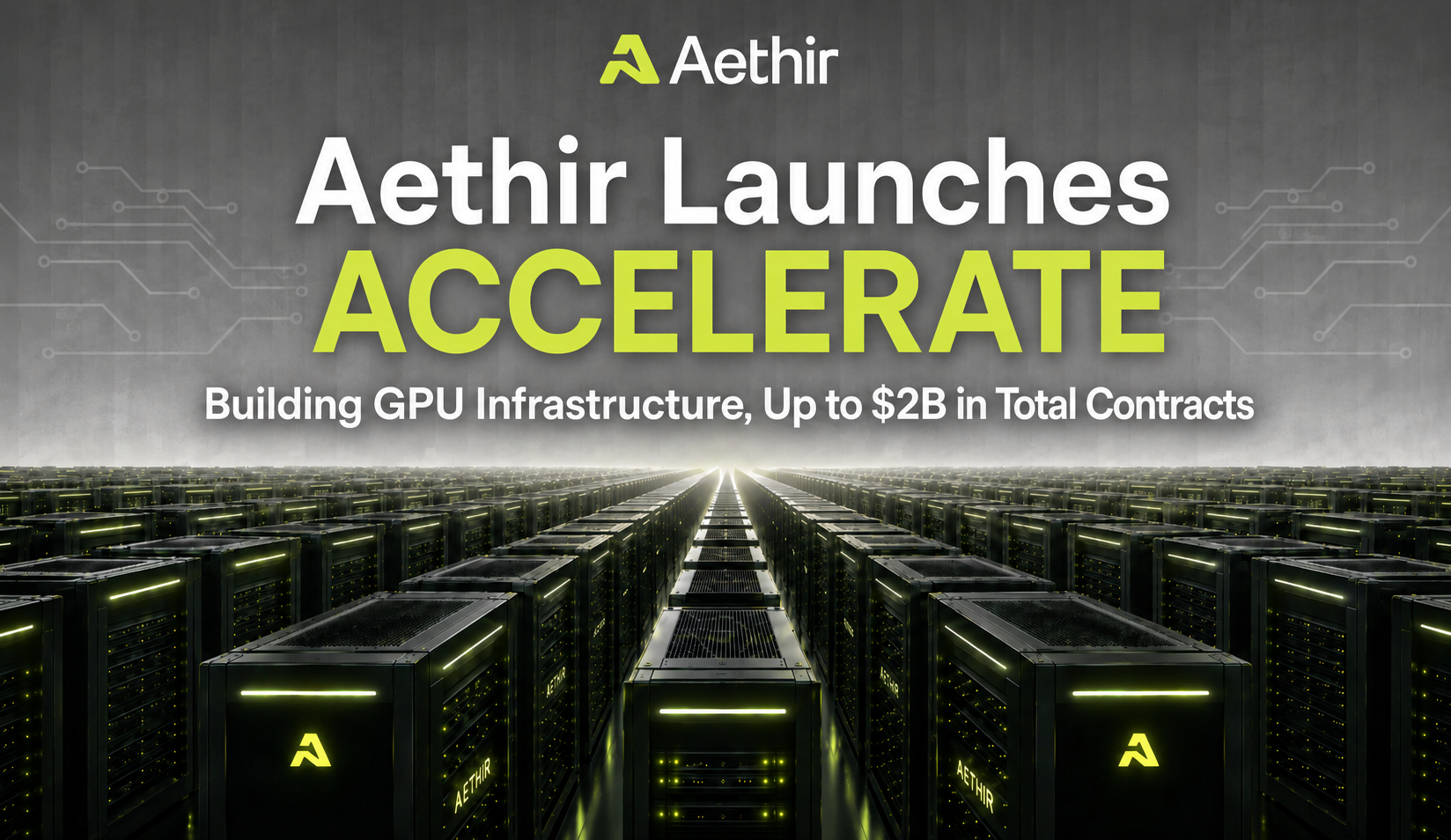
Furthermore, with Aethir ACCELERATE, Aethir is building out 10 small to mid-sized data centers for versatile AI workloads, with up to 20MW of power, offering streamlined access to new data center capacity in months, not years, required to build massive GPU data center campuses.
ERCOT has curtailed more than 8 terawatt-hours, with roughly 22% of renewable output wasted at constrained locations, and global flaring reached 151 billion cubic meters in 2024. A 2-megawatt pilot pairing GPU workloads with on-site renewables shows that curtailed renewable energy is converted into compute rather than discarded.
The Aethir network runs above 95% GPU utilization against the 60% to 70% typical of centralized fleets, and the case for a decentralized GPU cloud powering sustainable AI starts there. Independent Cloud Hosts monetize their GPU supply, so every underused site becomes network supply instead of stranded overhead.
The Energy Sector Is Also a Compute Buyer
The relationship runs both directions. Utilities, midstream operators, and independent power producers are among the heaviest new consumers of AI compute, and the EIA outlook for a near doubling of installed generating capacity is itself a forecasting problem that increasingly runs on GPUs.
Coverage of where new electricity demand is coming from points at the same operators who now need modeling capacity of their own, which puts the energy sector on both sides of the AI compute costs equation.
What Energy Operators Actually Run
Subsurface and asset modeling: Seismic imaging, reservoir simulation, and turbine wake modeling are burst-shaped workloads that spike hard and then go quiet. Paying reserved rates for a peak that arrives a few times a quarter is exactly the pattern that distributed inference economics handles better than fixed capacity.
Load forecasting and grid operations: Short-horizon demand forecasting, congestion prediction, and outage modeling run continuously and benefit from compute placed near the operating region. Aethir’s DePIN GPU network spanning 94 countries puts capacity close to the assets being modeled without regional premium pricing.
Predictive maintenance across distributed fleets: Wind, solar, and pipeline operators run inference against sensor streams from thousands of geographically scattered assets. The hidden cost problem in centralized AI infrastructure bites hardest on exactly this profile, where data volume is high, and the workload never stops.
Grid capacity will keep expanding, but not on the timeline AI roadmaps assume, and buyers do not have to wait on a substation to ship a product. Aethir delivers enterprise GPU compute on demand across 94 countries and 200+ locations, drawing on already-connected capacity, with no long-term contracts, no minimum commitments, and no egress fees.
That turns a power constrained data center market into a routing problem rather than a construction problem, and it gives underused sites and stranded power a live customer.
Explore the Aethir enterprise GPU offering to see which capacities are available today.
Frequently Asked Questions
Why is AI data center power a major constraint in 2026?
Accelerator supply improved through 2026 while grid capacity didn’t, so electricity became the slower of the two inputs and therefore the ceiling. Data center electricity demand is now the leading driver of US power consumption growth after 15 years of nearly flat demand, which means new AI capacity is gated by energization rather than by hardware availability. Forecasts of data center electricity demand through 2050 continue to point in the same direction, so this is a structural shift rather than a cyclical one.
How long is the grid interconnection queue for a new data center?
New high-capacity connections in major hubs such as Northern Virginia, Dublin, Singapore, and Amsterdam take four to seven years to complete, and projects average roughly five years in the queue before commercial operation. Even where capacity exists, approval for new grid capacity in major US and European markets typically takes 24 to 36 months before construction can start.
What is behind-the-meter power and why are operators using it?
Behind-the-meter power means generating electricity on-site rather than drawing it from a utility connection, using gas turbines, fuel cells, or dedicated renewables. Operators use it to bypass the grid interconnection queue entirely, at the cost of assuming permitting, fuel logistics, and capital that a compute project would not otherwise bear.
How does Aethir’s decentralized GPU cloud help with power constraints?
Aethir’s decentralized GPU cloud places workloads on sites that are already energized, rather than waiting for a new interconnect, so that capacity can come online in days or weeks rather than years. Aethir spans more than 430,000 GPU containers across 94 countries and 200+ locations, turning AI data center power scarcity into a routing decision rather than a construction program.