Key Takeaways
The SaaS Subscription Model Is Under Structural Pressure: In early 2026, $285 billion in software market value was repriced as enterprises began replacing discrete workflow tools with AI agents.
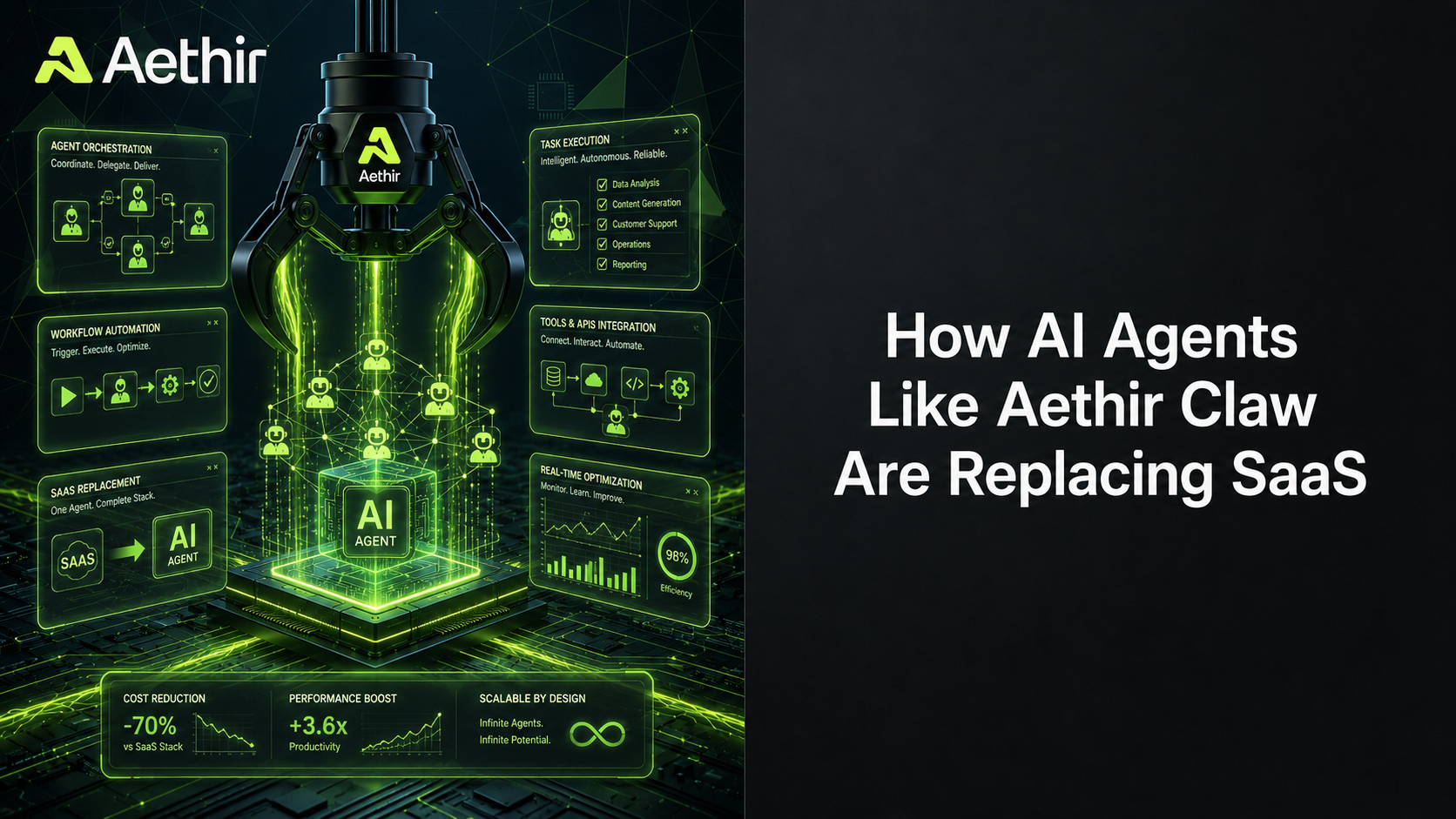
One Agent Can Replace What Four to Five Subscriptions Once Did: A single Aethir Claw instance can handle social media monitoring, social content drafts, design generation, and crypto portfolio tracking simultaneously. These functions previously required separate subscriptions totaling $150 to $300 per month.
Not All SaaS Is at Risk - Only Point-Solution Tools Are: AI agents are not replacing CRM platforms, ERP systems, or collaboration infrastructure. They are displacing discrete, repeatable workflow tools.
Decentralized Infrastructure Solves the Fragmentation Problem: Aethir Claw runs on a decentralized GPU cloud that consolidates hosting, compute, and LLM inference on a single platform, with no external model subscriptions required.
The Platform Removes Both Cost and Technical Barriers: Aethir Claw deploys in minutes with no Docker, SSH, or Linux configuration required.
The Market Signal Behind the SaaS Displacement
In February 2026, software stocks shed $285 billion in market value during a single trading session. The cause was not a product failure or an earnings miss but structural repricing. Investors began modeling a world in which AI agents perform the repeatable work that point-solution SaaS tools were built to automate, without the per-seat fee for each function. The signal was not subtle.
The SaaS business model charges per user, per tool, per month. This made sense when automating a workflow required human oversight at every step. It does not make sense for a single AI agent handling the entire workflow autonomously, without a seat assigned to it, running 24 hours a day on decentralized infrastructure.
Deloitte projects that up to half of all organizations will allocate more than 50% of their digital transformation budgets to AI automation in 2026. Zylo data shows AI-native application spend jumped 108% year over year, with large enterprises reporting a 393% increase as teams cut legacy subscriptions in parallel.
Gartner projects that 35% of point-product SaaS tools will be replaced by AI agents or absorbed into larger agent ecosystems by 2030. That timeline is compressing as agentic platforms mature faster than analysts projected when those estimates were first published.
Start automating your daily business operations stack with Aethic Claw now: claw.aethir.com
Which SaaS Categories AI Agents Are Actually Replacing
The displacement is not universal. AI agents are not replacing every SaaS product. They are eliminating the discrete, single-function tools that built their businesses around one repeatable workflow. Understanding which categories are at risk matters both for enterprises auditing their stack and for individuals evaluating where their current subscriptions still deliver unique value.
Social Media Management Platforms
Scheduling, monitoring, and analytics tools across multiple dashboards are being consolidated into a single AI agent that monitors brand mentions, drafts responses, schedules posts, and surfaces competitive insights from a single interface. The functions are not technically different, but the delivery mechanism is, and the pricing model that came with it does not survive the transition.
Crypto Portfolio Monitoring Services
Real-time portfolio tracking, whale-alert services, and on-chain analytics platforms that charge separately are being replaced by crypto AI agents that continuously monitor multiple data sources. On-chain intelligence that once required three separate subscriptions now runs as a single agent skill set, with alerts routed directly to messaging platforms without an additional fee per data feed. Aethir Claw’s CARA crypto AI agent is a great example of how AI agent automation is changing the way users conduct their daily crypto operations.
What a Single Aethir Claw Agent Can Replace
The theoretical case for AI agents replacing SaaS tools only becomes useful when it maps to a concrete subscription comparison. A single Aethir Claw instance, deployed on Aethir’s decentralized GPU cloud, handles various distinct workflow categories that previously required separate platforms, each billed monthly and managed independently with no integration between them.
Social Media Monitoring and Scheduling
Social monitoring and scheduling tools with comparable capabilities cost $49 to $99 per month. Aethir Claw can handle brand monitoring, post drafting, scheduling, and competitive tracking as part of a single subscription starting at $3.99 per month, running continuously without manual intervention or additional seat charges for each function.
Design Generation
Browser-based design subscription tools run $12 to $55 per month for individual plans. Aethir Claw can be configured to generate visual assets using its integrated design capabilities, eliminating the need for a separate design subscription for users whose requirements are workflow-level rather than production-studio-level. The Aethir Claw designer agent can handle visual content creation directly within the same agent session.
Crypto Portfolio and On-Chain Intelligence
Real-time crypto tracking services range from $15 to $49 per month. CARA, a crypto-native Aethir Claw agent, monitors wallets, tokens, and on-chain events continuously, with alerts routed directly to Telegram or other messaging platforms without an additional subscription fee per data feed or per monitored wallet.
Why Decentralized Infrastructure Makes the Difference
Most AI agent platforms replace the SaaS subscription but recreate the fragmentation in a different form. Agents running on centralized cloud stacks still require separately managed API subscriptions for model access, separate compute billing, and third-party VPS arrangements that reintroduce the margin and dependency problems they were supposed to solve. The infrastructure layer is the variable that most analyses miss.
Centralized Clouds Create New Dependencies
An AI agent hosted by a centralized cloud provider still requires separately managed API subscriptions for LLM access, separate compute billing, and a reseller-priced VPS. The consolidation benefit disappears when the infrastructure layer remains as fragmented as the SaaS stack it was supposed to replace, just invoiced differently.
Aethir Claw Runs on a Unified Compute Layer
Aethir’s decentralized GPU cloud consolidates agent hosting, model inference via the MaaS layer, and compute provisioning into a single platform. Users do not need external LLM API subscriptions, separate VPS billing, or additional model providers to run production-grade agents because everything operates within a single subscription and a single infrastructure layer.
Data Sovereignty Is Non-Negotiable at This Scale
Running sensitive workflows such as financial monitoring, enterprise communications, and portfolio management through SaaS tools means that data passes through third-party servers subject to external terms of service. Aethir Claw isolated VPS architecture and optional provider lockout give users full root-level control, with zero Aethir access to agent data or conversation history by default.
The SaaS Stack Is Compressing, Not Disappearing
The headline narrative overstates the case. AI agents are not eliminating enterprise software, they are compressing the point-solution layer of the stack while the structural systems beneath it remain intact. Understanding which tier is under pressure and which is not determines where agents deliver genuine value and where they remain a complement rather than a replacement.
Not Every SaaS Tool Is Being Replaced
CRM platforms, ERP systems, collaborative development environments, and enterprise communication infrastructure are not being displaced by AI agents. These systems manage structured records, compliance workflows, and team coordination in ways that require persistent organizational context, not just task execution, and that distinction matters for stack planning.
Point-Solution Tools Are the Primary Casualty
The SaaS category most exposed is the standalone workflow tool, the single-function application that charges $15 to $99 per month for one repeatable capability. These tools were never defensible at scale. They existed because the automation capability to replace them did not exist until now, and that window has closed.
Aethir Claw Occupies the Layer Where Compression Happens
As enterprises cut point-solution subscriptions, they need a single platform that absorbs those functions without recreating fragmentation in a different form. Aethir Claw runs multiple skill sets on one agent, on one infrastructure layer, under one subscription, making it a structural fit for the compressed stack, not a temporary workaround that introduces new dependencies.
Discover Aethir Claw’s general AI assistant now and deploy your own AI agent at: claw.aethir.com
Frequently Asked Questions
What does it mean that AI agents are replacing SaaS subscriptions?
The replacement is happening specifically in the point-solution category, with standalone workflow tools that charge per seat for a single repeatable capability. Where a business previously subscribed to five separate platforms for content, monitoring, scheduling, analytics, and crypto tracking, a single configured AI agent can now handle all five from one platform with one monthly fee.
How does a single Aethir Claw agent compare to multiple SaaS subscriptions?
A single Aethir Claw instance can handle social media monitoring, design generation, and crypto portfolio tracking simultaneously.
What makes Aethir Claw different from other AI agent platforms for this use case?
Aethir Claw consolidates hosting, compute, and model inference on a single decentralized GPU cloud platform. Most alternative agent platforms still require separately managed API subscriptions for LLM access and third-party VPS arrangements that recreate the fragmentation they are supposed to eliminate. Aethir Claw also provides a fully isolated VPS environment per agent with optional provider lockout, delivering data sovereignty that centralized alternatives cannot offer by architecture.