Key Takeaways
SOUL.MD and AGENT.MD Are Identity Architecture: Every Aethir Claw preset agent ships with SOUL.MD and AGENT.MD hardcoded into its core. These files define behavioral principles, trust boundaries, and operating constraints.
Long-Term Memory Transforms Agent Quality Over Time: AI agent persistent memory prevents session resets. It accumulates context and applies that context to every future interaction.
Storage Architecture Determines Memory Safety: AI agent memory architecture on shared multi-tenant infrastructure exposes agents to cross-tenant contamination, provider-side access, and memory poisoning attacks.
Aethir Claw Provides Isolated Persistent Storage Per Agent: Each Aethir Claw instance runs on a fully isolated Ubuntu 24.04 LTS VPS. Aethir Claw agent memory, conversation history, and agent configurations live entirely within that sovereign environment.
Persistent Identity Is What Separates Agents from Chatbots: A chatbot answers questions. An agent that remembers context from six months ago, adapts to user behavior over time, and maintains consistent values across sessions is a fundamentally different class of tool.
What AI Agent Memory Actually Is
Most discussions about AI agents focus on what they can do, including browsing, coding, trading, writing, and more. Far fewer address the question of whether an agent improves over time or resets to zero with every new session. The answer is the AI agent's architecture: how its memory is stored, retrieved, and applied between interactions.
Short-Term Working Memory
Within a single session, an agent holds the current conversation in its context window. This working memory is temporary because it governs what the agent knows right now, not what it will know next week. Most chatbots operate entirely within this layer, which is why they feel stateless to users who interact with them repeatedly.
Long-Term Persistent Memory
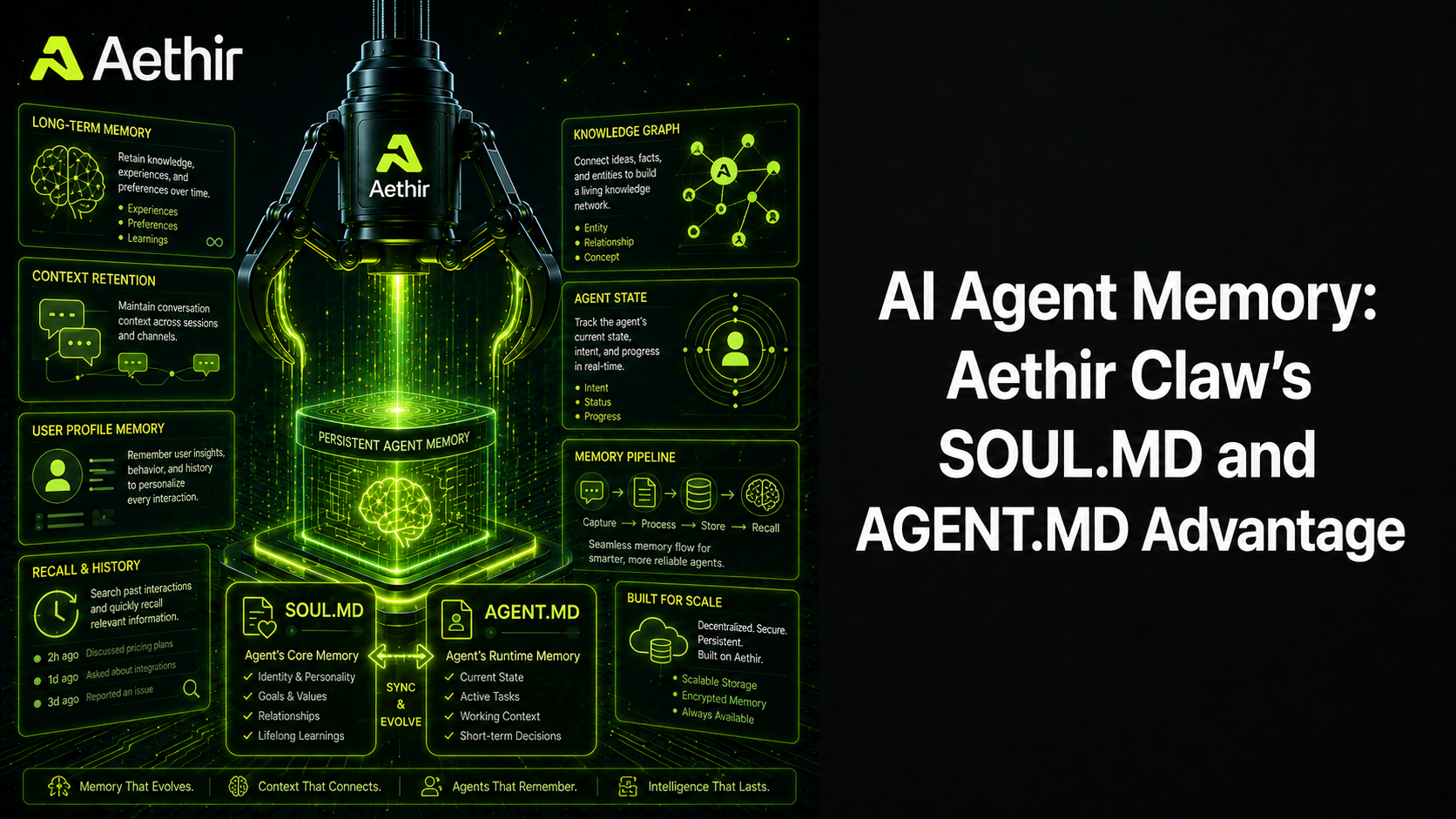
Across sessions, a production AI agent writes facts, preferences, and decisions to persistent storage files. These files are loaded at the start of each new session, giving the agent continuity and awareness of who the user is, what has been completed, and how the agent should behave. An AI agent's long-term memory is the layer that determines whether an agent becomes more useful over time.
Memory vs. Context Window
The context window is a model constraint that specifies the number of tokens processed per inference call. Agent memory is an infrastructure layer, entirely separate from the model. Memory can persist indefinitely regardless of how many tokens a model supports, and its quality depends entirely on where and how it is stored.
SOUL.MD and AGENT.MD: Identity as Core Agent Architecture
SOUL.MD defines agent values, operating principles, and trust boundaries. It loads at the start of every session, establishing the consistent behavioral foundation from which the agent operates. It can be described as an agent constitution comprising principles that govern how the agent handles conflicting priorities and maintains consistent conduct across all interactions over time.
The AGENT.MD identity file, on the other hand, provides the agent with structured knowledge of its own capabilities, environment, and intended purpose. Where SOUL.MD defines character, AGENT.MD defines roles, including the specific skills the agent holds, the integrations it manages, and the scope of tasks it is authorized to handle. Together, these files create a layered identity that is both consistent and contextually aware.
In most AI agent deployments, behavioral constraints are applied as system prompts that can be overridden or ignored. In Aethir Claw preset agents, SOUL.MD and AGENT.MDs are hardcoded at deployment. This means identity constraints cannot be stripped out by a malicious skill or a prompt-injection attempt that alters agent behavior.
How Long-Term Context Accumulates Across Sessions
As an agent completes tasks, it extracts relevant facts and writes them to persistent memory files, the MEMORY.md for curated knowledge and dated logs for session-by-session records. What gets written is determined by agent behavioral instructions, not raw data dumping. A well-configured agent captures decisions, preferences, and learned patterns rather than raw conversation transcripts.
At the beginning of each new session, the agent loads its persistent memory files alongside SOUL.MD and AGENT.MD, giving the agent immediate access to prior context. AI agent context persistence is possible because the agent retrieves accumulated knowledge at session start and applies it immediately, without requiring the user to re-explain their situation.
The practical value of AI agent persistent memory compounds over time. An agent with stateful AI agent storage used daily for six months has accumulated a working model of the user that a fresh deployment cannot replicate, regardless of model quality. This accumulated context is a user-specific asset stored on the agent side, not in the underlying model, and cannot be transferred when switching providers.
Why Storage Infrastructure Determines Memory Quality
AI agent memory architecture is only as strong as the infrastructure it runs on. The same AI agent persistent memory files that improve an agent over time also represent a concentrated hacking target. These files are a record of user preferences, decisions, workflow configurations, API credentials, and conversation history. Where those files live determines whether they are sovereign or exposed.
Cross-Tenant Contamination
On shared multi-tenant infrastructure, agent memory is stored on resources that other users share at the hardware or hypervisor level. A compromised neighboring instance can affect adjacent tenants. In the worst case, memory files can be read or manipulated at the infrastructure layer, poisoning agent behavior without the user ever becoming aware.
Provider-Side Access
Most managed AI agent hosting platforms rent shared infrastructure from traditional cloud providers, meaning the platform retains administrative access to the underlying environment. The MEMORY.md files, session logs, API keys, and conversation history are all visible at the infrastructure layer, to the hosting provider, not just to adjacent tenants.
Memory Poisoning as an Attack Vector
Research identifies memory poisoning as an emerging threat against stateful agents. An attacker who can write to long-term memory files, through a malicious skill, a prompt injection, or provider-side access, can corrupt agent behavior over time, causing the agent to act against user interests in future sessions. Stateful AI agent storage without proper isolation is uniquely vulnerable to this class of attack.
Memory Sovereignty on Aethir Claw: A Key Market Advantage
Aethir Claw agent memory runs on a fundamentally different infrastructure model. Each Aethir Claw agent is deployed on a fully isolated Ubuntu 24.04 LTS VPS. This decision was motivated primarily by security, but the same decision also creates a decentralized AI agent memory environment that shared infrastructure cannot replicate.
Per-Agent Isolated Storage
Each Aethir Claw instance runs on a dedicated VPS, not a shared container or a slot on multi-tenant infrastructure. The SOUL.MD, AGENT.MD, MEMORY.md files, session logs, and all persistent states live entirely within that environment. This isolated VPS agent memory setup means no adjacent tenant can access or influence these files, regardless of what happens elsewhere on the network.
Provider Lockout and True Data Sovereignty
Aethir Claw users can activate provider lockout, a root-level control that prevents Aethir from accessing the instance at all. With lockout enabled, agent memory files are genuinely self-custodial. The SOUL.MD agent identity files, behavioral configurations, and all persistent states are exclusively under user control, providing a level of memory sovereignty no reseller-based hosting provider can offer.
Memory Persists Across the Agent Lifecycle
Because the VPS is dedicated and persistent, memory files accumulate over the full lifecycle of the agent deployment. The AGENT.MD identity file and all memory components persist intact, making decentralized AI agent memory on Aethir Claw a compounding asset rather than a disposable session log. Aethir Claw agent memory built in month one, remains fully available in month six.
Finally, all of this is made possible by Aethir’s decentralized GPU cloud infrastructure. Because Aethir owns the underlying GPU infrastructure, Aethir Claw controls the full stack from compute to agent, no reseller markups, no third-party dependencies, no split economics.
Start using Aethir Claw today and deploy your first AI agent with ease at claw.aethir.com
Frequently Asked Questions
What is AI agent long-term memory and why does it matter?
AI agent long-term memory is a persistent storage layer that allows an agent to retain facts, user preferences, and decisions across sessions rather than starting from zero with each new conversation. Without it, an agent cannot improve over time or build a working model of user context.
What is SOUL.MD and how does it define agent identity?
SOUL.MD is a structured markdown file hardcoded into every Aethir Claw preset agent that defines behavioral values, trust boundaries, and operating principles. It loads at the start of each session, establishing consistent conduct across all interactions regardless of what skills are installed or what instructions are received.
How does Aethir Claw store agent memory across sessions?
Aethir Claw agent memory is stored on isolated VPS agent memory infrastructure, where all agent files, including SOUL.MD, AGENT.MD, MEMORY.md, and session logs, persist on storage inaccessible to other users. With provider lockout enabled, even Aethir cannot access the instance, making memory genuinely self-custodial throughout the deployment lifecycle.
What is the risk of agent memory on shared multi-tenant infrastructure?
On shared infrastructure, agent memory files sit on resources that other tenants share at the hardware or hypervisor level, creating risk of cross-tenant contamination and provider-side access.