Key Takeaways
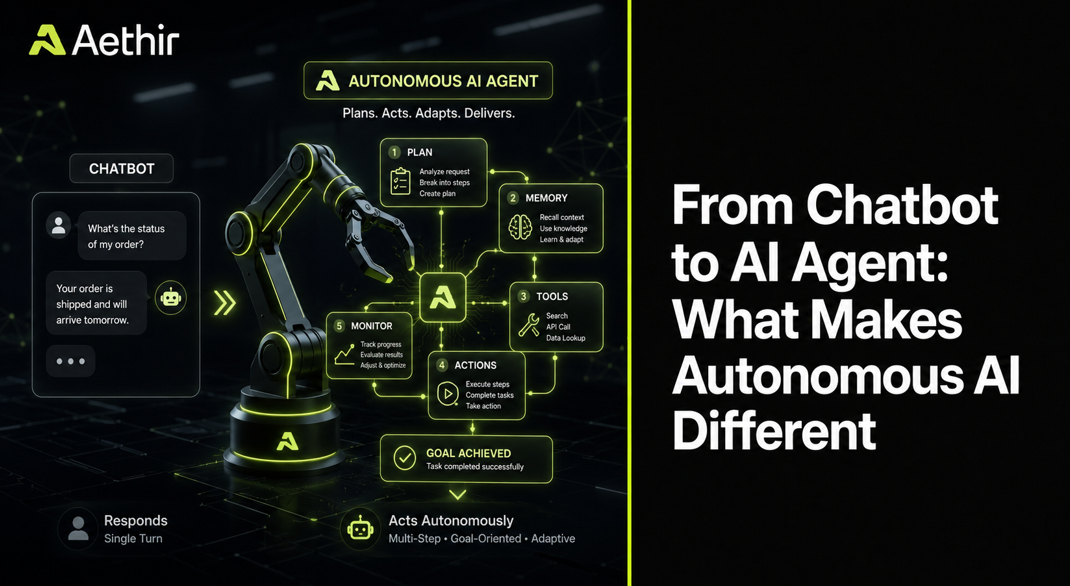
- Chatbots and Autonomous AI Agents Are Different Products: A chatbot handles a prompt-response cycle: the user sends a message, the model generates a reply, and the session ends. An autonomous AI agent plans multi-step workflows, uses external tools, and operates continuously without human input between tasks.
- The AI Agent Execution Loop Is the Core Architectural Difference: Agents run a perceive-plan-act-observe cycle repeatedly, executing tool calls, storing intermediate results, and adjusting behavior based on output, without waiting for the next user message.
- AI Agent Tool Use Puts Chatbots and Agents in Different Infrastructure Categories: Chatbots output text. Autonomous AI agents call APIs, browse the web, execute code, and write to persistent memory files.
- Agents Need Persistent Compute That Chatbots Don’t: A chatbot request starts a process, gets a response, and ends. A long-running AI agent needs an always-on AI agent infrastructure with persistent compute, storage, and process management that remains active across hours or days of autonomous operation.
- Every Aethir Claw Architecture Decision Responds to Autonomous AI Agent Requirements: The isolated VPS AI agent deployment model, 24/7 uptime, preinstalled Chrome for browser automation, and SOUL.MD/AGENT.MD behavioral constraints all exist because autonomous AI agents demand them.
What a Chatbot Actually Is
The AI agent vs chatbot distinction begins with understanding what chatbots are at the architectural level. A chatbot is a software system that processes a user message and returns a generated response. The session starts when the user sends input. It ends when the system returns output. Nothing persists between exchanges beyond the context window for that session.
Whether rule-based or LLM-powered, chatbots operate on the same core pattern: receive input, process it, return output. Advanced LLM chatbots can maintain context across multiple turns within a session, but the session itself is bounded. No state carries forward when the conversation window closes.
A chatbot generates text. It doesn’t call APIs, execute shell commands, browse live web pages, or write to external files. These capabilities are entirely outside the prompt-response architecture. Adding them requires converting the system into something categorically different, an AI agent, not simply upgrading the chatbot to a higher capability tier.
Each new conversation session starts with no memory of previous ones. The chatbot doesn’t accumulate a user model over time, log completed tasks, build knowledge graphs from past interactions, or carry forward context from prior sessions. Every conversation is effectively the first conversation.
Where Chatbots Perform Well
- Intent Classification and Single-Turn Response: Answering questions from a knowledge base, classifying support requests, generating first-draft text, and summarizing documents. These are single-turn or bounded multi-turn tasks that do not require access to tools, persistent memory, or continuous operation.
- Low Infrastructure Footprint: A chatbot runs on a server that scales to zero between requests. No persistent process, no long-lived execution environment, and no always-on compute is needed.
- Predictable and Bounded Outputs: Because chatbots don’t act on the external environment, their outputs are bounded to text generation. This makes them predictable and controllable in ways that autonomous agents are not by design. The security implications of a chatbot behaving unexpectedly are limited to what it says, not what it does.
What Defines an Autonomous AI Agent
An autonomous AI agent is a software system that perceives its environment, plans a sequence of actions, executes those actions using tools, observes results, and adjusts the plan, repeating this cycle without waiting for user input at each step.
- Perception and Goal Decomposition: The autonomous AI agent begins by perceiving its environment, reading memory files, checking tool outputs, reviewing prior session logs, and decomposing the goal into a sequence of concrete sub-tasks.
- Tool Execution and Live Observation: The AI agent execution loop proceeds through tool calls: browser requests, API calls, file writes, and code execution. After each action, the agent observes the output and updates the working context.
- Continuous Adjustment Without Human Handoff: The loop repeats until the goal is complete or a terminal condition is reached. The user doesn’t intervene between iterations.
Why AI Agent Infrastructure Requirements Are Different
The AI agent infrastructure requirements that follow from the execution loop are categorically different from what chatbots need. An autonomous AI agent requires persistent compute, a long-lived execution environment, and process management infrastructure. The AI agent execution loop can’t run on infrastructure designed for stateless request-response patterns.
Chatbots Run on Stateless Request-Response Infrastructure
A chatbot server spins up to handle a request and releases resources immediately after. No persistent process is maintained. No storage is allocated per session. The infrastructure scales to zero between conversations because the application requires nothing while waiting for the next prompt.
Chatbots don’t need a browser runtime, a file system, or a code execution sandbox. The model processes text and generates text entirely within the inference call. Adding these capabilities to a chatbot would make it categorically different and require provisioning the full execution environment agents need from the start.
Chatbot deployments can safely share infrastructure across users because each session is stateless and self-contained. There is no persistent memory to protect, no file system access to isolate, and no running process that could affect other users.
Agents Need Persistent Compute and Always-On Process Management
An autonomous AI agent requires persistent compute that remains active between tool calls, across memory read/write cycles, and through multi-hour workflows.
A long-running AI agent needs process management infrastructure: health checks, watchdog processes, restart policies, and execution logs. When a tool call fails or a network timeout occurs mid-workflow, the agent must recover rather than fail silently.
Agents hold API keys, access browsers, and write to file systems. Running multiple agents on shared infrastructure without isolation creates credential exposure vectors and cross-contamination risks that don’t exist in chatbot deployments. The AI agent infrastructure requirement for isolated execution is a direct consequence of what agents are permitted to do.
Memory, Failure Recovery, and Execution Continuity
Beyond persistent compute, autonomous AI agents require long-term memory infrastructure and failure-recovery mechanisms that have no chatbot equivalents. AI agent tool use generates artifacts that must persist across the agent lifecycle and survive session restarts. These infrastructure requirements compound as agent workflows grow more complex.
Long-Term Memory as an AI Agent Infrastructure Layer
Autonomous AI agent memory is not stored in the model context window because it is written to structured files on the execution environment file system. Memory files, session logs, and task completion records accumulate on the agent's persistent compute environment and are read at the start of each new session. Losing this storage layer means the agent starts every session cold, identical to a chatbot.
On a multi-tenant infrastructure, memory files stored by one agent could be accessed by the provider or corrupted by another process on the same host. Isolated execution environments are the prerequisite for memory integrity. An agent whose memory can be read or modified by external processes has no meaningful long-term memory capability, regardless of how sophisticated the memory architecture appears.
A well-architected autonomous AI agent builds a user model over time, incorporating preferences, context, prior decisions, and ongoing tasks. This accumulated context is what separates a long-running agent from a stateless chatbot.
The Role of Failure Recovery and Execution Continuity
Autonomous agent workflows can span hours. When a tool call fails at step seven of a twenty-step workflow, the agent must detect the failure, log the state, and either retry, route around the error, or surface it to the user without losing all prior progress. This recovery capability requires infrastructure-level support, not just application-level error handling in the agent code.
A long-running agent process on production infrastructure needs health monitoring: heartbeat checks, automatic restart on crash, and execution logs that capture state at failure. A chatbot server that goes down loses a single conversation. An agent that goes down mid-workflow loses hours of in-progress execution. The infrastructure response to these failure modes differs categorically.
Production agent deployments require execution continuity: the ability to persist enough state to resume a workflow after a restart without beginning from scratch. This requires checkpointing, structured state files, and a storage layer that survives process termination. None of these requirements apply to chatbot deployments, where each session is by definition a fresh start.
Why Aethir Claw Is Built for Agents, Not Chatbots
Every architectural choice in Aethir Claw is a direct response to the AI agent infrastructure requirements described in the sections above. Aethir Claw is purpose-built to meet the compute, memory, and execution requirements of autonomous AI agents. Each design decision maps to a gap that chatbot-era infrastructure couldn’t fill.
- Each isolated VPS AI agent deployment in Aethir Claw runs on a dedicated virtual private server rather than in a shared container. This gives each agent its own operating system, file system, process namespace, and network interface.
- Optional Provider Lockout for Full Data Sovereignty: Aethir Claw allows users to revoke all provider admin access from the deployed instance. With lockout enabled, root-level control passes entirely to the user, no Aethir administrator can access the VPS, the agent memory files, stored API keys, or execution logs.
- SOUL.MD: SOUL.MD defines the values, trust boundaries, and operating principles that govern the agent at the time of deployment. These constraints are hardcoded in the preset agent configuration and cannot be overridden by user prompts or third-party skill instructions.
- AGENT.MD: AGENT.MD defines the operational scope of the agent: the capabilities it can use, the integrations it can access, and the boundaries of its autonomous action.
Aethir Claw’s managed AI agent hosting platform has all the features needed to easily deploy an AI agent in less than 5 minutes, without worrying about memory loss, cross-agent contamination, or expensive inference fees. You only pay a single monthly subscription fee to deploy your AI agent.
Thanks to Aethir Mesh, our proprietary open-source LLM API platform, Aethir Claw users can easily access 11 top-tier open-source LLMs through a single API key, at highly competitive pricing.
Deploy your AI agent now on Aethir Claw and move from chatbots to crypto-native agentic AI: claw.aethir.com
Frequently Asked Questions
What is the difference between an autonomous AI agent and a chatbot?
An autonomous AI agent plans, uses tools, and executes multi-step workflows without human input between tasks. A chatbot handles a prompt, generates a response, and ends the session.
How does the AI agent vs chatbot distinction affect infrastructure choices?
Chatbots run on request-response servers that scale to zero between sessions, with no persistent process, no always-on compute, no isolated execution environment. Autonomous AI agents need persistent compute, process management, secure execution environments with file system access, and isolated storage that survives session restarts.
How do AI agents work compared to a traditional chatbot?
How AI agents work differs fundamentally from chatbot architecture. An autonomous AI agent perceives its environment, decomposes a goal into sub-tasks, executes tool calls, observes results, and adjusts its plan, repeatedly, without waiting for user input at each step. In practice, AI agents work through an execution loop that runs for minutes, hours, or days, accumulating context across many tool interactions. A chatbot processes one prompt and returns one response.
What AI agent infrastructure does Aethir Claw provide that chatbots do not require?
Aethir Claw provides a dedicated isolated VPS per agent, 24/7 persistent compute, Chrome preinstalled for browser automation, and SOUL.MD and AGENT.MD behavioral constraints, and optional provider lockout for data sovereignty. A long-running AI agent needs every layer of its infrastructure stack. A chatbot requires none of it.