Key Takeaways
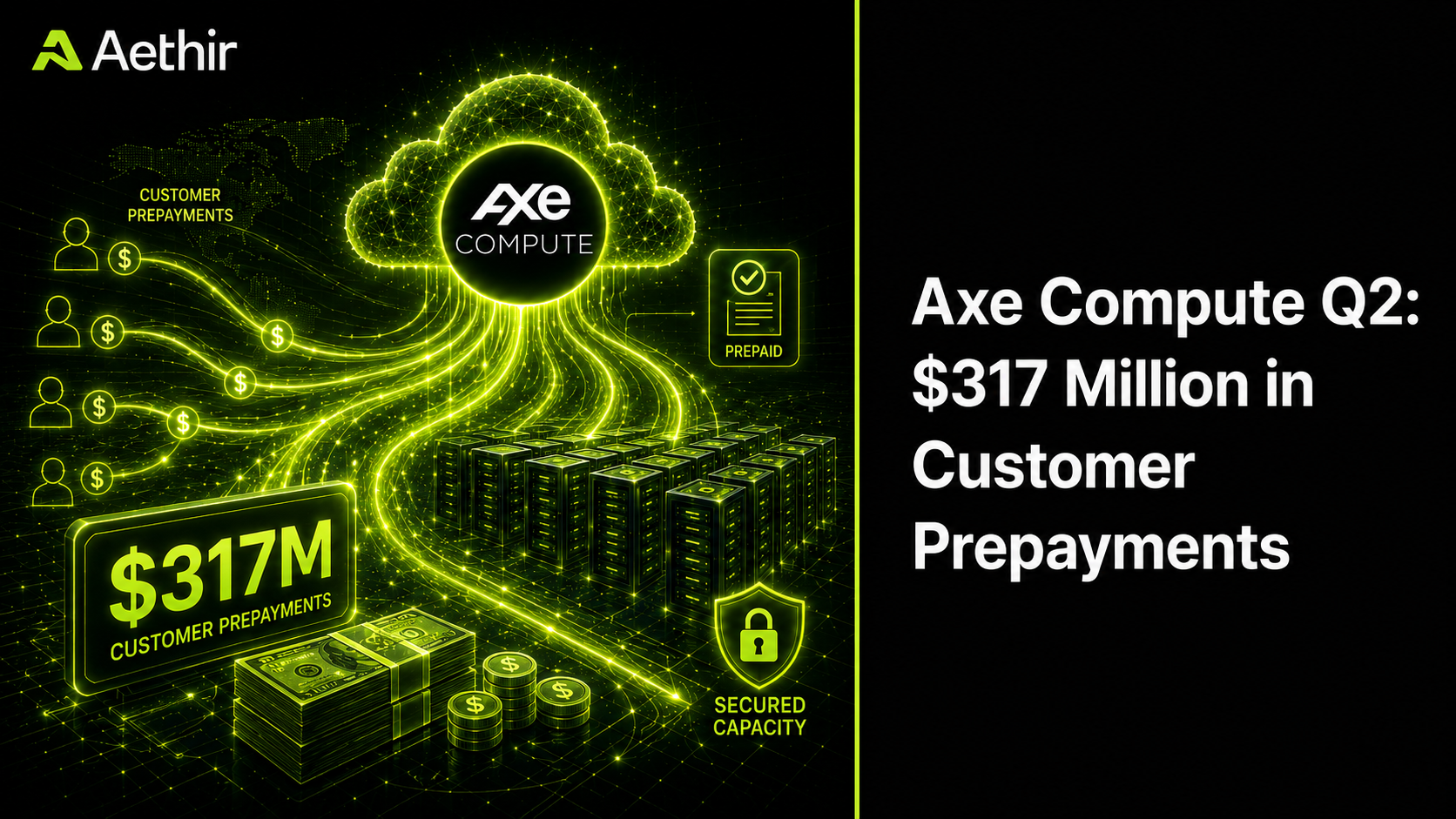
$534 million in customer prepayments is the headline mechanic: Axe Compute expects to receive more than $534 million in aggregate customer prepayments across its 2026 agreements, and states that this covers a substantial portion of the associated GPU capex.
Project-level financing replaces corporate leverage: Because prepayments de-risk each cluster individually, the remaining funding can be raised against that specific project rather than against the whole company. Project-level financing keeps the obligation attached to an asset with contracted revenue behind it.
Equity dilution is the cost this model is designed to avoid: Up-front cash reduces reliance on equity financing.
The peer contrast is a balance sheet contrast: Several large peers carry billions in GPU-collateralized debt, including CoreWeave with more than $21 billion outstanding at an average interest rate near 11%. Neocloud financing built on prepayments doesn’t create that maturity exposure.
How Neocloud Deals Used to Get Paid For
Until recently, neocloud financing had two settings. You issued equity, which meant existing holders absorbed the equity dilution required to fund GPU capex. Or you borrowed against the GPUs themselves, which meant the balance sheet absorbed a maturity that came due whether or not the cluster ever filled.
Both routes funded the hardware first and looked for tenants afterward.
The Two Legacy Routes and What Each Cost
Equity issuance transfers the cost to shareholders: Selling shares to buy GPUs works, but every round of AI infrastructure expansion funded that way shrinks each existing holder claim on future contracted revenue. At small market capitalizations, the equity dilution required to fund a serious cluster can exceed the value of the contract it supports.
GPU-collateralized debt transfers it to the future: Borrowing against the fleet preserves ownership but pledges depreciating collateral to a fixed repayment schedule. The template scaled the sector quickly and left the industry with tens of billions of dollars maturing between 2026 and 2028.
Both assume utilization that has not yet been sold: The core weakness in either route is that GPU capex is committed before demand is contracted. A provider carrying interest or dilution against unsold capacity is paying for optimism, and the spot market decides whether that optimism was priced correctly.
Axe Compute’s Prepayment Mechanic
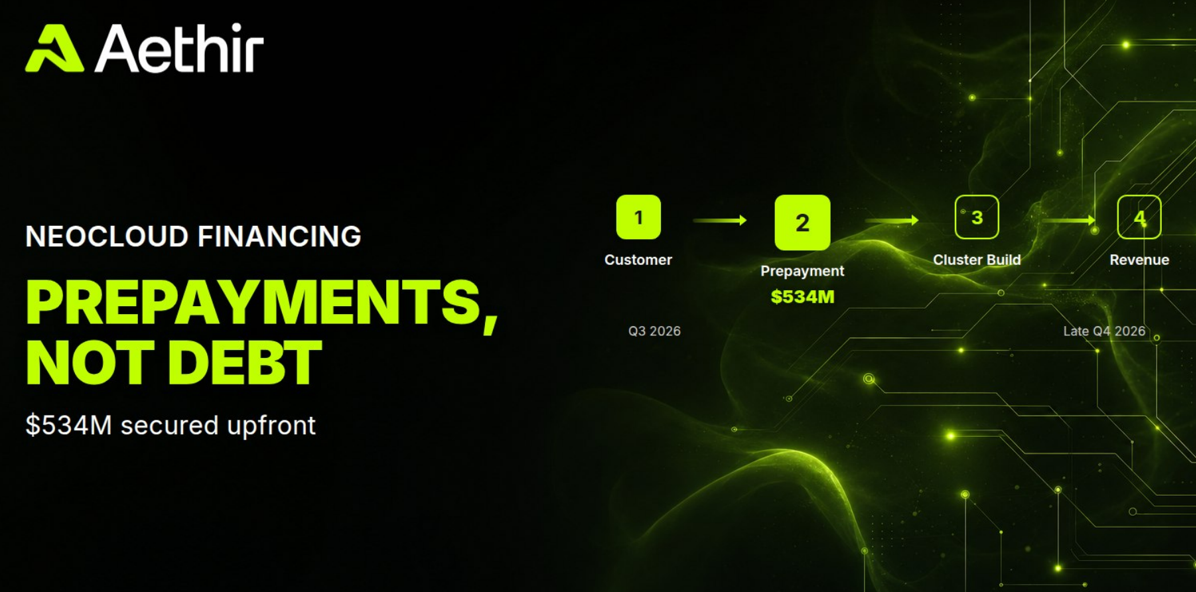
The new model reverses the order of operations. Under the Axe Compute Build program, a customer signs a multi-year agreement for a specified cluster, pays a significant portion up front, and the provider uses that cash to fund the deployment. Axe Compute expects over $534 million in aggregate customer prepayments across its agreements and says the amount covers a substantial portion of the associated GPU and infrastructure capex.
Cash lands before revenue recognition: Customer prepayments are expected in Q3 2026, with revenue recognition beginning in late Q4. The company holds construction funding for a full quarter before it books a dollar of contracted revenue, which is the inverse of the usual working capital cycle.
GPU CapEx is matched to a signed obligation: Because the cluster is specified in the contract, the hardware order corresponds to demand that is already committed for five years. There is no window in which the provider owns idle AI infrastructure and hopes a tenant appears.
The prepayment is itself a credit signal: A customer willing to send nine figures in advance is making a stronger statement than one signing an up-to spending ceiling. Prepaid paper is a commitment, while a contract cap is only a permission, and neocloud financing built on the former is qualitatively different.
Upgrade clauses protect the prepaying customer: Axe Compute’s agreements include provisions for ongoing GPU upgrades as newer generations ship, which is what makes prepaying a five-year term rational for the buyer. Without that clause, a prepayment would be a bet on a single hardware generation holding its value.
Why Project-Level Financing Beats Corporate Leverage
Prepayments rarely cover a cluster in full, so the remaining gap still needs funding. The difference is what that funding is secured against. Axe Compute’s CEO, Christopher Miglino, has been direct about the mechanism, stating that the largest deployments come with significant upfront payments, which allow the company to secure project-level financing that reduces reliance on equity.
The Structural Advantages
The obligation sits with the asset, not the enterprise: Project-level financing attaches funding to a single cluster with its own contracted revenue stream and economics. A problem at one site doesn’t automatically become a problem for every other deployment or for the corporate balance sheet.
Contracted revenue improves the terms: Lenders pricing a facility against a signed five-year agreement with cash already received are underwriting something closer to an infrastructure cash flow than a technology bet. That generally produces cheaper capital than unsecured corporate debt at the same company.
GPU capex stops being a company-wide risk: Under the Axe Compute Build program, the customer specifies the GPU type, location, and configuration, and Axe designs, deploys, owns, and operates the stack. Each build is financeable on its own merits, which is how a small company can credibly commit to large GPU capex.
Less reliance on the equity market cycle: Because project-level financing and customer prepayments together cover most of the requirement, the company isn’t forced to issue shares into whatever window the market happens to offer. Neocloud financing that doesn’t depend on sentiment is more durable than that which does.
Equity Dilution Is the Quiet Cost of AI Buildouts
Debt gets the attention because maturities have dates. Equity dilution is less visible and often more expensive, because it never appears as a line item that comes due. For a company growing GPU CapEx faster than cash flow, the choice between the two is the single most consequential decision in neocloud financing, and prepayments are what create a third option.
If contracted revenue triples but the share count also triples, holders are no better off. Avoiding equity dilution while contracted value scales is what turns a growth story into a per-share outcome.
Equity raises depend on market receptivity at the moment capital is needed, which rarely coincides with when the contract is signed. Customer prepayments arrive on a contractual schedule rather than a market schedule.
CoreWeave, for example, carries more than $21 billion of debt at an average interest rate around 11%, up from under $8 billion in 2024. Interest at that scale consumes gross margin regardless of how the AI infrastructure performs.
What the Prepayment Model Actually Costs
Every financing structure moves risk somewhere. Prepaid neocloud financing removes refinancing exposure and reduces equity dilution, while creating a delivery obligation funded by money already received.
For buyers, the practical value of the prepayment model is that it makes a provider's incentives legible: a company paid in advance is contractually committed to delivering the cluster you specified, on terms that include upgrade provisions.
For the sector, it demonstrates that large AI infrastructure can be financed without pledging depreciating hardware or issuing shares into a soft market. The obligations are real, and the delivery risk is real, but they are the kind of risk that shows up in a build schedule rather than a refinancing calendar.
Frequently Asked Questions
What are customer prepayments in a neocloud contract?
Customer prepayments are cash paid up front by the enterprise buyer when a multi-year dedicated capacity agreement is signed, before the cluster is deployed and before any revenue is recognized. Axe Compute expects more than $534 million in aggregate customer prepayments across its 2026 agreements, which it says covers a substantial portion of the associated GPU capex.
How is project-level financing different from corporate debt?
Project-level financing is raised against a single cluster and the contracted revenue attached to it, rather than against the company as a whole. That keeps the obligation ring-fenced to an asset with a signed multi-year agreement behind it, and it typically trades at prices better than unsecured corporate borrowing at the same issuer.
Why does avoiding equity dilution matter so much here?
Funding GPU capex by issuing shares means existing holders pay for the growth through equity dilution, which, at small market capitalizations, can exceed the value of the contract being funded.
Is prepaid Neocloud financing safer than GPU-collateralized debt?
It removes the refinancing exposure created by pledging depreciating hardware against fixed maturities, which is the specific risk concentrated in the 2026 to 2028 period. In exchange, it creates a delivery obligation funded by cash already received, so deployment execution and counterparty concentration replace refinancing as the main risks.
How does Aethir fit into this financing picture?
Aethir operates a decentralized network that aggregates GPU capacity from independent Cloud Hosts rather than buying and financing a fleet, so there is no central GPU capex to fund through debt or equity dilution. Aethir Foundation is also the largest shareholder in Axe Compute through its 2025 treasury transaction.
Disclosure
Aethir Foundation is Axe Compute's largest shareholder, through its 2025 treasury transaction. We cover Axe as an interested holder. This article reflects Aethir's views and is not investment advice. For official company information, see Axe Compute's SEC filings (CIK 0001446159) and investors.axecompute.com.
Nothing in this article should be relied upon as a guarantee of future performance or results.